
№ 7 (10), 2026. A Bone of Contention or the Golden Chance: Prospects for Economic Cooperation Between Russia and North Africa as a Window of Opportunities

April 23, 2026
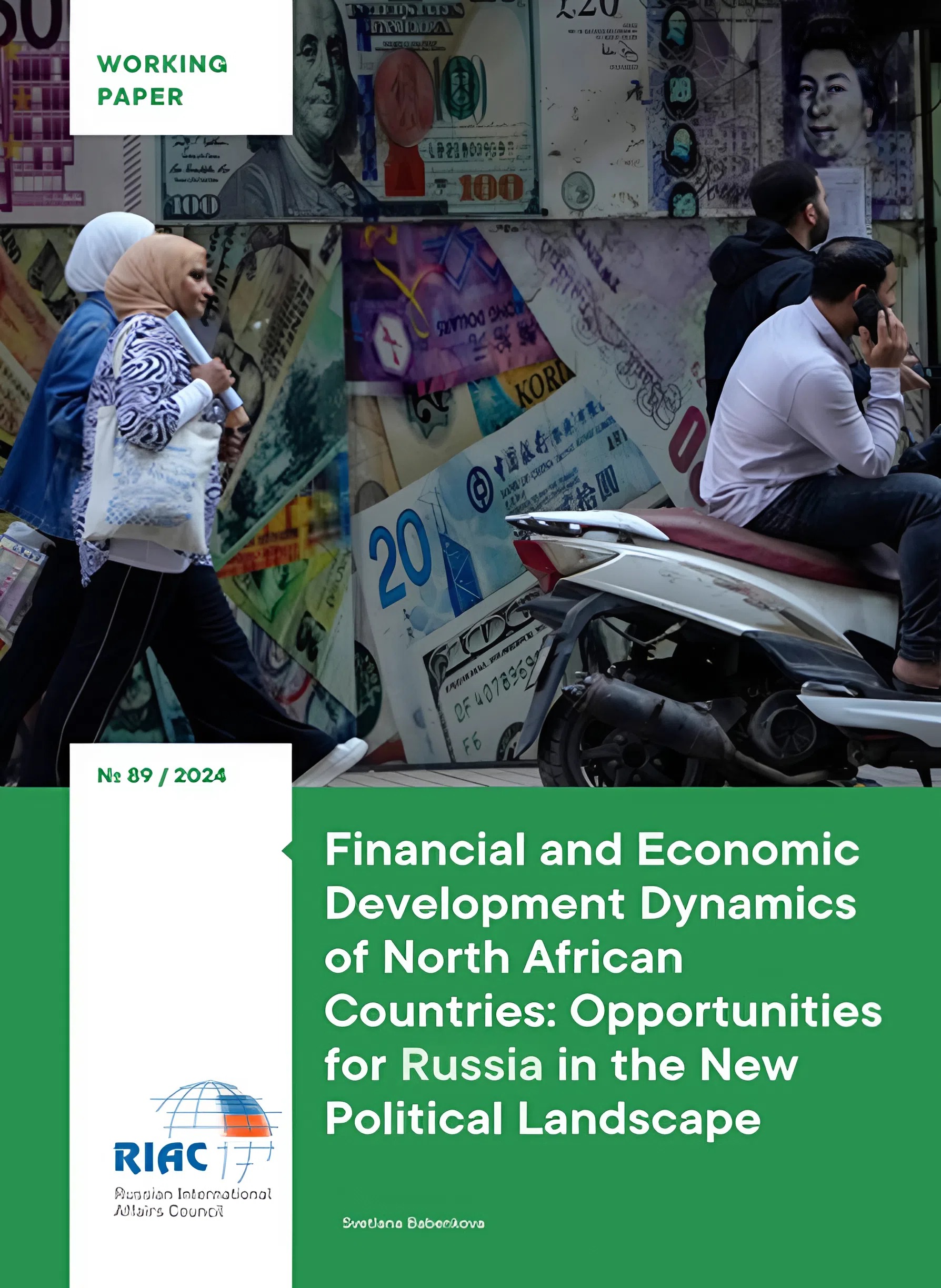
Financial and Economic Development Dynamics of North African Countries: Opportunities for Russia in the New Political Landscape. S. Babenkova; edited by S. Gavrilova, I. Bocharov, A. Korzun, D. Rastegaev. Russian International Affairs Council (RIAC), 2024.
There is no denying that the North Africa is one of the most significant political regions in the contemporary era due to its resources, geostrategic role, and rapidly changing level of economic development. Currently, in the period of transformation of international relations, we are facing numerous challenges of both hard and soft security.
Despite the dynamics, changing the character of security in the region, it is crucial to point out that it is soft security that remains the most pivotal issue for all states in the North Africa, regarding particularly in terms of the superior role of food security. Amid the latest developments, the North Africa can be tantamount to a window of opportunity for actively involved regional and global players within the international arena, such as Russia, the US, the EU, etc. Hence, there is a relevant question: “Is North Africa the region of new possibilities or a new epicenter of economic rivalry between major superpowers?”
Dr. Svetlana Babenkova, Senior Research Fellow in the Department of Economic Research at the Institute of Oriental Studies of Russian Academy of Sciences (RAS), reportedly raises this issue in the RIAC’s working paper, entitled “Financial and Economic Development Dynamics of North African Countries: Opportunities for Russia in the New Political Landscape”.
In the research, author analyzes a wide range of economic aspects of the region by drawing parallels between its financial attractiveness and probable areas of cooperation of North Africa countries with Moscow. The current research paper reveals the competitiveness of the region, marking a high level of economic involvement of both Western and Chinese companies. Undoubtedly, the determination of weaknesses of the region, trapping North African countries in a tremendous economic impasse, is a strong point of the research, since a lack of certain economic possibilities could lead to a strategic need for reformist actions in the region.
For instance, not only are the latest economic and political crises assessed as the milestones for the comprehensive backlash in the region, but the Arab Spring also is defined as the turning point in the transformation of economic processes in the region. Hence, author rightly assumes that numerous entanglements in some countries of the region, such as the currency crash in Egypt, could be resolved by phasing out reams of aid packages from international monetary institutions. Despite this, from Dr. Svetlana Babenkova’s perspective, the governments in North Africa must create a favorable investment climate for non-governmental actors around the globe.
Author highlights that Russian corporations could offer different pathways that help national governments in the region address prevalent issues more quickly. On one hand, transferring Russia’s state-of-the-art banking technologies to the region could be a good decision. This would enable unified payment systems, as seen in the successful cooperation between Russia and the Islamic Republic of Iran. On the other hand, the author should be more specific about the differences between the economic development of Iran and North African countries. It is important to outline a precise interaction mechanism with the region for various macroeconomic issues and interaction clusters.
The research paper reports that developing interaction between the North Africa and Russia within the framework of activity of the BRICS has a positive impact on economic involvement of both Russian and Chinese actors, marking the most efficient areas of partnership with the North Africa. Furthermore, it was emphasized that agriculture, oil refining, nuclear energy, and space programs have a superior significance to national economy in the region’s countries, but author did not assess the level of Russia’s economic involvement in these areas of partnership with North Africa countries. For instance, there are several successful cases of cooperation between the Russian nuclear industry corporation “Rosatom” and African countries due to Russian state corporation’s unparalleled leadership in both nuclear technologies and nuclear energy engineering.
Author also points out that the North Africa leaders’ deep understanding of the need for an equal format of interaction with Russia has prompted the international community to criticize the factor of “colonial dependence” in contemporary international relations, contrasting with Western states, which are perceived as pursuing aggressive economic policies in recent decades.
From the Russian economist’s perspective, the development of ICT-sector in the region, accompanied by massive involvement of Russian digital technology companies, could both foster a level of economic growth in the North Africa and enable Russia to carve out a niche in this pivotal sector for the region. It is also significant to strengthen cooperation between both public and private sectors, thereby gaining a leading position in this paramount field of economic development.
Regretfully, there is no relevant explanation of the human capital development in the region to maintain a high level of the Research and development (also known as R&D level) in the North Africa, since there are numerous prospects for boosting an efficiency of academic diplomacy between Russia and the region’s countries. Nevertheless, author tends to stand a comprehensive position, providing not only positive impacts of the Russian actors on countries’ society, but also potential drawbacks of Russia’s activity in both macroeconomic and microeconomic processes in the region. Additionally, Dr. Svetlana Babenkova’s analysis of Russia’s interaction with the North Africa is supplemented by reams of provided statistics, enabling to reconsider potential paths of cooperation with North African countries and deeper look into potential zones of cooperation to strengthen the leadership of Moscow in the region.
Today’s political agenda of the North Africa dictates new terms of potential prospects for cooperation, and this region transforms into a space, where the interests of major powers clash. Currently, we identify cooperation with the region’s countries as a burden of state actors, since a series of classical diplomatic approaches seems to be the only pathway to achieve the superior goals of economic interaction with the emerging economies, such as the North Africa. Digital markets and technological sectors in numerous developing countries are a window of opportunity not only for the government, but also for large and middle companies with innovative decisions, thereby developing living standards in the region and providing the sustainable goals agenda.
The current working paper of the RIAC is the ultimate reminder that development of interstate economic relations depends on predominantly strong interaction between state and private sectors in the region. Hence, it stands to reason that the emergence of technological and innovative decisions jointly with unified, well-balanced policy within the framework of a strong public-private partnership, aimed at prompting measures on the R&D, could undergo sweeping changes in the regional security and stability. In this sense, this work catalyzes development of new strategies to strengthen Russia’s leading position in the region in the foreseeable future.
Keywords: Africa
AFR
E16/SHAH – 26/04/23
