
Book Review № 3 (6), 2026. The Middle East – At the Crossroads of Paths and Destinies: Ural Orientalists on the Anniversary of Academician Vitaly Naumkin

March 2, 2026
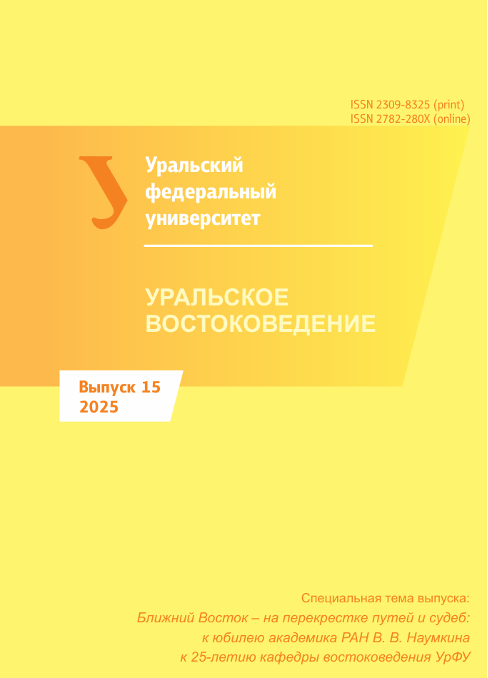
URAL SURVEY OF ORIENTAL STUDIES. Scientific peer-reviewed Journal, 2025. Vol.15. Ural Federal University, 2025. Editor-in-Chief: Professor V.A. Kuzmin. URL: https://journals.urfu.ru/index.php/uos/issue/viewIssue/638/621
ISBN 2309-8325 (Print), ISBN 2782-280X (Online)
“URAL SURVEY OF ORIENTAL STUDIES” Journal – is an international academic journal covering a wide range of topics in the history, culture, linguistics, political science, economics, philosophy, and religious studies of Asia and Africa. Published since 2005, it remains the only journal on Asian studies at Ural Federal University (UrFU) and one of the largest specialized journals published in the Ural-Siberian region.
The journal’s scholarly mission is to explore issues of cross-border relations, contact zones, and interregional and intercultural interaction in the East. This explains its emphasis on colonial and postcolonial studies, imagological issues (the formation of the image of the Other in various cultures), the history of international relations in East Asia, Central Asia, and the Middle East from antiquity to the present day, the history of relations between Russia and the East (in particular, the history of Russian emigration to Asia and Africa), and regional integration in Asia and Africa today. These topics are traditional for «URAL SURVEY OF ORIENTAL STUDIES» and presented in every issue of the journal.
Its most recent issue (Vol. 15 for 2025) is noteworthy because it is arranged to commemorate multiple anniversaries simultaneously: the 20th anniversary of the Journal, the 25th anniversary of the UrFU Department of Oriental Studies, and the 80th anniversary of Academician of the Russian Academy of Sciences (RAS) Vitaly Naumkin, who is among other honors a member of the Trialogue Club International (since 2016) and PIR Center Advisory Board (since 2014).
Eighteen papers covering political, economic, sociological, anthropological, and linguistic facets of Oriental studies are included in this special edition (one of which is written by Academician Naumkin). It examines the Middle East via the lenses of historical memory, cultural heritage, and religion. It also includes a thematic review of the book “Mystical Landscapes in Medieval Persian Literature”[1], published in 2025. The aforementioned book caused quite a stir in the professional community and was hotly discussed by adherents of various schools of oriental studies.
The special issue of the journal brought together under its cover leading orientalists of the Ural-Siberian region, as well as invited experts from scientific organizations in Moscow, St. Petersburg, and several foreign countries – for most of whom Academician Naumkin became not only a colleague, but also a mentor and role model.
Another true gem of the Journal is the introductory article dedicated to the hero of the day. In it, Academician Naumkin emerges not only as a leading Russian orientalist, teacher, and mentor, but also as a creative individual and adventurer. Almost in every way, he’s on par with the semi-legendary Baron Munchausen – the only difference being that, unlike the famous German aristocrat[2], Academician Naumkin is more inclined to downplay his own achievements and accomplishments. He chuckles when his interlocutors recall Fitali, a folklore hero from the Socotra archipelago (Yemen)[3].
This article also addresses a long-standing question: what is the connection between Academician Naumkin and the Ural School of Oriental Studies? And why are two anniversaries featured on the cover, not three? However, we won’t give away all our cards – the readers are better off answering some questions themselves.
Anniversary issue of the “URAL SURVEY OF ORIENTAL STUDIES” Journal is interesting to readers, first and foremost, for its diversity and multifaceted approach. It examines not only the events of bygone days, but also trends and phenomena that are still gaining momentum – but are already, to varying degrees, influencing the direction of development in the East.
It’s also highly symbolic that the special issue’s varied palette contains an additional meaning: each of its thematic facets, inone way or another, reflects a specific aspect of Academician Naumkin’s professional path – not only as a researcher, but also as the director of the Institute of Oriental Studies RAS. It builds upon his creative legacy and enhances it.
And in some cases, he even argues with the master (but carefully and with great respect).
Keywords: Middle East
RUF
E16/SHAH – 26/03/02
[1]Mystical Landscapes in Medieval Persian Literature / ed. by Keshavarz F, Karamustafa A. Edinburgh: Edinburgh University Press, 2025. 336 p.
[2]This refers to Hieronymus Karl Friedrich von Münchhausen, who became famous among the German aristocracy for his incredible stories about his exploits and past. – author’s note.
[3]Academician Vitaly Naumkin entered the folklore of Socotra under the name “Fitali” – for his contribution to the systematization and development of the Socotrans language, as well as for the creation (together with the orientalist Lev Kogan) of an alphabet for this language – author’s note.
