
Book Review № 5 (8), 2026. «Hitting a Bullet with a Bullet»: When Film Depicts Nuclear Standoff

April 10, 2026
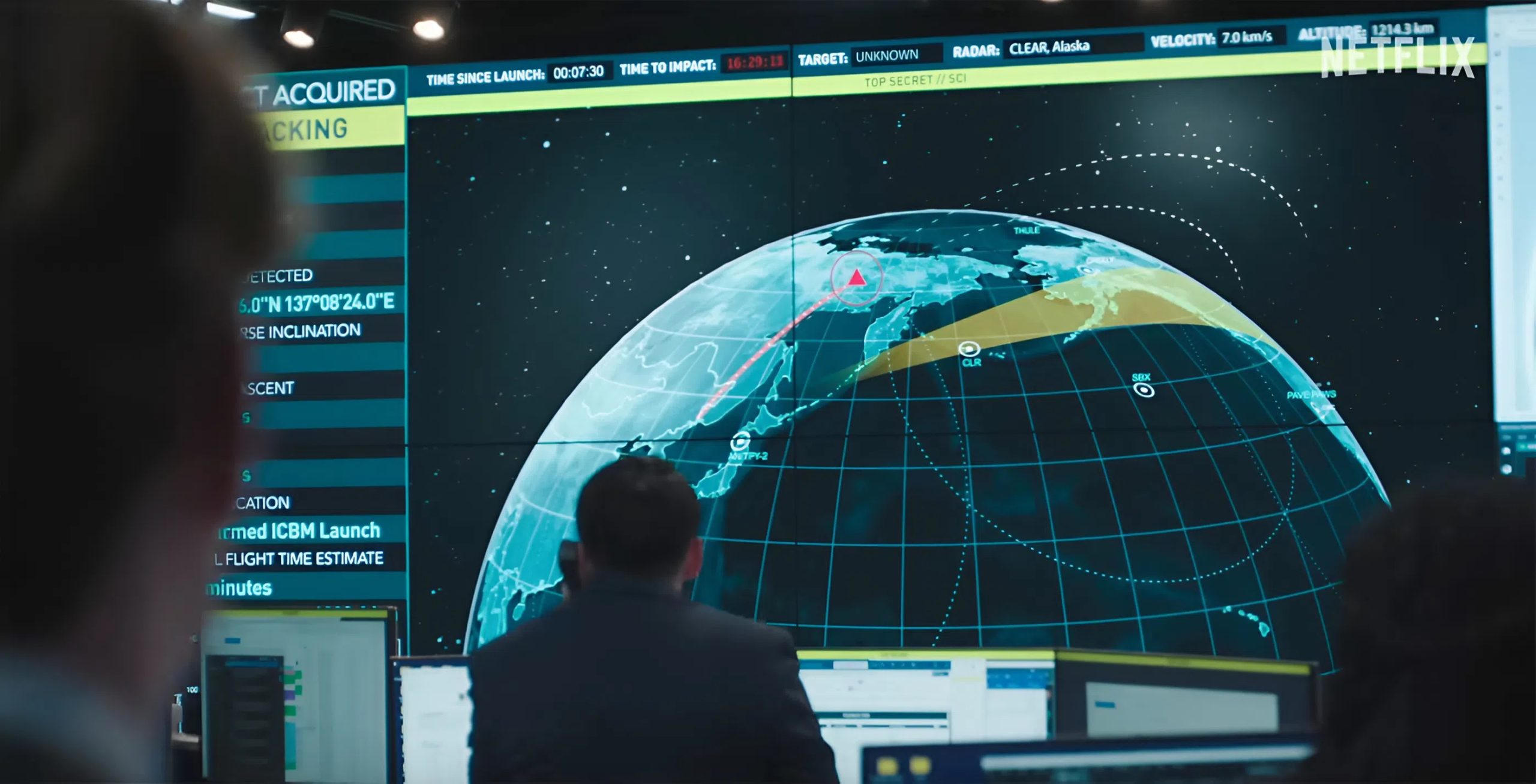

Political thriller «House of Dynamite» (written by Noah Oppenheim, directed by Kathryn Bigelow, 2025).
«If atomic bombs are to be added as new weapons to the arsenals of a warring world, or to the arsenals of nations preparing for war, then the time will come when mankind will curse the names of Los Alamos and of Hiroshima».
J. Robert Oppenheimer’s acceptance speech for Army-Navy “Excellence” Award, October 16, 1945
The premiere of the feature film «The House of Dynamite», directed by Kathryn Bigelow, took place in October 2025. The film simulates a hypothetical crisis triggered by a launch of an intercontinental ballistic missile at the USA and a failed attempt by the US national missile defense system to intercept it. The film is divided into three parts, each depicting the reaction of key US decision making centers (the White House Situation Room, the US Strategic Command, and the US Presidential Administration) to the unidentified launch. The film has an open ending, featuring the US President having to make a decision on a retaliatory nuclear strike.
While «The House of Dynamite» stands as a classic nuclear war thriller, it also carries a clear foreign policy message aimed at both the American government and the general public. On the one hand, the film aims to assure the American public that, should a nuclear war break out, the US government will make every effort to protect them or, at least, deprive the attacking side of any incentive to launch a second strike. On the other hand, amid the unfolding strategic stability crisis, the film tends to make a case for ramping up efforts to modernize the US national missile defense system. This is precisely the strategic objective that the second Donald Trump administration is vigorously pursuing. In early 2025 it announced the «Golden Dome» initiative, thereby undertaking to dramatically improve a crucial aspect of the US missile defense system. It should be noted that the film’s narrative directly highlights the gravity of this issue: in the picture, US satellites and sensors failed to promptly detect both the moment and the place of an ICBM launch, which triggered a catastrophic chain of events.
The history of the US missile defense dates back to the late 1940s and the «Wizard» program, which involved the development of the first anti-ballistic missile systems designed to counter Soviet Union threat. Remarkably, the proposed method of intercepting the enemy missile envisioned the use of ballistic missiles armed with nuclear warheads. The first operational US anti-ballistic missile system (ABM), developed in the late 1950s and designated Nike Zeus, was intended to engage enemy ballistic missiles during the mid-course phase, prior to their re-entry into the lower atmosphere. The Nike Zeus missiles carried a thermonuclear warhead with enhanced neutron radiation. When an incoming enemy missile encountered the neutron flux, the neutrons were supposed to induce a premature, spontaneous chain reaction in the warhead’s fissile core – a phenomenon known as the «popcorn effect»- thereby destroying the enemy warhead. As part of the further development of missile defense systems, new anti-ballistic missiles (interceptors) emerged – namely, the Spartan and the Sprint. Both would later enter service with the US Armed Forces.
The fundamental challenge the US government faced in developing missile defense systems was the inability to ensure protection of the entire national territory against a large-scale enemy attack. Even the Safeguard program, initiated under President Richard Nixon, could defend only limited geographic areas. Following the signing of the ABM Treaty in 1972 and the 1974 Protocol, the United States deployed the Safeguard system at the Grand Forks ICBM base in North Dakota. The terms of these agreements also capped the development of anti-ballistic missile launchers for both the USA and the USSR at 100 units. This inevitably slowed the pace of US missile defense development, a trend reinforced by the fact that roughly half of the US nuclear arsenal was already attributable to SLBMs by that point.
Interest in missile defense was revived in 1983 when President Ronald Reagan, concerned about the United States’ excessive reliance on nuclear weapons to sustain deterrence, announced the Strategic Defense Initiative (SDI). The initiative aimed at establishing a multilayered missile defense architecture with space components. Although the SDI was never fully implemented, its research and technologies laid the foundation of modern missile defense concepts, including the «Golden Dome» program.
By the early 2000s, the USA had developed missile defense systems designed for terminal-phase interception – the Patriot and THAAD (Terminal High Altitude Area Defense) systems. In the aftermath of 9/11, the USA withdrew from the ABM Treaty, justifying its decision by the need to counter missile threats from terrorists and the so-called «rogue states». With international legal constraints no longer in place, the USA advanced its missile defense programs, developing the Ground-Based Midcourse Defense (GMD), which laid the foundation of America’s contemporary national missile defense architecture.
The architecture of the US homeland missile defense system, the measures required for its upgrade and the evolving threats it must contend with in the 21st century are set forth in the US Missile Defense Review, the most recent edition of which was published in 2022. The US homeland missile defense system comprises three elements:
Detection and tracking systems
Interceptors
Integrated command and control system
«The House of Dynamite» offers a fairly accurate depiction of the challenges the contemporary US homeland missile defense system is facing.
Firstly, there are structural challenges. The 2022 US Missile Defense Review outlines the establishment of an integrated defense architecture, achieved through closer integration of national and regional missile defense components (Integrated Air and Missile Defense) – as a key development priority. Nevertheless, by 2025, such an architecture has yet to be created largely due to the absence of a fully integrated detection and tracking system. It explains the possibility of an attack on the US territory as depicted in the film. In theory, the implementation of the «Golden Dome» program can help resolve this issue. The program envisions replacing large American satellites with a network of smaller spacecraft operating in low Earth orbit. This would enable the early detection of missile launch sites, as well as the types and modifications of missiles. In the distant future, the United States is looking to develop space-based systems to intercept enemy missiles during the boost phase.
Secondly, the film highlights the limited effectiveness of existing ground-based ICBM interceptors during the mid-course phase. According to publicly available data, the success rate of US ground-based interceptor tests is about 50%. To increase this rate, one must launch up to four interceptors against a single ICBM. Presuming from the fact that the US arsenal currently includes only about 44 silo-based interceptors, the GMD has a limited effectiveness against a large-scale attack on the American homeland. Striving to enhance the system’s performance, the USA intends to commence replacement of its aging ground-based interceptors with next-generation ones by 2028. What will set them apart is an advanced kinetic warhead capable of engaging multiple targets. At the same time, it is also worth noting that the USA continues to use warheads with high-explosive fragmentation payloads.
One should also emphasize low effectiveness of the current US national missile defense system against certain modern weapon systems. A versatile family of Russian-made precision-guided cruise missiles (the Kalibr), the Russian nuclear-powered intercontinental cruise missile (the Burevestnik) as well as Chinese fractional orbital bombardment systems (FOBS), which allow the missiles to travel in low Earth orbit and evade US radars, are of particular concern to the US military command.
Finally, the film emphasizes the critical role that human decision-making plays in such crisis scenarios. Given that no nation has ever experienced a full-scale nuclear strike, the psychological effect of such an event on those responsible for decision-making remains impossible to predict. «The House of Dynamite» clearly illustrates this dilemma through the actions of the US Secretary of Defense and the US President.
To sum up, «The House of Dynamite» delivers an unequivocal call to modernize the existing US national and regional missile defense systems. Since the US missile defense was originally designed to counter threats from «rogue states» such as North Korea and Iran, these days the US government recognizes strategic vulnerability of their systems to advanced air- and sea-based ICBM threats emerging from Russia and China. While maintaining its commitment to nuclear deterrence, the United States intends to pursue the development of the multilayered missile defense architecture that comprises enhanced systems designed to meet both present and emerging threats.
Keywords: Nuclear nonproliferation; Strategic stability; Missile defense
AC
E16/SHAH – 26/04/10
