
Book Review № 8 (11), 2026. Nuclear War: A Scenario

September 14, 2026
Jacobsen A. Nuclear War: A Scenario. New York: Penguin Random House, 2024.
ISBN 978-0525658627
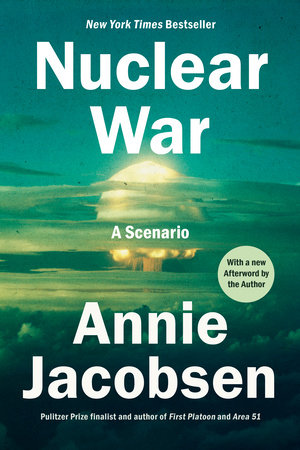
In March 2024, American investigative journalist Annie Jacobsen – a Pulitzer Prize finalist and author of books on the secret Area 51 base, the Nazi scientists of Operation Paperclip, and covert CIA programs – published a work whose scope surpasses everything she had written before. The book’s premise is at once simple and audacious: to reconstruct, minute by minute, what would happen if a single nuclear warhead were launched at the United States. No fictional license, no embellishment – only facts, verified through more than forty exclusive interviews with presidential advisers, nuclear weapons designers, scientists, military officers, and intelligence officials. Among Jacobsen’s interlocutors are former Secretary of Defense William Perry, U.S. Strategic Command commander General Robert Kehler, physicist and creator of the first thermonuclear bomb Richard Garwin, climatologists Alan Robock and Brian Toon, MIT missile-technology expert Theodore Postol, Los Alamos National Laboratory director Charles McMillan, and dozens of other specialists. The result is a book that reads like a disaster novel, though it is written with the precision of a technical report.
The book’s structure is unconventional. It is divided into five parts – “Escalation,” “The First 24 Minutes,” “The Next 24 Minutes,” “The Next (and Final) 24 Minutes,” and “The Next 24 Months and Beyond” – interspersed with nine “historical lessons,” brief excursions into the past that explain the logic behind various doctrines and technologies. This device is methodologically well thought out: the reader is never overwhelmed by the flood of acronyms – SIOP, SBIRS, STRATCOM, NORTHCOM, LOW, GMD, THAAD – since each one is immediately given historical and human context.
The first part is devoted to how the world arrived at its current nuclear posture – from the December 1960 briefing at Offutt Air Force Base, where the Single Integrated Operational Plan, which envisioned the deaths of six hundred million people, was presented, to today’s thousands of deployed warheads. Especially noteworthy is the testimony of John Rubel, deputy director of defense research, who was present at that briefing. Only one man in the room – Marine Corps Commandant General David Shoup – dared to say aloud that a plan resulting in the deaths of three hundred million Chinese, in a war that might not even be their war, was “not the American way.” No one supported him. Rubel said nothing and remained silent for forty-eight years. This episode vividly demonstrates how deeply institutional inertia can suppress even well-founded moral objections.
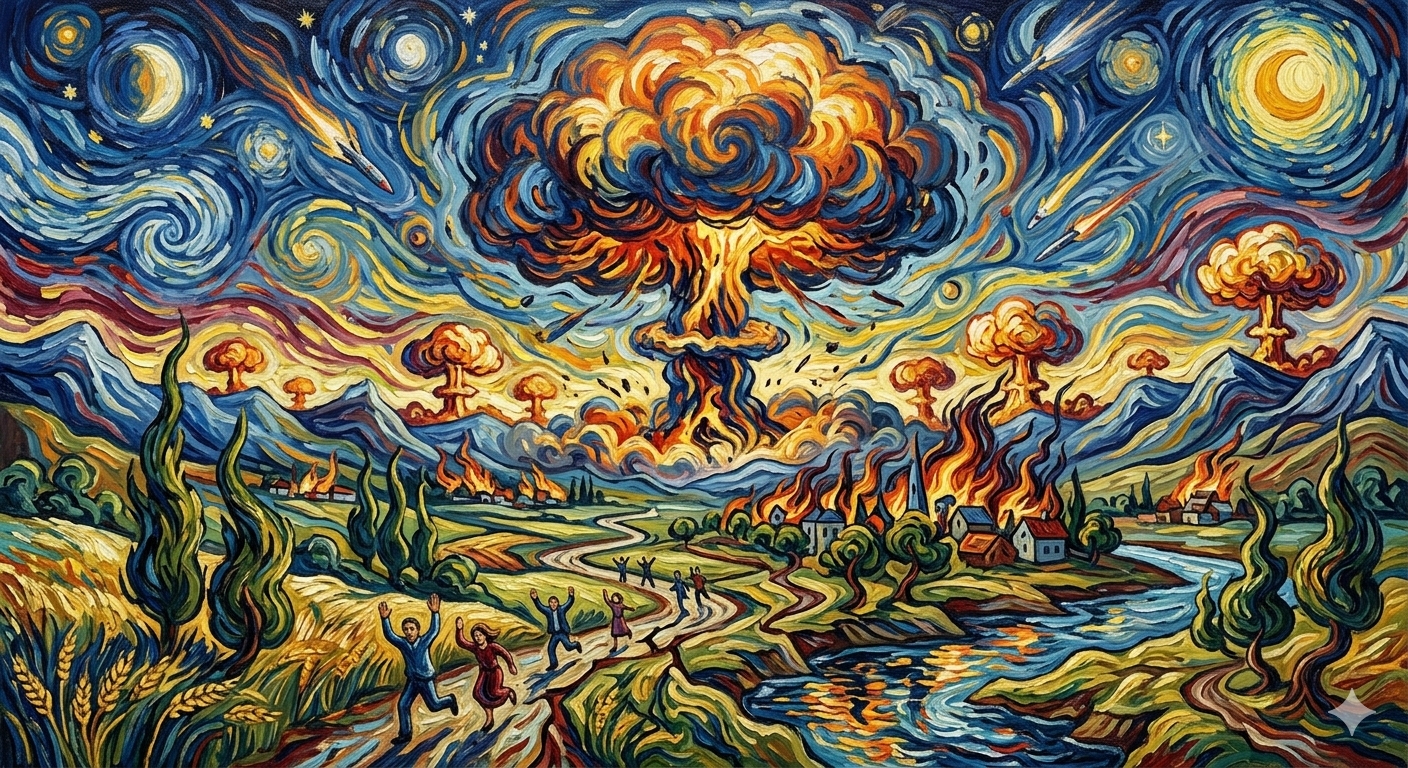
The scenario itself begins on March 30 at 3:03 p.m. Eastern Time, when a North Korean “Hwasong-17” intercontinental ballistic missile – nicknamed “the Monster” by analysts – launches from an unimproved dirt site thirty kilometers from Pyongyang, fired from a twenty-two-wheeled mobile launcher. Four-tenths of a second later, American SBIRS infrared satellites in geosynchronous orbit detect the engine plume. One minute thirty seconds later, the alert reaches Cheyenne Mountain and STRATCOM headquarters. Three minutes fifteen seconds in, the U.S. president receives his first briefing; he has roughly six minutes to decide. Nine minutes in, four Ground-based Midcourse Defense (GMD) interceptors attempt in succession to destroy the Hwasong-17 – and all four fail. Twenty-one minutes in, a second missile, launched from a North Korean submarine, strikes the Diablo Canyon nuclear power plant in California. Twenty-three minutes in, the first nuclear detonation occurs: a one-megaton thermonuclear bomb destroys the Pentagon. Thirty-three minutes in, the president, having escaped the White House aboard Marine One, authorizes a retaliatory strike on North Korea – fifty Minuteman III ICBMs and eight Trident SLBMs carrying thirty-two warheads, eighty-two targets in all. Forty-five minutes in, the Russian early-warning system “Tundra” mistakes these missiles flying over Russian territory for a strike on Russia itself. Forty-five minutes and one second in, the Russian president authorizes a massive retaliatory strike – roughly a thousand warheads. Seventy-two minutes after the scenario began, global nuclear war has broken out.
Jacobsen constructs this timeline with journalistic precision and, at the same time, cinematic expressiveness. She does not merely list events but populates every moment with living people: command-and-control officers inside Cheyenne Mountain, a president listening to advisers in the Situation Room, operators of Russian early-warning systems at Serpukhov-15, technicians in Minuteman silos in Wyoming. A vivid example of this approach is the scene at Echo-01 launch silo in Wyoming, where launch-crew officers remove Air Force insignia from their uniforms and replace them with Strategic Command emblems – once merely an exercise ritual, now happening in earnest for the first time. The book’s final section, “The Next 24 Months and Beyond,” addresses long-term consequences: a nuclear winter lasting up to ten years according to Toon and Robock’s calculations, a seventy-percent drop in solar radiation, destruction of the ozone layer, the collapse of global agriculture, and, by various estimates, the deaths of up to five billion people from starvation.
The “historical lessons” are of particular value in this work. The lesson on deterrence explains how a concept originally meant to prevent nuclear war turned into an engine of an unprecedented arms race: by 1967 the United States had amassed thirty-one thousand two hundred fifty-five nuclear bombs, produced on average at a rate of five per day. This fact demonstrates that the logic of deterrence, once set in motion, acquires its own momentum that outstrips its original political purpose. The lesson on the LOW doctrine notes that every American president since George W. Bush has promised to review this “dangerous option.” None has done so.
In turn, the lesson on the presidential “Football” publicly reveals, for the first time, the history of its creation, based on Los Alamos National Laboratory documents declassified in 2023. Physicist Harold Agnew discovered in 1959 that nuclear bombs at a NATO base in Europe were guarded by a single young private with eight rounds of ammunition. It was precisely this shock that prompted him to develop the first Permissive Action Link (PAL) device. Particularly notable is the lesson on the 1983 “Proud Prophet” war game. Over two weeks, more than two hundred participants simulated various nuclear-war scenarios, and in every single case the outcome was the same: total mutual annihilation. As political scientist Paul Bracken, a participant in the exercise, recalled, “it was a catastrophe that made every war of the preceding five centuries pale by comparison.” Nuclear war cannot be won. This conclusion was established forty years ago, yet the nuclear command-and-control system is built as though it did not exist.
Several theses of independent scholarly and political value emerge clearly from the book. The first and central one is that the LOW doctrine is catastrophically dangerous. Under it, a nuclear strike is launched not after enemy missiles are confirmed to have hit their targets, but at the very first signal from early-warning systems of a launch. Jacobsen demonstrates the specific mechanism of catastrophe: American ICBMs launched at North Korea fly over Russia. This is unavoidable given geography, since Minuteman III missiles lack the range to strike the Korean Peninsula without crossing Russian territory.
The Russian “Tundra” system, less reliable than SBIRS according to expert Theodore Postol’s assessment, “looks sideways” and cannot maintain vertical coverage, which can cause it to mistake cirrus clouds for missile trails. It registers fifty Minutemen as more than a hundred missiles targeting Russia. The logic of LOW kicks in automatically. Here the author demonstrates what Charles Perrow’s reliability theory calls a “normal accident”: in sufficiently complex, highly coupled systems, catastrophe is not an anomaly but a logical consequence of the architecture itself. This point makes clear that the problem lies not in the malicious intent of particular leaders but in the systemic properties of the nuclear deterrence structure itself.
The second thesis concerns the effectiveness of American missile defense. Jacobsen relies on Postol’s assessments: the probability of intercepting a single North Korean ICBM with the GMD system does not exceed a few percent given decoys and maneuvering warheads. The book describes in detail how all four interceptors launched from Fort Greely fail – the exoatmospheric kill vehicle simply cannot distinguish the actual Hwasong-17 warhead from decoys in the seconds available to it. Tellingly, in 2017 the Missile Defense Agency announced a “strategic pause” in the kinetic-interceptor program due to “design flaws”; nevertheless, all forty-four interceptors remain on combat alert. The Sea-Based X-Band Radar (SBX), which cost ten billion dollars, likewise exemplifies what critics call “the Pentagon’s ten-billion-dollar failure.”
The third thesis addresses the ethical illegitimacy of the principle of “sole authority”: the U.S. president has the right to order the use of nuclear weapons unilaterally, without any consultation with Congress or the Senate. In the book, this thesis is embodied in the figure of the acting president in the finale who, knowing he will die within minutes, must open the “Black Book” and choose an option for a massive strike on Russia from among nine hundred seventy-five targets. This image conveys, in maximally concentrated form, the absurdity to which the logic of nuclear deterrence has led.
It is also worth dwelling on details absent from most public discussions of nuclear scenarios. The strike on the Diablo Canyon nuclear power plant specifically is no accident. Drawing on assessments by nuclear engineer Glenn McDuff and physicist Frank von Hippel, Jacobsen shows that a strike on an operating nuclear power plant creates what Japanese experts, after Fukushima, called a “devil’s scenario”: an uncontrolled meltdown of nuclear fuel, the burning of more than two thousand five hundred spent-fuel assemblies, and contamination of an area comparable to two states the size of New Jersey, for an indefinite period. A separate line of analysis is the “Doomsday scenario” – using a North Korean satellite as an orbital nuclear device to detonate a high-altitude electromagnetic pulse (EMP) over the continental United States. Drawing on data from the EMP Commission and interviews with its longtime director, Dr. Peter Pry, Jacobsen describes a cascading failure of the entire American power grid: the collapse of SCADA systems, transportation breakdowns, the shutdown of nuclear power plants, and the loss of water supply and communications. One may debate how realistic this scenario is, but Jacobsen provides a convincing array of sources, including open testimony before the Congressional Committee on Homeland Security in 2017.
Speaking of the book’s merits, its unprecedented work with sources deserves mention above all. A significant portion of the details Jacobsen reproduces – the structure of the “Black Book” (the presidential decision handbook), the design of the “Football,” the STRATCOM procedures for authenticating a presidential order through the “challenge–response” system, and the operation of the three timers in the STRATCOM commander’s bunker (red – until the strike, blue – until the counterstrike, green – until safe evacuation) – had previously remained outside public knowledge. Los Alamos National Laboratory specifically declassified the history of the presidential “Football” for this book – a document that had remained classified since 1959.
It is telling that before publication, the manuscript was read by a retired lieutenant general who had overseen these scenarios at NORAD, and he found not a single passage requiring removal. The book’s genre hybrid of reportage, historical documentary, and thriller makes it a rare example of the successful popularization of nuclear-security issues. In recent decades this subject has catastrophically degraded within public discourse; the nuclear threat vanished from mass consciousness along with the end of the Cold War, becoming little more than a backdrop for James Bond films. “Nuclear War: A Scenario” brings it back with compelling force – alongside the works of William Perry, Eric Schlosser (“Command and Control”), and Daniel Ellsberg (“The Doomsday Machine”). Within this body of work, Jacobsen’s book occupies a special place: it is the most detailed and up-to-date public reconstruction of American nuclear procedures, based not on leaks or literary imagination but on hundreds of hours of interviews with actual participants in the system.
At the same time, for all its merits, the book is not free of significant limitations that must be noted. Chief among them is an asymmetry of perspective. “Nuclear War: A Scenario” is written almost exclusively from the American point of view. Russian and North Korean leaders in the scenario are depicted as silent figures whose motives remain offstage. The North Korean leader launches the missile without any explanation; he is simply the “mad king,” as Jacobsen repeatedly calls him. This stance is methodologically vulnerable: most serious studies of North Korea identify a fairly definite, if peculiar, rational logic to its nuclear strategy, in which the arsenal serves above all as a guarantor of regime survival. By accepting the image of the “irrational despot” as a given, the author closes off precisely the question that is most interesting from an analytical standpoint: under what circumstances might a rational actor arrive at a decision to strike first with nuclear weapons? The Russian side is depicted in somewhat greater detail – in particular, the description of the “Tundra” system and its vulnerabilities draws on the views of expert Pavel Podvig. On the whole, however, the Russian decision-making system remains a black box. This is not merely a literary shortcoming but a substantive problem, since nuclear deterrence is by its very nature a relationship between actors and requires understanding the logic of each side.
A number of the book’s technical claims have sparked controversy among experts. Peter Huessy, a nuclear-policy analyst, pointed out that Jacobsen inaccurately describes the “launch under attack” option, which in fact gives the president considerably more time than the scenario suggests. The scenario’s own narrative choices also matter: the American counterstrike is carried out by land-based Minuteman ICBMs flying over Russian territory, whereas Trident submarine-launched ballistic missiles based in the Pacific could follow trajectories that avoid overflying Russia altogether. It is precisely this choice – Minuteman rather than Trident – that largely “predetermines” the inevitability of a Russian-American nuclear war within the scenario as described.
The detailed “minute-by-minute” format creates the illusion of exhaustive knowledge of how things would “actually” unfold. But no one possesses this knowledge: military plans are classified, and the specific decision-making algorithms are not publicly disclosed. Jacobsen constructs a plausible but still authorial rendering, and the danger lies in the reader mistaking it for an exact snapshot of reality. Finally, the book implicitly rests on the normative assumption that the LOW doctrine is unacceptable – a position shared by many experts – but it barely engages with counterarguments. LOW exists precisely because, without it, the temptation of a first disarming strike arises. This is a classic security dilemma, and the book favors only one side of it.
The publication of “Nuclear War: A Scenario” in 2024 proved exceptionally timely. During this period, the international situation in nuclear security was marked by tension unprecedented since the Cold War. North Korea was building up its ICBM capability, including the Hwasong-17, capable of reaching any point in the continental United States. China was rapidly increasing its warhead numbers, approaching a thousand by 2030. New START had expired, and arms-control negotiations had stalled. In this context, the book performs an important function: it translates dry strategic jargon into vivid human reality and reminds a broad audience that the nuclear threat did not disappear along with the Berlin Wall.
From the standpoint of Russian-American relations, the analysis of the vulnerabilities of the “Tundra” system is of particular interest. The logic Jacobsen builds is clear: the technical imperfection of early-warning systems, combined with the LOW doctrine, creates a systemic risk of accidental nuclear war independent of the intentions of political leaders. This is a strong argument for renewing bilateral dialogue on de-alerting nuclear forces – a topic that has almost entirely dropped off the Russian-American agenda. In January 2022, the five permanent members of the UN Security Council signed a joint statement declaring that “a nuclear war cannot be won and must never be fought,” verbatim repeating a formulation used by Reagan and Gorbachev thirty-six years earlier. Yet declarations without verifiable mechanisms remain mere words. Jacobsen’s book is, among other things, an argument that concrete steps to reduce nuclear risks must follow these words.
In conclusion, it should be stated that the significance of “Nuclear War: A Scenario” lies not so much in the originality of its theses – most of them have long been known to specialists – as in its ability to convey them to a broad audience in language that audience can understand and feel. In the end, this is precisely the main function of quality science journalism: to make closed expert knowledge public property. For a specialist in international security, the book offers a detailed public reconstruction of American nuclear procedures, a compelling demonstration of the systemic risks built into the very architecture of nuclear deterrence, and arguments in favor of reforming the LOW doctrine and the principle of sole authority.
The book’s main shortcoming is its American-centrism, which is at the same time its inevitable limitation. Jacobsen writes for an American audience, drawing on American sources. “Nuclear War: A Scenario” is an American voice in a conversation that has long needed the participation of Moscow, Beijing, Pyongyang, and the wider international community. The book deserves to be read not because it provides answers, but because it asks the right questions. In a world where arms control is deteriorating and nuclear thresholds are becoming the subject of open speculation, the ability to ask the right questions is, in itself, a valuable contribution to the discussion of international security.
Keywords: Nuclear deterrence; Strategic stability; Arms control
NPT
E16/NOS – 26/09/14
