
CHAPTER 19. WIND OF CHANGE: WORLD ORDER TRANSFORMATION THROUGH THE PRISM OF EXPERT ASSESSMENTS

Since 2021, a team of MGIMO and HSE researchers and graduate students has been conducting an annual International Hierarchy Expert Survey (IHES)[1], which is voluntary, anonymous, confidential, online, and in English[2]. More than 200 International Relations (IR) experts in 53 countries took part in the fourth wave of IHES, from December 2024 to March 2025. Their responses were converted into indices that can be used in research and applied analytics. This chapter relies on IHES data to categorize IR experts’ thinking about the ongoing world order transformation, in particular to differentiate Western (the US and Europe) and Non-Western (Russia and Eurasia) expert views on some core elements of this transformation.
The most important point is that in the non-Western part of Eurasia, expectations of major changes in the world system during the current decade are very high, while retrospective assessments of the most significant changes in the past differ substantially from those in the West.


On Figure 67, there are several points worth paying attention to:
A general interpretation of these observations may be that Russian and Eurasian experts both view the current decade as a turning point, a period of transformations comparable to those remembered as epochal in history and previously accompanied by decisive victories and defeats. Western experts, by contrast, assess the transformations brought by the current decade more modestly. However, the understanding of the nature of these changes presumably differs between Russian and Eurasian experts. Eurasian experts tend to see them as a continuation of the trends of the 2000s and 2010s, when many non-Western countries grew faster than the global average, and when the agenda of reforming international institutions took shape – aimed at making a more representative system of “global governance”, not only by including the largest developing states but also the so-called “middle powers”. The current moment is viewed as an accelerated, yet evolutionary continuation of a process unfolding over the past three to four decades. Russians, on the other hand, interpret the present moment in a more “revolutionary” way, as a rupture marking the end of the West’s centuries-standing dominance, which, even in recent decades, showed no intention of relinquishing its position[3].
The recognition of a profound transformation of the world system is accompanied by apprehension rather than optimism. Analysis of the results from the latest IHES waves allows for the following generalization: “The current transformation of the international system is seen as comparable to those which followed the World Wars and the Cold War. Such a transformation is not expected to be quick. In such a dynamic environment, failure may happen faster than success, and some changes may be disadvantageous to most states. All together, experts are more wary than optimistic regarding change”[4].
This general observation also applies to attitudes of experts from the non-Western part of Eurasia recorded in the survey. However, one detail deserves particular attention (Figure. 68). When asked to estimate how long it would take in today’s world for a country to improve its position in the global system (that is, to significantly increase its international status), the most common answer among Eurasian experts was “10–30 years”. This option was also the most popular among other groups, except for the American experts, where the “5–10 years” option received slightly more responses – apparently reflecting their sense of unease amid global changes[5]. Yet, Eurasian experts chose the leading answer far more decisively: it received nearly 70% of their responses, compared to only 42% among Russians and 32% among Americans. Among Eurasian experts, other options lagged far behind the top one. By contrast, 20–33% of Russian and American experts believed that change could come either faster (“5–10 years”) or, conversely, slower (“30–80 years”), with 25–28% in each of these groups favouring the latter timeframe.


These data reflect how seriously the ongoing transformation of the world system is regarded in the non-Western part of Eurasia. There are no illusions that this transformation can be swift, yet there is also no willingness to wait for an improvement in one’s position in a distant future.
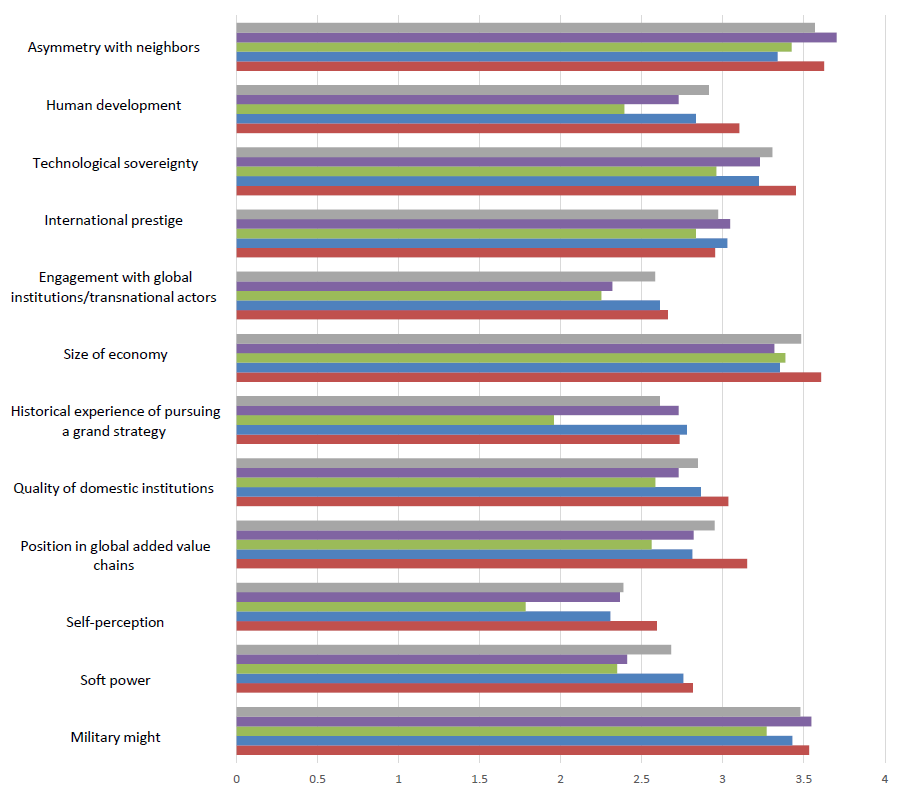
It is noteworthy what, in the view of Eurasian experts, determines a state’s position in the world system (Figure 69). The greatest importance – almost equally – was attributed to military might, the size of the economy, and asymmetry with neighbouring countries (that is, superiority over them). Ranked fourth, with some distance from the former three, was technological sovereignty. Military might, economic size, and technological sovereignty represent material dimensions of strength. Other factors – those related to domestic development, international political and economic engagement, historical experience, prestige, soft power, and so on[6] – were rated significantly lower by Eurasian experts[7].

As mentioned earlier, one of the three main factors determining a state’s status and position in the global hierarchy, according to Eurasian experts, was “asymmetry with neighbouring countries” (that is, superiority over them). This indicates that Eurasian experts view the pursuit of regional hegemony as a natural aspiration for states. This interpretation is fully supported by a separate question about regional hegemony[8]. Respondents considered China to be an already established regional hegemon. They also identified several other countries as having strong regional hegemonic ambitions: Russia, India, Turkey, Saudi Arabia, Iran, Israel, and Egypt.
However, the number of respondents who believed these countries already possess regional hegemony (“already a regional hegemon”) was much lower than the number who said they aspire to it (“aspires to become a regional hegemon”). This can be interpreted as an expectation that the aforementioned countries will act to consolidate or expand their regional dominance. By contrast, experts attributed far less pronounced hegemonic ambitions to Pakistan, Indonesia, North Korea, Japan, and South Korea – the latter being the only country for which more than half of the experts stated that it does not aspire to become a regional hegemon.
[1] Over the years, the following people helped conduct surveys and process their results: MGIMO professor Ivan Safranchuk, MGIMO graduate students Alexander Nesmashnyi, Vera Zhornist, and Bogdan Barabash, HSE graduate student Daniil Chernov, MGIMO student Evgenia Komarova, HSE students Khusravkhon Nabiev and Nikita Svistunov, and HSE research fellow Dylan Royce.
[2] For the survey methodology and indices based on survey results, See: Nesmashnyi, Zhornist and Safranchuk, 2022; Safranchuk, Nesmashnyi and Chernov, 2025. Survey data is available on Harvard Dataverse: Chernov D., Nesmashnyi A., Zhornist V., Safranchuk I. (2025). International Hierarchy Expert Survey. URL: https://doi.org/10.7910/DVN/PXVTEY – Editor’s note.
[3] A necessary caveat is that the very nature of the survey method allows respondents to “slide” in their answers between what is, what ought to be, and what is desirable.
[4] Safranchuk I., Nesmashnyi A., and Komarova E, 2025. Will It Get Worse? Expert Perception of Global Transformation // Russia in Global Affairs Journal, 23(4), pp. 104–112. DOI: 10.31278/1810-6374-2025-23-4-104-112.
[5] Let us assume that some American experts fear the rise of others even more than others hope to rise.
[6] Respondents were asked to identify which of the listed factors are essential for determining a state’s place in the global hierarchy: asymmetry with neighbouring countries, human development, technological sovereignty, international prestige, engagement with global institutions and transnational actors, size of the economy, historical experience in pursuing a “grand strategy,” quality of state governance institutions, position in global value chains, self-perception, soft power, and military might.
[7] It should be noted that Eurasian experts did not dismiss any of the proposed factors: all received relatively high evaluations. However, the ones mentioned above clearly emerged as the absolute leaders.
[8] Respondents were asked to choose, for each of the 30 countries included in the survey (14 of which belong to the non-Western part of Eurasia), one of the following options: already a regional hegemon, aspires to become a regional hegemon, or has no regional hegemonic ambitions.
