
CHAPTER 2. NUCLEAR WEAPONS: WHAT FUTURE FOR ARMS CONTROL?


There is no need to once again repeat all the current challenges facing arms control, whether nuclear or not. Arms control is in deep crisis with a possibility of further degradation. Almost no major treaties remain operational, although some lesser ones are still in effect (i.e. between Russia, China and Central Asian states regarding near-border military activities, or between India and Pakistan on non-targeting of nuclear infrastructure).
The only treaty limiting nuclear arsenals of great powers is the New START, and it remains to be seen if anything will come in its place after February 2026, although Russia has taken some measures to at least lay the foundation for possible arms control talks with the US and other partners. This is a crucial topic, and it will be addressed separately within this chapter.
…The New START Treaty will expire on February 5, 2026, signalling the imminent end of the last international accord directly limiting nuclear missile capabilities. A complete renunciation of this treaty’s legacy would, from many points, be a grave and short-sighted mistake. It would also have adverse implications for the objectives of the Treaty on the Non-Proliferation of Nuclear Weapons.
In order to prevent the emergence of a new strategic arms race and to preserve an acceptable degree of predictability and restraint, we consider it reasonable to maintain at this turbulent time the status quo established under New START. Accordingly, Russia is prepared to continue observing the treaty’s central quantitative restrictions for one year after February 5, 2026.
Following that date, based on a careful assessment of the situation, we will make a definite decision on whether to uphold these voluntary self-limitations. We believe that this measure is only feasible if the United States acts in a similar spirit and refrains from steps that would undermine or disrupt the existing balance of deterrence.
Vladimir Putin
President of Russia
September 22, 2025
http://www.en.kremlin.ru/events/president/news/78051
The reasons for the existing arms control crisis are numerous but can be assembled into two major groups: political and technological. First, there have been dramatic shifts in military-political relations between countries over the last several decades. Old actors are less capable, new actors are eager to change the balance, and there has been increasingly less appetite for diplomacy and specifically for adapting what remained of arms control for the new global realities. Second, warfare itself has changed dramatically, and so-called “emerging and disruptive technologies” affected and continue to affect both the actual battlefield dynamics, the deterrent effects of selected weapons, and the perceptions of decision-makers and analysts alike.
While these are rather evolutionary processes, not revolutionary, the overall volume of ongoing changes on the global scale provides for dramatic cumulative results. In terms of impact related to the relations among nuclear powers, both positive, stabilizing and negative, destabilizing trends are observed.
Global Nuclear Weapons Dynamics
Before going deeper into details and effects of the ongoing developments in nuclear and conventional fields, several perspectives on the dynamics of the global nuclear stockpiles should be observed. While there are no doubts that current total numbers of nuclear weapons are no match for the peak of the previous Cold war, a nuanced approach can help to understand some specific issues that face us today.
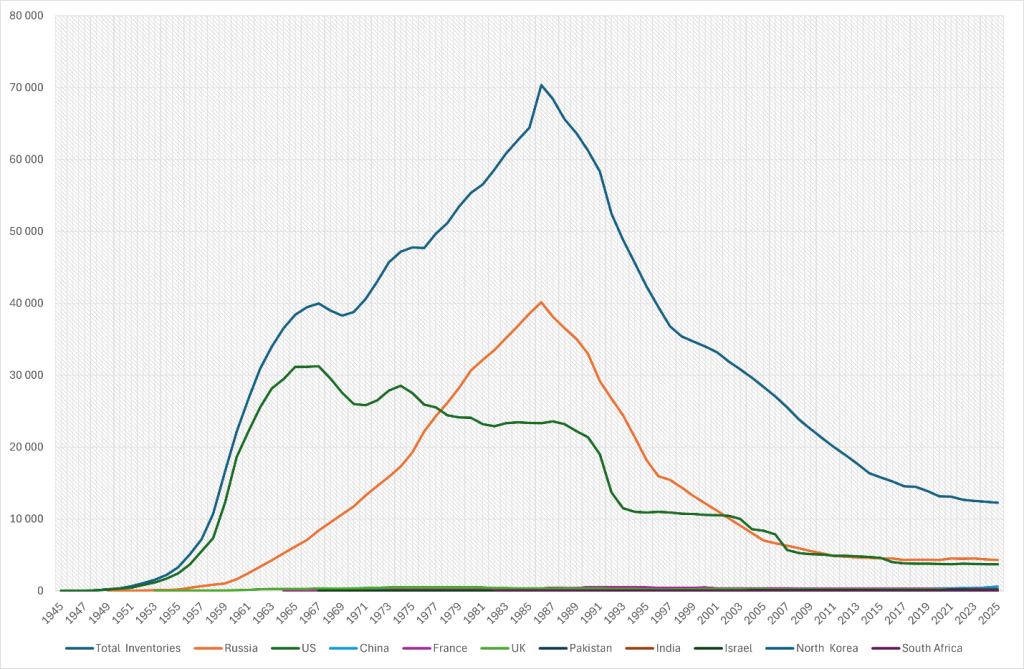
If we look at the dynamics over the last 15 years and remove the Russian and American nuclear behemoths, the picture is significantly different.
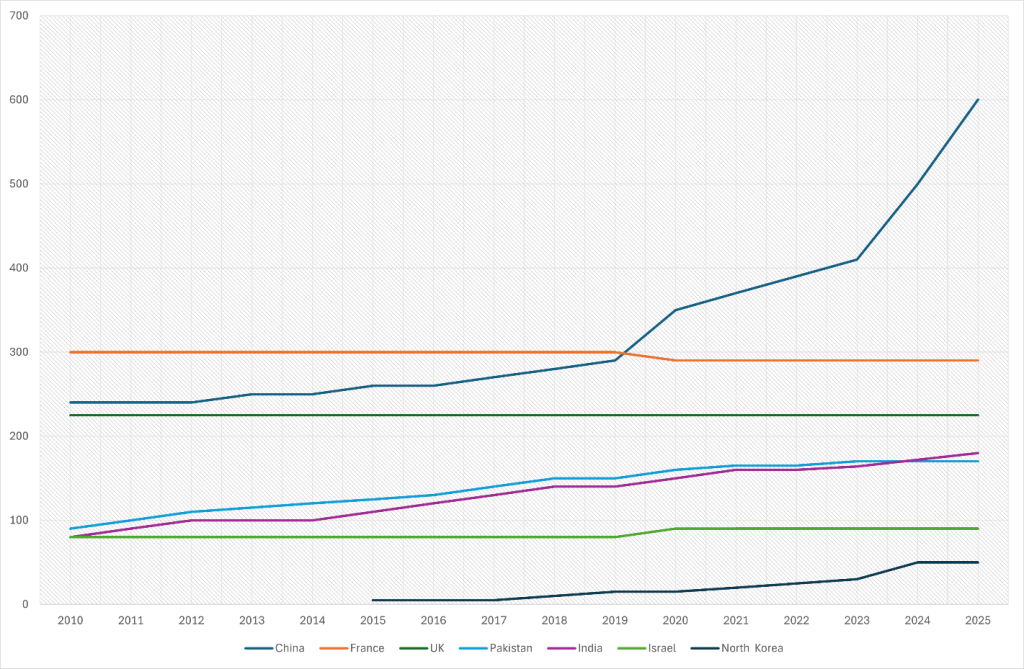
No surprises that there are very real concerns about a possible nuclear arms race on a global scale, not to mention the absence of progress in nuclear disarmament as provided in the NPT Article 6, although a more nuanced approach here might be useful as well, and it will be addressed in this chapter.
It gets even more interesting especially if one considers the growing emphasis on nuclear capabilities in France and the UK and their latest national and joint nuclear-related documents[1] and rhetorics which open the possibility for future growth of nuclear stockpile in these European NATO countries.
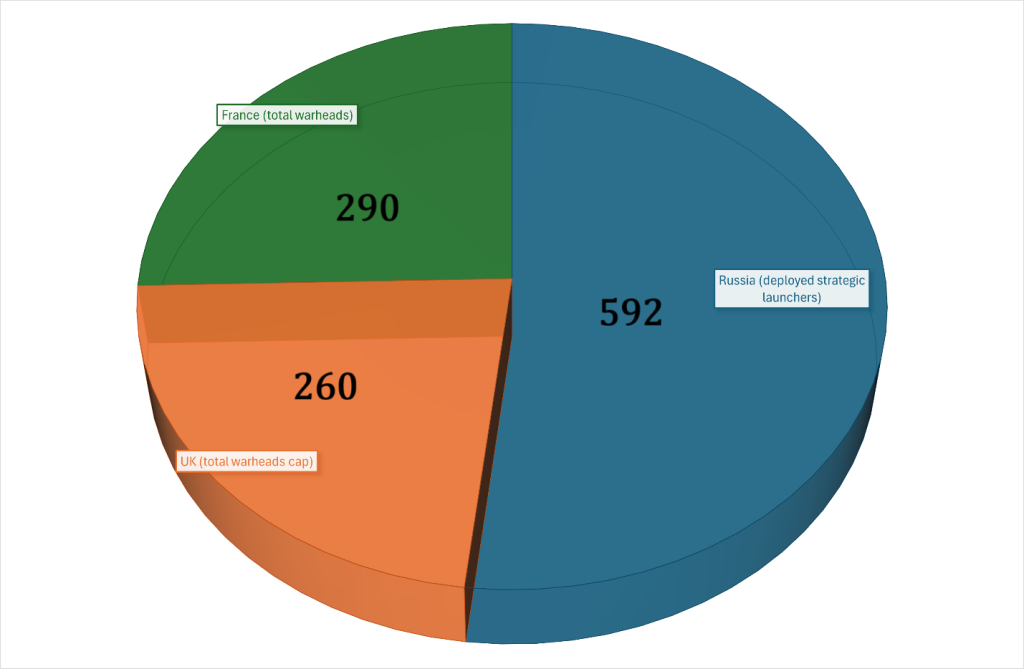
Adapted from the data: Kristensen, H. M., Korda, M., Johns, E., & Knight, M. (2025). Russian nuclear weapons, 2025. Bulletin of the Atomic Scientists, 81(3), p. 208–237. https://doi.org/10.1080/00963402.2025.2494386; Kristensen, H. M., Korda, M., Johns, E., & Knight-Boyle, M. (2025). French nuclear weapons, 2025 Bulletin of the Atomic Scientists, 81(4), 313–326. https://doi.org/10.1080/00963402.2025.2524251; Kristensen, H. M., Korda, M., Johns, E., & Knight, M. (2024). United Kingdom nuclear weapons, 2024 Bulletin of the Atomic Scientists, 80(6), 394–407. https://doi.org/10.1080/00963402.2024.2420550
Of course, comparing the total nuclear stockpile of these two countries with deployed strategic launchers in Russia only, especially given the geography and clear role for the Russian tactical nuclear weapons, can be considered a trick. Moreover, there are no doubts that no one will ever plan to use a single warhead per a single launcher. Nevertheless, this gives a good taste of the changed global and regional security dynamics.
The bottom line is that while Russia and the US remain the most capable nuclear weapon states, both quantitatively and qualitatively, China is rapidly bridging the gap[2], and other countries are becoming increasingly relevant. This is a combination of two trends: greater emphasis on nuclear deterrence and decades of Russian and US nuclear reductions.
Effects of Emerging and Disruptive Technologies
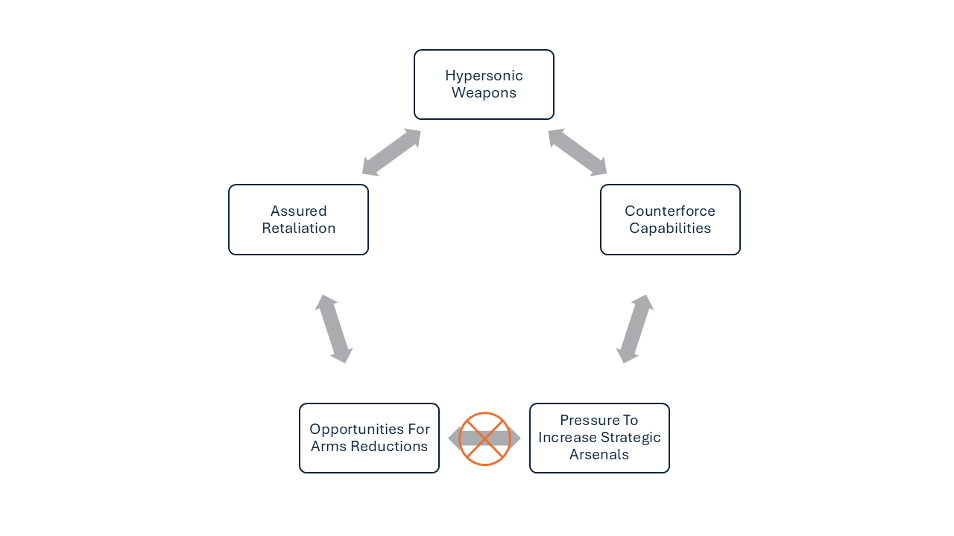
The rapid technological developments affecting nuclear and non-nuclear capabilities are a very important factor. For example, we can look at hypersonic missile technology, which, on the one hand, enhance counterforce capabilities, and thus, can degrade strategic stability and thus, instigate arms race.
But on the other hand, hypersonic weapons increase missile defense penetration and defeat capabilities, thus, enhancing the deterrent effects, and thus, enhancing strategic stability. Moreover, if hypersonic glide vehicles are considered a more reliable way to deliver nuclear warheads, it even might contribute to future reductions in the total numbers of nuclear weapons.
Another very important example is artificial intelligence (AI). A lot has been already said and written on the intersection of AI and nuclear (and especially on the challenges of the meaningful human control), of course, but sometimes it is important to try to simplify the landscape.
The most important effects are the following:
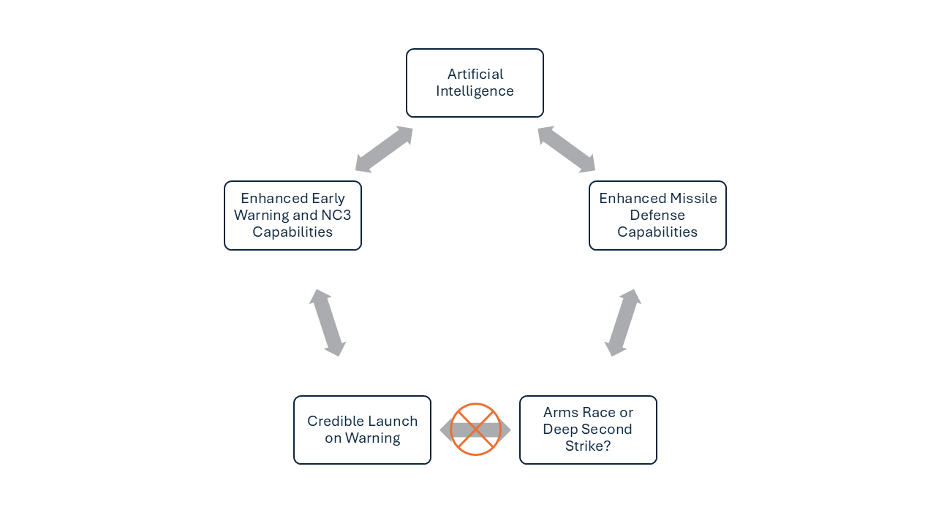
AI can enhance nuclear command, control and communications, again enhancing deterrent effects, making nuclear retaliation inevitable. However, AI can be used, and is already being used to enhance targeting, both for counterforce, or the so-called “left-of-launch” missile defense, and also for ‘traditional’ missile defense, helping to enhance recognition of decoys and performance of interceptors. At the same time, same technologies contribute to the reliability of early warning systems – again making the situation more stable.
As shown on the diagrams above, some of the effects of these two broad technological categories are mutually exclusive, and this is one of the major reasons for a concern. Without proper communications between major global powers, the destabilizing effects are more likely, than the stabilizing ones.
Emerging technologies make conventional weapons much more capable, and accessible. This means that more work needs to be done on the concept of non-nuclear deterrence itself[3], as currently it remains somewhat under researched, despite real cases of strategic non-nuclear operations in Europe and in the Middle East.
Advanced Strategic Non-nuclear Weapons and the Wars of the Future
As covered by the author in the 2024-2025 edition on the Security Index Yearbook[4], there are three main categories of strategic targets that can be destroyed by non-nuclear means (including but not limited to conventional missiles, drones and cyberattacks):
As of Autumn 2025, there is significant real-world evidence of such capabilities being used for precisely these tasks. There have been numerous attacks by Ukrainian drones against Russian heavy bombers and airbases, as well as Early Warning radars, not to mention critical infrastructure, and a massive Russian campaign against Ukrainian military industry, energy infrastructure (with a notable exception of nuclear powerplants) and even very specific operation against the solid fuel ballistic missile design and production facilities[5].
In the Middle East, Israel used drones and precision munitions, including air-launched ballistic missiles, in its effort to degrade Iranian nuclear and missile capabilities, with US joining the operation with strategic bombers hitting nuclear sites with conventional munitions[6]. In turn, Iran demonstrated capability to hit strategic targets (headquarters, refineries, airbases) in Israel and even US communications infrastructure in Qatar with conventional missiles[7].
This leads to several specific takeaways. First, dual-capable (nuclear and non-nuclear) weapons and platforms, especially in the form of heavy bombers, are quite usable, but also can become a liability and an escalation factor. Second, it is clear, that strategic targets can be hit by conventional weapons, although this would likely lead to disruption and degradation, as total destruction is relatively hard to achieve through non-nuclear mean and takes a lot of time and munitions. Third, nuclear weapons do not prevent conventional wars, not to mention armed conflicts on a smaller scale – but they never meant to. Fourth, there is no automation in escalation on the nuclear and non-nuclear “ladders”, or rather vortexes. So far use of force remains somewhat measured and gradual – which does not make it something good and positive, of course.
…Now about the recent military exercise. I would ask the Chief of the General Staff to report on one more event that I briefly mentioned in my opening remarks – namely, the test of the Burevestnik nuclear-powered unlimited-range cruise missile. I have received a report from the industry and I am aware of the assessments made by the Ministry of Defence – this is indeed a unique weapon that no other country possesses.
I clearly remember that when we announced the development of this weapon, even very high-level, top-class specialists told me the goal was worthy and respectable but unattainable in the near historical perspective. Once again – that was the view of those high-class experts. And now the decisive tests have been completed.
Vladimir Putin
President of Russia
Visit to the Joint Force command post
October 26, 2025
http://en.kremlin.ru/events/president/news/78301
Technological developments are a very important factor in these dynamics. We are rapidly approaching a reality where offensive and defensive capabilities and even the munitions themselves are interconnected, as well as means of intelligence, surveillance and reconnaissance and data analysis. Emerging technologies serve as a force multiplier, and as such are becoming a primary target for counter-attack – or even pre-emptive attacks. This calls for active international pursuit of risk reduction measures, but, unfortunately, such perspectives are rather distant.
Under such circumstances nuclear proliferation remains possible, especially given the fact that a lot of new technologies might help with design of nuclear weapons and even production of some of its parts through additive manufacturing, not to mention simulations – which can decrease the need for live nuclear testing both by future and by existing nuclear weapons possessors.
However, proliferation of conventional deep strike capabilities is of even greater concern.
The only way for reliable control of nuclear proliferation, as well as proliferation of advanced military technology, is to revitalize international cooperation. Unfortunately, under current circumstances counter-proliferation – actual military action against possible proliferators – is becoming a baseline option.
To conclude, as the conventional capabilities are growing and given the continuous rise of the global military spending[8], there are hardly any prospects for general disarmament. The link between conventional and nuclear capabilities is also clear. So, further implementation of the NPT Article 6, which provides for both nuclear and general disarmament, is getting extremely hard to achieve.
Any Future for Arms Control?
The future of global nuclear order is in the making right now. We still have the Nuclear Non-Proliferation Treaty and moratorium on nuclear testing, International Atomic Energy Agency and the Preparatory Commission for Comprehensive Nuclear-Test-Ban Treaty Organization International Monitoring System are operational, and there is a nuclear use taboo. However the pressure is high, and it is a task for everyone, including academic and expert communities, to support the existing and develop future arms control mechanisms that can be adapted to the existing and future challenges.
It is possible to start small, however, even such a simple thing and an easy win for everyone as a Russian post-INF moratorium initiative[9] failed[10]. Still, this does not mean that we should stop trying, and Russian side tries to come up with new measures. For instance, in September 2025 President Putin proposed unconditional extension of the New START limits on strategic offensive arms for at least a year after its expiration in February 2026[11]. Further extension is conditional depending on the actions of the United States, especially in the missile defense domain and their Golden Dome project.
Moreover, in October 2025 President Putin disclosed a somewhat broader understanding of the scope of the possible future arms control measures, should other nuclear weapon states be ready to engage in such discussions[12]. Those include ‘traditional’ strategic offensive arms as well as novel systems, INF-range weapons, multi-purpose nuclear-powered submarines, tactical nuclear weapons, nuclear arsenals of all nuclear weapon states.
The focus remains on preserving strategic parity between Russia and the United States, although it is also shifting from quantitative to qualitative dimension.
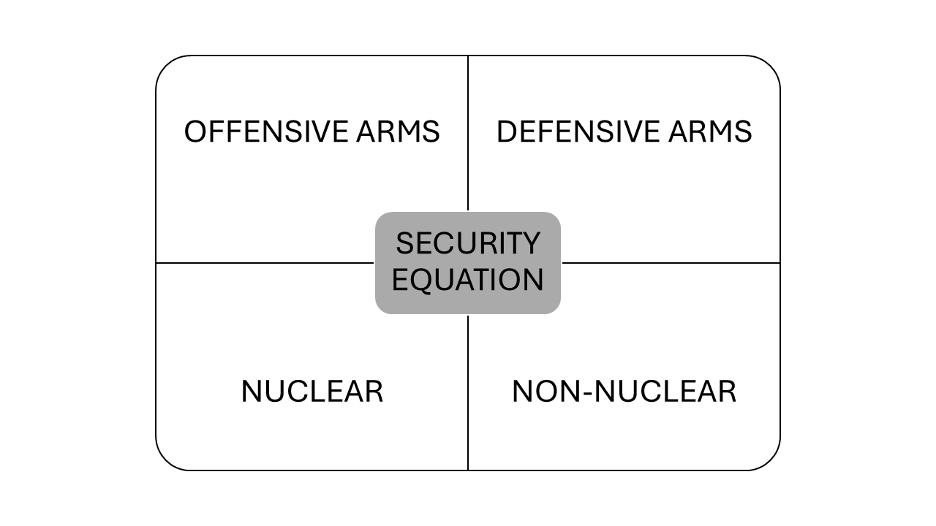
Russian idea of the security equation[13], which “should take into account all factors significant for strategic stability in a comprehensive manner”, “is not limited to nuclear weapons” and intended “to embrace the entire spectrum of both nuclear and non-nuclear offensive and defensive arms that are capable of resolving strategic tasks”, remains relevant and seems as a good foundation for future discussions and negotiations.
Major nuclear powers should and can come up with measures to stabilize their relations, based on the Joint Statement of the Leaders of the Five Nuclear-Weapons States[14] that the nuclear war cannot be won and should never be fought, and that any direct military confrontation between nuclear powers should be avoided. Unfortunately, a very real threat of such confrontations exists both in Europe and in Asia. The other documents can also be used as a basis for future joint arms control efforts, including but not limited to the Joint statement by the Russian Federation and the People’s Republic of China on Global Strategic Stability[15].
It is crucial to emphasize that the main “task” of strategic stability is to remove incentives for a first nuclear strike.As there is somewhat limited understanding of what can explicitly lead to a nuclear use by a nuclear power (and it is by design), and the escalation dynamics can’t be fully managed, the discussions should include prevention any direct armed conflict between nuclear superpowers – as specifically said in the statements mentioned above.
Possible “incentives for a first nuclear strike” are based on the possible offensive actions by the adversary that will degrade one’s arsenal, or the enhanced defensive capabilities of the adversary that are being developed in a way that can undermine your retaliatory strike capability, or both. The “incentives” will require several technological and operational steps, and very probably an ongoing military conflict.
Strategic stability and strategic deterrence are related. “Full-spectrum cross-domain” activities are meant to enhance strategic deterrence, where one tries to prevent a course of actions by the adversary that might lead to a conflict. However, the very same activities might be seen as destabilizing by the adversary, and, in turn, force him to pursue steps meant as a deterrence messaging, but perceived as threatening.
Thus, despite the intention to deter destabilizing actions, even more rapidly and dramatically destabilizing dynamics are possible. To counter this, strategic deterrence operations should include a very robust messaging (or even “interpreting”) element, and extra steps must be taken to ensure that the message is received and understood. The idea that a limited use of nuclear weapons can help to restore deterrence is a terminal stage of the flawed logic in this case.
Arms control can help to prevent an indefinite action-reaction spiral that by default leads to arms race and escalation. Transparency, limits and reductions are as good an instrument for national security as hard military power, however, it is rarely acknowledged. There is no lack of arguing for strategically stable balance achieved by extreme ambiguity and huge arsenals, but such stabilization will hardly survive for a prolonged period, especially in a situation with numerous actors and numerous domains are involved in the confrontation. The world is an increasingly dangerous place, with technological advancements and political turmoil making use of force a more frequent option. Nuclear and advanced conventional weapons are a crucial piece on the puzzle of international military-political relations; however, the puzzle itself can hardly be solved in the short-term. Still, the academic and expert community should continue to diagnose the current illnesses and pursue stable long-term solutions.
[1] The Strategic Defence Review 2025 // the UK Government. June 2, 2025. URL: https://www.gov.uk/government/publications/the-strategic-defence-review-2025-making-britain-safer-secure-at-home-strong-abroad; National Strategic Review 2025 // Secretariat-General for National Defence and Security. URL: https://www.sgdsn.gouv.fr/files/files/Publications/20250713_NP_SGDSN_RNS2025_EN_0.pdf; Northwood Declaration (UK-France joint nuclear statement) // the UK Government, July 10, 2025. 10.07.2025. URL: https://www.gov.uk/government/news/northwood-declaration-10-july-2025-uk-france-joint-nuclear-statement
[2] Kashin V. The Policy of the People’s Republic of China on the Construction of the Military Component of the Strategic Deterrence System in 2020s. World Economy and International Relations Journal, 2023, vol. 67, №11, pp. 99-111. https://doi.org/10.20542/0131-2227-2023-67-11-99-111 EDN: DGJQQX
[3] Yermakov A., Stefanovich D. Is Non-Nuclear Deterrence Possible? // Russian International Affairs Council. June 30, 2020. URL: https://russiancouncil.ru/en/analytics-and-comments/analytics/is-non-nuclear-deterrence-possible/
[4] Stefanovich, D., Chapter 5. Assessing Development of New Types of Conventional Weapons. Security Index Yearbook, Vol. 1 (2024-2025) // PIR Center, 2024. URL: https://pircenter.org/en/editions/security-index-yearbook-chapter-5-assessing-development-of-new-types-of-conventional-weapons/
[5] Russia derails Ukraine’s Western-backed missile program – FSB (VIDEO) // Russia Today. August 14, 2025. URL: https://www.rt.com/russia/622868-russia-derails-ukraine-missile-program/
[6] Gordon, C. ‘15 Years of Incredible Work’: The Inside Story of the Mission to Bomb Iran’s Nuclear Sites // Air&Space Forces Magazine. June 26, 2025. URL: https://www.airandspaceforces.com/inside-story-b-2-mission-bomb-iran-nuclear-sites/
[7] Greet K., Iranian Attack Destroyed U.S. Satellite Communications Dish at Al Udeid Air Base // The Aviationist. July 15, 2025. URL: https://theaviationist.com/2025/07/15/iranian-attack-destroyed-satcom/
[8] Unprecedented rise in global military expenditure as European and Middle East spending surges // SIPRI. April 28, 2025. URL: https://www.sipri.org/media/press-release/2025/unprecedented-rise-global-military-expenditure-european-and-middle-east-spending-surges
[9] Statement by Vladimir Putin on additional steps to de-escalate the situation in Europe after the termination of the Intermediate-Range Nuclear Forces Treaty (INF Treaty) // President of Russia. October 26, 2020. URL: http://en.kremlin.ru/events/president/news/64270
[10] Statement by the Ministry of Foreign Affairs of the Russian Federation on the moratorium on the deployment of ground-launched intermediate-range and shorter-range missiles // MFA of the Russian Federation. August 4, 2025. URL: https://mid.ru/ru/press_service/spokesman/official_statement/2039749/?lang=en
[11] Meeting with permanent members of the Security Council // President of Russia. September 22, 2025. URL: http://en.kremlin.ru/events/security-council/78051
[12] Valdai Discussion Club meeting // President of Russia. October 2, 2025. URL: http://en.kremlin.ru/events/president/news/78134
[13] Deputy Foreign Minister Sergey Ryabkov’s opening remarks at a briefing at the Rossiya Segodnya International Information Agency on arms control and strategic stability // MFA of the Russian Federation. February 11, 2021. URL: https://www.mid.ru/en/foreign_policy/news/1415641/
[14] Joint Statement of the Leaders of the Five Nuclear-Weapons States on Preventing Nuclear War and Avoiding Arms Races // President of Russia. January 3, 2022. URL: http://en.kremlin.ru/events/president/news/67551
[15] Joint statement by the Russian Federation and the People’s Republic of China on Global Strategic Stability // President of Russia. May 8, 2025. URL: http://en.kremlin.ru/supplement/6310
