
CHAPTER 29. TIMES WE DO NOT CHOOSE: LEADING POWERS, INTENSE RIVALRIES AND GLOBAL SECURITY LANDSCAPE


The last decade witnessed major shifts in international politics that undermined preceding expectations regarding global security landscape. The scope of these changes questions our ability to predict major strategic trends. It reinforces skepticism regarding predictability in international politics[1]. Nevertheless, closer examination of this record provides valuable lessons, incentivizing better forecasting in this field. Through careful exploration of the past, one can learn that future is never just a repetition of the present.
After the Cold War, scholars and pundits professed the demise of great power politics and interstate conflicts. Despite recuring quarrels on various issues between national capitals, academic debates and official security documents treated major wars as largely obsolete due to the rise of globalization[2]. Instead, they cautioned against the risks caused by transnational spillovers from areas with weak and limited statehood[3]. They brought to the forefront threats arising from terrorist activity, migration flows and proliferation of radical ideologies. Concerns regarding the roots of these dangers drew attention to the economic and social hardships in the least fortunate countries. They resulted in securitization of poverty, hunger and deprivation as underlining causes of transnational threats[4].
Climate change emerged as another source of insecurity that diverted international agenda away from military threats. Its positioning as a global challenge incentivized adoption of the discourse of shared responsibility. Nevertheless, states immediately engaged in intense haggling over burden-sharing when faced with the calls to address it. Moreover, efforts in climate change mitigation and adaptation were used as sources of competitive advantage in international politics.
None of these issues disappeared by the mid-2020s and in some areas the situation only deteriorated throughout the first quarter of the 21st century. However, their role in international security debates significantly diminished. Concerns over interstate competition and prospects of major wars reemerged. Their shadow subdued other challenges even for those states that remain on the sidelines of the rising tension.
These transitions alert against treating security as a stable category, demonstrating its evolving meanings due to the shifts in perceptions of relevant international actors[5]. They also caution against extrapolation of current trends. Things that seemed unthinkable at one point become imminent relatively shortly in historical terms. Overall, observed failures in forecasting security agendas draw attention to the importance of structural context in which states identify threats for themselves and seek remedies against them.
This chapter strives to examine potential developments in international security landscape by the early 2030s building upon long-term historical patterns in this area and predominant explanations of interstate relations. It claims that intense rivalries between leading powers are likely to continue in mid-term, increasing probability of major wars. However, such confrontations will hardly reach the magnitude of general collision similar to the First or the Second World War. The sequence of wars in the mid-19th serves as a more probable analogy for comparison.
The next two sections establish theoretical and historical foundations for forecasting international security. The first of those explain patterns of transition between periods of relative interstate clam and intense rivalries between leading powers. The second, explores specific reasons that trigger major wars as the most consequential form of confrontation. Then, I examine the state of international politics in the mid-2020s, establishing a clear reference for forecasting. The following section outlines general scenarios for the evolution of global security landscape by early 2030s. The chapter concludes with discussion of specific contingencies threatening the prospects of a major war within the established timeframe.
Patterns of Change in Security Landscape
Oscillation between relative calm in interstate relations and intense rivalries, similar to the one we observed in the last three and a half decades, is not atypical throughout history. It fosters recurring cycles in international politics, which provide a rough clue for forecasting changes and continuities in security landscape, even if it does not allow specific predictions regarding individual events. Their repetition is due to the fact that each of the two phases establishes prerequisites for the other.
Periods of forceful confrontation usually correspond to drastic changes in material capabilities among leading powers. These shifts are painful for previously dominant states that face decline in their international standing. They often seek to arrest this worrisome trend by undermining the rise of potential competitors. Such attempts provoke rebuttal from the latter, launching spirals of escalation. This dynamic creates a precondition for major wars that involve two or more leading powers and reshape international orders[6].
However, competition between leading powers is enormously exhaustive. It weakens not only the vanquished, but also the vanquisher[7]. Their mutual attrition paves the way for extended rapprochement. As states face threats not only from foreign foes, but also from domestic fractures and social discontent, they tame their international designs and settle differences, in order to address challenges from within. Due to the popular pressures internal development can elevate to the status of the highest security priority. This shift of attention reinforces general peace in international system.
In cases of less exhaustive states the demise in interstate competition fosters excessive security establishments to seek justification for their preservation. It often incentivizes inflation of threats through raising concerns regarding distant and non-existential challenges and leads to increasing voluntarism in foreign policies. Expanding ambitions of these powers aggravate others, preparing grounds for acute disagreements. As aspirations of states broaden, the chances that they will run into interests of their peers increase.
Such disputes reemerge at the forefront as the exhaustion from preceding struggle between leading powers subsides. Those states that spent periods of relative calm to put their house in order emerge reinforced. Meanwhile, leading powers that waste permissive conditions of general peace on pursuing excessive ambitions decline. Previously noted redistribution of material capabilities emerges from this dynamic. Similarly, as intense rivalries establish preconditions for détentes, long peace supplies fuel for subsequent struggles.
This dynamic is likely to continue into the future as long as states persist as the main form of political organization of human beings and their policies continue to be motivated by distributive concerns. Under these circumstances even anxiety over common threats falls into shadow of insecurity caused by interstate jealousy. Illustratively, COVID pandemics, allegedly endangering humanity as a species in 2020, did not foster general rapprochement across national boundaries rather provided fuel for mutual suspicions and accusations.
Henceforth, it was naive to treat relief from great power rivalries after the demise of the bipolar confrontation as the “end of history” and prologue for perpetual peace. Instead, it followed the established historical pattern. The one that manifested itself, for example, when Napoleonic wars set the stage for the tranquility of the European concert. The latter prepared hostilities among leading powers from 1850s to early 1870s, which in its turn produced renewed equilibrium that survived until the First World War. Its destructiveness allowed the twenty-year interbellum followed by another global collision.
The one exception from these cycles was the Cold War, which started immediately after the most destructive military conflict in human history. Exhaustion from the Second World War did not prevent transition of the Soviet Union and the US from allies under anti-Hitler coalition into bitter opponents. However, memories from recent past played important role in discouraging direct clash between them. Leadership on both sides stayed immensely cautious, due to vivid personal recollections regarding the preceding conflict.
Their success in managing competition also proceeded from mutual insulation of the two superpowers, which limited the list of items to fight for. Unlike many other leading powers throughout preceding historical periods, they did not have extensive border, nor engaged in high volumes of trade. Thanks to the clear-cut division of Europe, which was the most valued prize for both, the Soviet Union and the United States restricted their struggle largely to areas where they had limited stakes. This diminished the chances for escalation of their confrontation into a major hot war.
However, relative peacefulness of that period elevates the dangers in the subsequent cycle of intense rivalries. The one that we are today. Assessment of the patterns of security competition between leading powers through the lenses of the Cold War provides a misleading sense of comfort. The temptation of drawing direct analogies should be weighed against the record of other historical periods, which did not happen to be so lucky in averting major wars.
Causes Behind Major Wars
The record of preceding centuries proves that intense rivalries often lead to major wars. The record of the Cold War demonstrates that confrontation between leading powers even if it sets preconditions does not make such wars imminent. Henceforth, the question of what does trigger such collusions is extremely important due to their gravity in international politics. It also needs to be accompanied by examination of reasons why certain states manage to stay out of these hostilities.
Historical textbooks somewhat disturb our view on international politics as they allocate such a large word count on armed conflicts. Meanwhile, they statistically speaking comprise rare events[8]. In other words, the number of armed conflicts that happen is small relative to the universe of potential cases in which they could have happened. In most instances states manage to settle their differences without direct resort to force, even if this eventuality always menaces over their calculations.
In its turn, major wars amount to only a small portion of all militarized interstate disputes. They constitute collisions that involve two or more leading powers in a direct armed struggle. Given their tremendous capabilities, these states face enormous devastation in a war with each other[9]. Therefore, occasional accidents or individual idiosyncrasies are insufficient to trigger them. Leading powers engage in major wars only under narrow circumstances. Students of international politics suggest three types of scenarios that can lead to them.
Some observers associate war initiation with opportunistic optimism, when states believe that winning is cheap and easy[10]. This presumption is intuitively appealing, and it is valid for asymmetric wars between states significantly disparate in their capabilities. Even in these instances there is a large room for miscalculation. Meanwhile, the outcome of a war between peers is uncertain by definition, while fighting is tremendously demanding in finance, blood and political capital. Henceforth, major wars rarely proceed from optimistic delusions regarding certain triumphs.
Similarly, these conflicts cannot be explained by domestic reasons emphasized by proponents of the diversionary theory of war[11]. This explanation claims that elites facing stiff internal dissent engage in militarized disputes to prolong their rule. It appeals to rally around the flag effect which envisages that struggle against external enemies solidifies popular support of national governments. Nevertheless, this explanation neglects that in such a scheme political leaders relinquish control over their fates to generals. In other words, it presumes that to stay in power, they are eager to effectively give it up.
Historical record demonstrates that general public is often more hardline in times of an acute crisis, whereas political leaders remain cautious. Although short victorious wars boost popularity of governments, collisions between leading powers rarely follow such script. Instead, they frequently pave way for political revolutions. Elected governments routinely face defeat in the ensuing polls after military victories[12]. Thus, initiating a war against another leading power for addressing difficulties at home is both an overkill and an unjustifiable gamble.
This leads to the ultimate explanation of rationales behind major wars. It focuses on pessimistic anxiety about deteriorating strategic environment and frantic efforts to prevent further worsening of one’s international standing[13]. In other words, this explanation relies on presumption that fear rather than greed is the primary motivation in confrontation among peers. This explanation claims that states that initiate a conflict do not expect imminent success, but anticipate that avoiding it would benefit their opponents.
Preventive argument becomes especially tempting if states believe that some form of collision is anyway inevitable. This conviction strengthens as tensions build up through prolonged periods of brinkmanship. Under increasing desperation states tend to fear losses from inaction more than losses from the collision. Initiating a war in this context comprises an attempt to take fate in one’s own hands rather than passively observing daunting dynamics.
Preventive logic seems counterintuitive as it envisages that states launch hostilities even when they do not expect to win a war. However, it fits findings in cognitive psychology portraying humans as largely conservative and risk-averse, but also extremely concerned regarding preservation of their previous possessions and standings[14]. It also outcompetes opportunistic and diversionary explanations in matching historical record packed with hasty instances of war initiation.
For example, in 1812 Napoleon invaded Russia despite unresolved guerrilla in Spain. If he had not believed that the window of opportunities was closing, it would have been more reasonable for him to finish off the rebellion before taking on a new opponent. However, he believed that France was running out of clock before Tsar Alexander I acquires preeminent military force through aligning with Britain. Similarly, Germany launched an all-European war in 1914, although it acknowledged deficiencies in its infamous Schlieffen plan, as it feared that in a next couple of years Russo-French alliance would become overwhelmingly strong[15].
These examples draw attention to one additional factor which is sometimes omitted from debates on war-initiation and that is alliances. History knows multiple instances of major wars between just two leading powers. For example, neither Austro-Prussian war of 1866, nor Franco-Prussia war of 1870 escalated to the struggle between all European monarchs. However, the conflicts started in 1914 and 1937/1939[16] expanded into the general collisions of global scale. This brings to the attention variability in geographic scope of conflicts that requires explanation.
The same destructiveness of major wars that undermines opportunistic logic of their initiation creates powerful incentives to stay out from the fight for states that do not have immediate bets in the dispute that fostered hostilities in the first place. They can even hope to benefit from exhaustion of those leading powers engaged in struggles while they continue to focus on internal development. This strategy is well known in international relations literature as buck-passing[17].
If one of the sides in a major war acquires an upper hand, it often incentivizes those sitting on the fence to join it to acquire a share in the potential spoils. By its nature, this bandwagoning usually does not produce significant effect on the outcome of the conflict and it is usually confined to smaller states. In a most astonishing example of such opportunistic wickedness Saxony and Württemberg switched sides right in the middle of the Battle of the Nations in 1813, abandoning Napoleon for the winning coalition led by Russia.
However, security interests of states in many instances become interrelated. Given, insufficiency of their own capabilities to resist overwhelming threats they come into alignment with other like-minded powers. Under these circumstances, exhaustion of a formal or informal ally leaves states relying on it severely exposed in protecting their own interests. This concern can stimulate them to enter the war to reverse its course, even if they do not have substantial stake in it[18].
Moreover, it can also tempt weaker states to provoke a conflict against a stronger foe so as to ensure entanglement of allied leading power on their side. As the latter cannot except their defeat for practical or reputational reasons, it faces a stark choice to join the fighting it did not intend to happen in the first place or to suffer a strategic loss in a conflict it did not take part in. Therefore, not only expansion of wars beyond their initial scope, but even their initiation partly depends upon the interconnectedness of security commitments in international politics at a given time.
Henceforth, in assessing probabilities of collisions among leading powers in the forthcoming years it becomes more important to examine their anxieties rather than ambitions. It also means that major wars can happen when neither side has clear edge nor feel prepared for them. This could make their policies seem irrational for observers, that compare outcomes of these clashes with a status quo ante. Meanwhile, states in taking decisions consider not so much their actual positions but expectations about possible futures. The correctness of their calculations can only be assessed against counterfactuals that did not materialize.
The World We Live in
Before examining possible scenarios, one needs to diagnose the current state of international politics, considering key variables that predefine patterns of competition and alignment in the world. The change in global security agenda over the last decade followed significant structural shifts. They fostered intense interstate rivalries but also imposed limitations on their extent.
The dominant trend that has defined transformation of a global security landscape in the last decade has been redistribution of material capabilities from the Western states to the rising powers. It remains a long-term process, which proceeds gradually and unevenly. Therefore, the West and especially the US retain significant leverage on the world stage. This is especially evident in military expenditures, as Washington continues to spend more than the next nine largest powers combinedly. However, the shift in capabilities is consistent through time and proceeds in parallel across various domains.
| 2009 | 2014 | 2019 | 2024 | |
| G7 | 52.0% | 45.3% | 45.1% | 44.3% |
| incl.: | ||||
| France | 4.4% | 3.6% | 3.1% | 2.8% |
| Germany | 5.7% | 4.9% | 4.5% | 4.2% |
| Japan | 8.7% | 6.1% | 5.8% | 3.6% |
| United Kingdom | 4.0% | 3.8% | 3.2% | 3.3% |
| United States | 23.8% | 21.9% | 24.3% | 26.2% |
| BRICS* | 15.5% | 21.9% | 24.1% | 25.8%* |
| incl.: | ||||
| China | 8.5% | 13.3% | 16.5% | 16.8% |
| India | 2.2% | 2.5% | 3.2% | 3.5% |
| Russia | 2.0% | 2.6% | 1.9% | 2.0% |
As a result of the ongoing redistribution, four main players stand out as the leading powers given a combination of their capabilities and eagerness to pursue proactive strategies of global scale. These are Russia, China, India and the US. The EU has material prerequisites to join this club but lacks internal coherence to do so. Its external activities largely serve internal struggle between supranational authorities and national elites for political control over the integration entity.
Meanwhile, multiple other non-Western states become increasingly capable of projecting their interests beyond tight regional boundaries. The list includes countries, such as Brazil, Indonesia, Iran, Saudi Arabia, South Africa, Turkey and the UAE. Their renewed strength enables them to acquire greater influence on global stage through introduction of creative strategies and use of multilateral fora.
Back in 2007 at Munich Security Conference Russian President Vladimir Putin envisaged that rising centers of wealth would inevitably claim greater role in international politics[19]. By mid-2020s his prediction materialized. In line with the patterns discussed in previous sections, the West becomes increasingly desperate in attempts to arrest a shift towards multipolarity. It uses whole arsenal of measures including diplomatic stigmatization, economic coercion, military brinkmanship and proxy wars. Its assertive policies aggravated tensions with several non-Western powers, in particular, Russia and China.
| 2009 | 2014 | 2019 | 2024 | |
| G7 | 64.9% | 55.9% | 54.0% | 49.3% |
| incl.: | ||||
| France | 2.8% | 2.6% | 2.6% | 2.4% |
| Germany | 2.4% | 2.3% | 2.6% | 3.2% |
| Japan | 1.9% | 2.0% | 2.0% | 2.2% |
| United Kingdom | 3.8% | 3.4% | 3.1% | 2.9% |
| United States | 51.1% | 43.2% | 41.2% | 36.2% |
| BRICS* | 13.1% | 17.7% | 19.8% | 21.9%* |
| incl.: | ||||
| China | 6.5% | 9.6% | 11.7% | 11.9% |
| India | 2.8% | 3.0% | 3.6% | 3.1% |
| Russia | 2.5% | 3.6% | 3.1% | 5.6% |
Nevertheless, the two categories are not politically homogenous nor monolithic. The West experiences heated haggling over burden sharing. The US and its allies, especially in Europe, demonstrate increasing divergence in threat perception. Meanwhile, rising powers, due to their growing foreign policy ambitions, inevitably enter disputes not only with the West, but also with each other. Border differences between China and India is the case in point. Therefore, states do not split into clearly demarcated polarizing blocks rather they retain flexibility in their alignments.
Two additional factors affect the global security landscape apart from redistribution of capabilities. These are the high levels of economic interdependence between states and domestic dissatisfaction within them. They modify patterns of competition and cooperation on international arena by influencing the scope of national interests and ability of leading powers to compete. However, their impact remains largely misunderstood by mainstream followers of outdated theories.
The advancement of globalization brought states in dense interconnection. Although the share of trade relative to GDP stopped growing from the late 2000s and even experienced temporal declines during Global Recession and COVID pandemics, it remains significant by historical measures (see, Figure 91). Moreover, one should consider the quality and not only quantity of interdependence, as transnational supply chains retain dominance in global production.
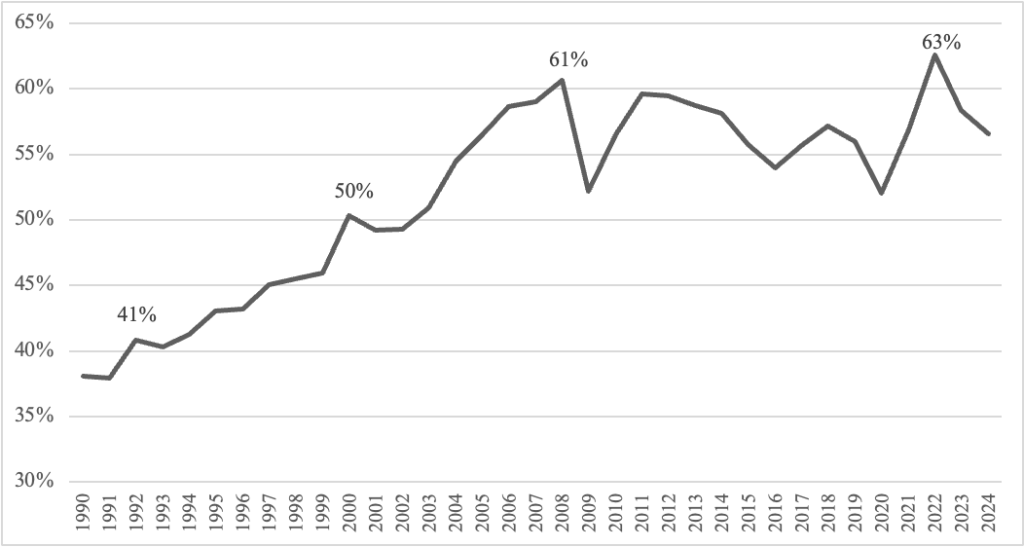
For more than a century liberal theorists and ideologues alike professed that commercial interdependence tames political rivalries between states as it elevates the price of confrontation for them[20]. However, these claims fail to recognize that it also increases reliance of states on common regulation of economic exchanges. As the latter are never politically neutral and benefit some more than others, disagreements over these rules produce sources for friction. As a result, anxiety over access to foreign markets and suppliers add up to hostilities.
Moreover, interdependence produces non-linear consequences for economic coercion. While it augments the price of disruption in trade and investment, it also puts in place robust networks of connections via third parties that help bypass punitive measures introduced by some states against the others. The futility of economic coercion induces states to transition to other forms of pressure, including military ones. Therefore, commercial interdependence discourages escalation of tensions over trivial matters but stiffens struggle over the core ones.
Apart from increasingly competitive international environment, states also face significant challenges from within. Symptomatically, the number of internal armed conflicts (both internationalized and purely domestic) in the last 25 years dwarfed in comparison the number of collisions between states. The gap between them surged in the mid-2010s, reaching record levels by 2023–2024. Although external meddling sometimes plays a role in internal destabilization, the rise of the latter discloses the fragility of states from within.
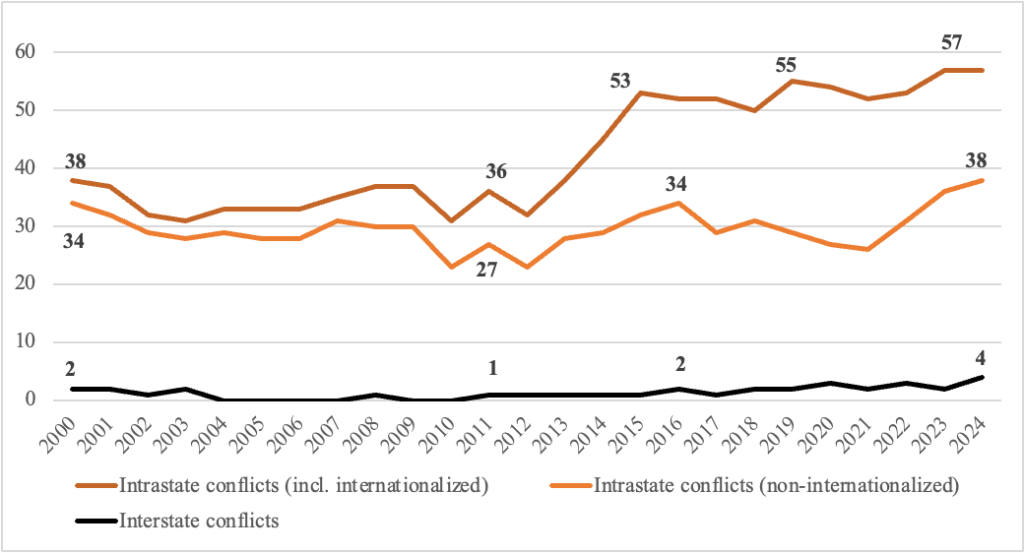
One of the previous sections examined limitations on attempts to divert attention from social grievance through assertive foreign policy. Internal fractures incentivize states to focus on domestic stability at the expense of their ability to compete internationally[21]. Although it does not prevent them from engaging in confrontation completely, it puts limits on the resources available for them, for example, restraining the extent of military establishments. Domestic concerns also precaution states from logrolling into solid coalitions which provide extensive guarantees of mutual assistance.
In sum, international politics appears to be increasingly contentious due to the growing differences within an increasing pool of states. They even instrumentalize non-state actors and transnational flows in their rivalries, despite previous claims that the latter threaten to degrade sovereign authorities and the leverage of leading powers. However, the very multiplicity of the sources of insecurity slackens the division of states in consolidated alliances and therefore partly ameliorates the intensity of confrontation.
Quo Vadis: Scenarios for Global Development
Patterns identified in previous sections along with the diagnosis of the current situation provide foundations for tentative conclusions regarding possible developments in international security environment by early 2030s. Given probabilistic nature of regularities in politics, it is preferrable to organize them into alternative scenarios to account for remaining uncertainties.
The ongoing trends create clear prerequisites for further rise of international rivalries, including the very confrontation between leading powers, which previously led to major wars. However, no tendency continues endlessly rather reaching a breaking point at a certain historical moment. Therefore, the first question of the day which will shape the scope of potential scenarios is to explore to what extent the preceding developments will continue, or will we transition to a different phase in a cycle of rivalries and rapprochements.
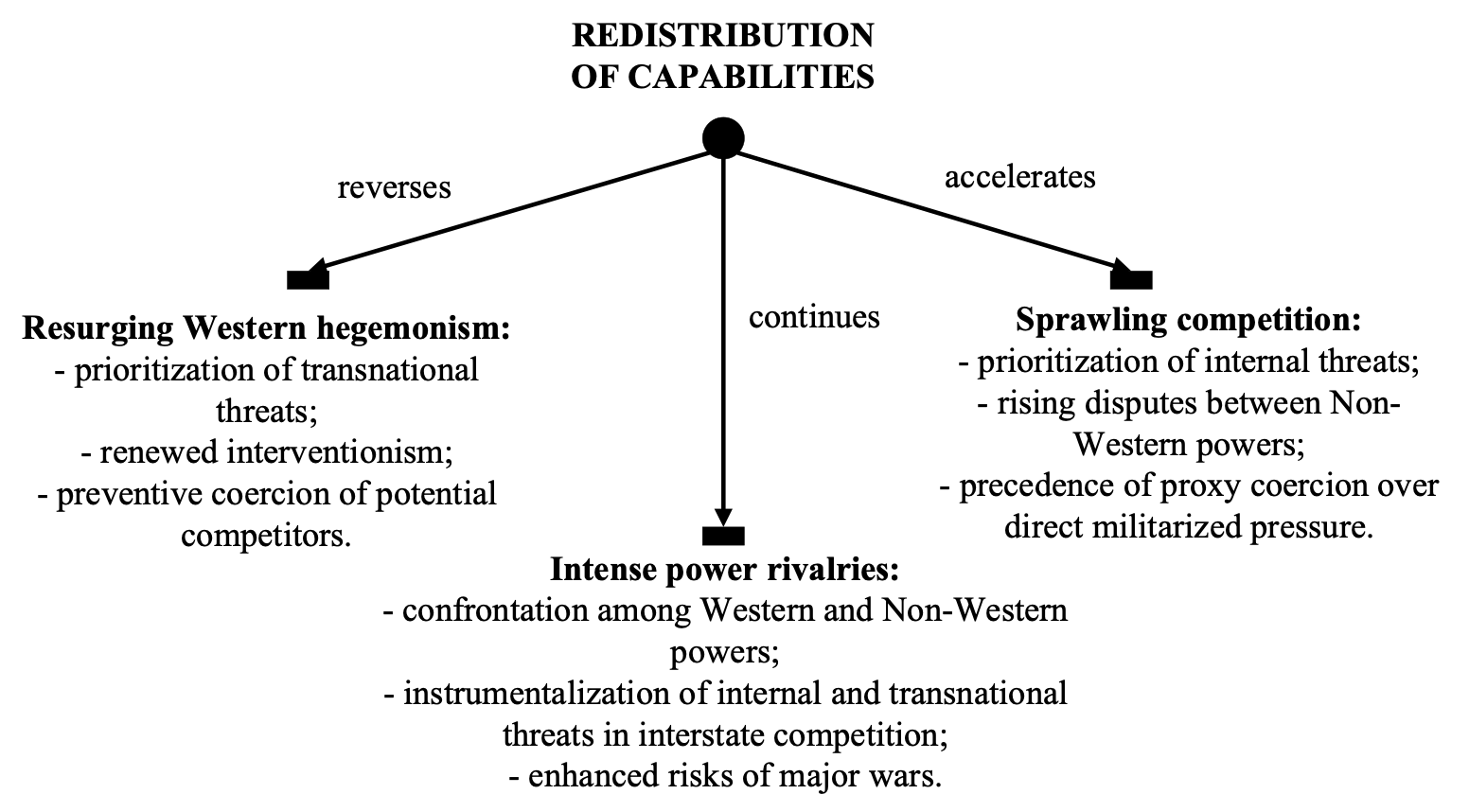
As intense rivalries are largely a product of redistribution of capabilities, arrest of the latter would reduce strains in international politics. Some Western authors entertain this scenario, claiming that it would lead to reestablishment of the US predominant position in international politics[22]. One should note that none of the American leaders, including Donald Trump, abandoned this goal. Building upon the record of previous decades even if it reduces the chances of a major war, this resurgence will foster the return of Western interventionism and harassment of dissenting states (similar to the one from 1990s to early 2010s).
Moreover, the US can emerge from the reversal of the power transition more revengeful and uncompromising than before. Washington would draw from history a lesson that it was too complicit and not enough ruthless after the collapse of the Soviet Union allowing peer competitors to resurface. It would be tempting for Washington to contrast Russia and China after the Cold War with Germany and Japan eliminated for good from the ranks of leading powers after the Second World War through prolonged occupation and intrusive external controls.
However, this instinct will compete with the task of policing areas of fragile statehood. The spillover of transnational threats would once again rise on the Western agenda due to the increased sensitivity to losses. Slowing in redistribution of capabilities would mean decrease in economic growth across non-Western world, which would make it more susceptible to extremist ideologies and terrorism. Lack of progress in fighting against deprivation would stimulate further rise in migration flows.
Due to the important role of the Chinese rise in redistribution of capabilities through previous years, its recent deceleration serves as a prescript towards this scenario. Economic growth in China slowed from around 10% fifteen years ago to roughly 5%. The rapid ageing of the Chinese population puts a hefty demographic cap on its potential revival. Notwithstanding these difficulties, Beijing’s rise will likely continue way into the 2030s due to the acquired inertia. Moreover, other non-Western states, primarily India, would be eager to replace Beijing as locomotives of power transition.
On the other hand, the US faces its own challenges, including eroding industrial base, accumulating debt and fierce internal political struggles, which provoke speculations regarding forthcoming American collapse. Washington’s allies, such as the EU, Japan and UK are in an even more precarious position. They play less of a role in maintaining global standing of the West, with the US remaining its ultimate champion. Therefore, acceleration of the American decline would have a paramount effect on a global balance.
For the first time in the last 500 years, it would produce a world in which all leading powers are non-Western. The main source of insecurity in this scenario would be renewed competition between them. As overarching concerns over American hegemonism obscure their dormant disagreements, the latter would remerge once the former subside. In other words, definitive US decline would not prevent further redistribution of power within the non-West, which in its turn would keep relations tenuous.
At least in mid-term perspective, rivalries in this scenario will likely remain less hostile than the current ones with the destabilization fostered by anxiety of Western powers. Non-Western powers will first focus on exploiting opportunities of American retrenchment. Moreover, their recent record of economic rise will leave them more satisfied and optimistic relative to the US and its allies that experience long-term decline. Finally, they boast an advantage of being less obsessed with ideological proselytism unlike the West, which cannot view its liberal model as anything but universal.
However, the chances that the US will repeat the fate of the Soviet Union by the 2030s are limited. The American economy retains strong competitive advantages in cutting technological fields, its population continues to grow, and its currency preserves central position in world finance. Despite political fractures, Washington pursues rather coherent policy on global arena. Therefore, the baseline scenario envisages that the American might will degrade but not disappear.
Therefore, redistribution of capabilities from the West to the rest is likely to continue incrementally even if progressively. This dynamic will provide strong preconditions for prolongation and aggravation of rivalries, providing fruitful grounds for interstate conflicts, including major wars. Short of those, it will envisage instrumentalization of all sources of leverage to acquire an edge in confrontation between leading powers.
As the previous section demonstrated economic interdependence and domestic dissatisfaction serve as the two key modifiers on interstate confrontation. Therefore, developments in these two areas can either reinforce or tame global insecurity in the forthcoming years, especially under conditions of continued or accelerated redistribution of capabilities among leading powers.
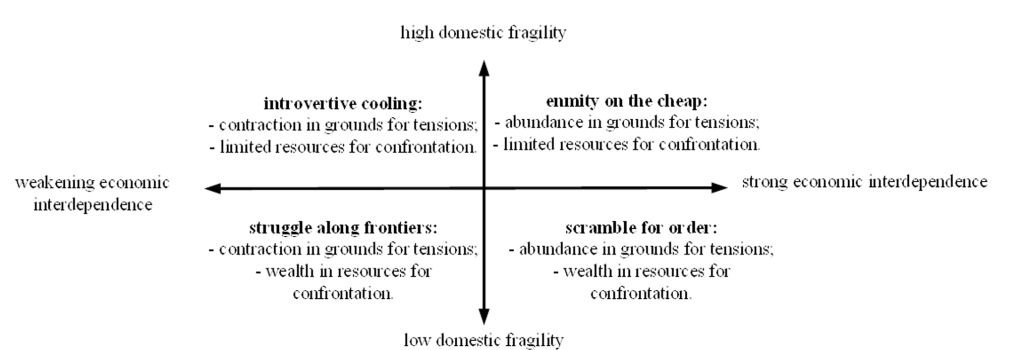
Weakening economic interdependence would have a moderating effect on confrontation between leading powers by reducing their dependence on global markets. It seems likely development in the context of growing rivalries as states turn towards protectionism and import substitution. However, they can appear incapable of significantly reducing the ties of globalization due to the complexity of the modern forms of production and finance. Then, they would live with acute concerns regarding the rules in global economy, which would predetermine their wealth. The latter alternative is more probable in the timeframe till 2030s.
As for the prospects of internal fractures, they can further deteriorate given disruptive consequences of growth in technological innovations. Advancement in AI, automation and robotics foster social upheavals that consume substantial portion of national resources and attention of governments. Continuation of these tendencies would weaken power base of states to compete on international arena. Nevertheless, if such technological innovations bring an age of unprecedented wealth as some optimists suggest, it will provide additional resources for states to fight for their ambitions. So far this level of plentifulness seems remote.
As a result, the combination of two intervening variables produces four potential outcomes. The most probable one is enmity on the cheap where strong economic interdependence provides major grounds for confrontation between states but concerns over domestic fragility restrict their capacity. This outcome will nudge leading powers to apply creative ways to undermine opponents, including through meddling in their affairs or using proxies, but restrict exposure to military collisions. However, it does not fully preclude armed conflicts over core interests, especially, in instances of miscalculations.
Somewhat less likely is scramble for order outcome in which decrease in internal fragility enables states to compete more severely over the shape of common regulations and global markets. This is the most dangerous prospect in terms of potential grounds for major wars. It even provides incentives for logrolling of hostilities into a general clash, encompassing all or most of leading powers, similar to the First and Second World Wars.
The third most likely outcome is introvertive cooling when decrease in economic interdependence diminishes the need to fight over global matters, while heated internal fractures demand states to focus on their domestic business. These dynamics create the strongest headwinds against confrontation even in the context of major redistribution of capabilities. Therefore, it envisages somewhat less perilous circumstances than the other three combinations. This outcome introduces the most fertile preconditions for general peace under deglobalization.
Finally, the combination of weakening economic interdependence along with greater stability at home would provide grounds for prioritization of rivalries over local matters even if there is less risk of collision over global regulations or trade flows. In this outcome confrontation would most resemble historical patterns of hostilities over territories and boundaries, therefore it bears the name of struggle along frontiers. It is the least probable in the medium term.
Although high levels of domestic fragility will likely preserve certain pushback against intensification of interstate struggles in a foreseeable future, it is not clear to what extent it will be able to compensate the aggravating effects of redistribution of capabilities along with the remaining controversies over global regulations of economic interdependence. Therefore, it is important to examine specific contingencies in which leading powers will risk escalation into major wars by the 2030s.
Risks and Limitations of Future Escalation
Although intensification of rivalries between leading powers constitutes a baseline scenario going forward, confrontation can take multiple forms, rise to a different degree and acquire various geographic scopes. Cyberoperations, stigmatization of opponents via media, competing for deference from third parties and even interference in internal affairs has become routine instruments of interstate competition by the mid-2020s. There is no doubt they will remain in use in the forthcoming years amid rising tensions, but there is little evidence that any of them will provide decisive advantage against a committed opponent.
Economic coercion through sanctions, technological restrictions or trade wars features as the main tool used by leading powers to inflict damage on each other. Despite associated losses in wealth, it also has marginal effect on political calculations of states. As leading powers are enormously resilient entities, they sustain substantial harm when their core interests are at stake. The record of the Cold War testifies that intense rivalries can prolong for decades without resolution. Similarly, existing disagreements will likely continue unless leading powers pursue ultimate escalation to the armed struggle.
Therefore, the prospects of their military collisions arise as the most dreadful even if not the most probable risk for international security. Based on the existing composition of leading powers, there are three main hotspots in the world with serious risks of triggering a major war. These contingencies emerge from tensions between:
The first one most closely resembles the classical instances of intense rivalries, as it features two ambitious powers with a lengthy border and unresolved territorial disputes. They also compete over political influence in Asia and more generally across the Global South. Moreover, China and India heavily invest in their military might, which establishes preconditions for an acute arms race. Due to their geographic proximity, their relations will likely remain uneasy even in the case of deglobalization, exemplifying the struggle along frontiers model.
Although there is little prospect that the two states overcome their differences by 2030s, they are also unlikely to slide into a military collision. India in every likelihood will continue catching up against China but will still face a long road ahead. Despite its symbolic value, their disputed area in Himalayas remains remote from major political and economic centers of either power. Meanwhile, Beijing faces more immediate threats from Washington. Overall, neither China, nor India will be in such a desperate condition envisaged by the preventive logic for initiating a major war.
Confrontation between China and the US despite significant geographic distance between the two is potentially more tenuous than between China and India. Washington views Beijing as its main competitor on global arena, which fosters severe hostility even in the absence of mutual territorial claims. As described in the previous section, sudden collapse of either power is unlikely. Therefore, they are destined to brinkmanship, especially if the prerequisites for the ‘scramble for order’ model materialize.
Disputes over Taiwan or South China Sea can produce a miscalculation in Washington over extent of Chinese commitments. This scenario comprises ingredients for spiraling into armed hostilities. Certain American analysts even played with an idea of provoking Beijing into conflict in this area in order to isolate it diplomatically and undermine its economy. However, high stakes in case of a direct military standoff between the two nuclear powers should make their decision-makers excessively cautious and chances of sleepwalking into a war slim.
A deep-seated optimism in Washington regarding its ability to outcompete potential opponents despite claims of American decline serves as an important guardrail against escalation of China–US rivalry into a direct military collision. The victories in the First and Second World War, collapse of the Soviet Union after the Cold War and prevailing in industrial contest with Japan in the 1980s reinforce US ideological faith in superiority of its political and economic model. This belief, however delusive, reduces chances that the US will grow so reckless to initiate a major war, even if China continues to catch up.
Confrontation between Russia and the West differs from the previous two hotspots due to the collective nature of one of the sides in a rivalry. Its roots go back to the end of the Second World War which left Europe polarized into two blocs. Termination of the Cold War did not eliminate regional bipolarity. The West preserved NATO as a focal point of its political consolidation, denying Moscow a voice in deliberations on European security. Alliance expansion in the subsequent decades exaggerated a threat to Russia, bringing the sides to the indirect military collision in Ukraine.
This rivalry produces the highest risks of escalation to a major war in the mid-term future, given the anxiety of the West caused by its inability to inflict strategic defeat on Russia. The tenets of alliance politics further aggravate this confrontation. As the EU, its Member States and the UK remain highly dependent on the US, they acquire incentives to elevate hostilities entangling Washington in an armed struggle. The rapidness of their decline does not leave room for the same strategic optimism as in the US. As a result, they can become sufficiently reckless to provoke a militarized collision between leading powers.
The preceding list does not include disputes in several tumulus regions, such as Africa, Latin American and, in particular, Middle East. These parts of the world will likely continue to suffer from domestic instability, economic deprivation and armed conflicts. Clashes in the Middle East will remain especially frequent in mid-term future and will continue to draw attention of extra-regional players. However, tensions between Israel and Iran, Iran and Saudi Arabia, or Israel and Arab neighbours do not threaten core interests of leading powers, therefore, they bear low probability of triggering a major war.
The probability of escalation of conflicts beyond the three contingencies outlined above diminishes due to the flexibility of alignments that is likely to endure until the 2030s. It will restrict interconnectedness of security commitments, which is a precondition for logrolling private disputes into a general collision. For the same reason, those wars that can arise from rivalries between leading powers will also in every likelihood remain isolated from each other. Therefore, the most probable scenarios of escalation will resemble more the hostilities of the 1850s to 1870s than global struggles of the 20th century.
This geographic limitation can serve as source of relief for global audiences if not for the states that will be caught in potential clashes. However, it also diminishes the chances for promotion of inclusive security regimes that will cover all leading powers. Differentiation of threats will necessarily foster fragmentation of solutions. In departure from the preceding century, not only alliances, but also arms control arrangements and conflict settlement mechanisms will need to become regionalized to be enforceable. It is unclear how far this tendency will proceed in the mid-term, due to the institutional inertia.
Conclusion
In the next several years international politics will tend to become more dangerous than at any point in the last eight decades. This inference reflects the combination of conditions beyond control of any specific individual or state. However, as Karl Marx wrote: “men make their own history” even if “they do not make it just as they please; they do not make it under circumstances chosen by themselves”[23]. Decision makers have discretion under most unfavourable provisions to choose between alternatives. Therefore, preceding analysis suggests plausible scenarios rather than definitive findings.
In this regard, some observers hope that the increased destructiveness in the means of violence, namely the presence of nuclear weapons, will dissuade states from risking a global catastrophe. This proposition is shaky and hard to justify considering the previous human history. It often relies on an arrogant presumption that the current generation is wiser than our ancestors. Ironically, this conviction often goes hand in hand with wailings that current political leaders are no match to the strategic geniuses of the past, which would imply that today we are actually in a worse position than before.
Expectations that the most dangerous scenarios will just wither away by some spontaneous forces of history are imprudent and cavalier. Attempts to avoid serious debate on their likelihood would be harmful. The risks of wars are always in the background of international politics. Today they are on the rise, so the diagnoses presented in this chapter can serve as the foundation for managing them more efficiently and creatively. The one thing that makes this work somewhat simpler is that it is not for the first time that international politics produces intense rivalries between leading powers. We have a long record to learn from.
[1] Bernstein S. et al. God gave physics the easy problems: Adapting social science to an unpredictable world // European Journal of International Relations. 2000. Vol. 6. № 1. p. 43-76; Tetlock P. E. Expert Political Judgment: How Good Is It? How Can We Know? Princeton: Princeton University Press, 2005.
[2] See, for example, Mueller J. Retreat from doomsday: The obsolescence of major war. N.Y.: Basic Books, 1989; Pinker S. The better angels of our nature: The decline of violence in history and its causes. N.Y.: Penguin, 2011; Goldstein J. S. Winning the war on war: The decline of armed conflict worldwide. N.Y.: Penguin, 2012.
[3] Patrick S. Weak links: fragile states, global threats, and international security. Oxford: Oxford University Press, 2011.
[4] Paris R. Human security: paradigm shift or hot air? // International security. 2001. Vol. 26. № 2. P. 87-102.
[5] Buzan B., Weaver O., de Wilde J. Security: A New Framework for Analysis. Boulder, CO: Lynne Rienner, 1998.
[6] Gilpin R. War and change in world politics. Cambridge: Cambridge University Press, 1981; Copeland D. C. The origins of major war. Ithaca: Cornell University Press, 2001.
[7] Angell N. The great illusion; a study of the relation of military power in nations to their economic and social advantage. N.Y., London: G. P. Putnam’s sons, 1910.
[8] Braumoeller B. F. Only the dead: the persistence of war in the modern age. Oxford: Oxford University Press, 2019.
[9] Mearsheimer J. J. War and international politics // International Security. 2025. Vol. 49. № 4. P. 7-36.
[10] Van Evera S. Causes of war: Power and the roots of conflict. Ithaca: Cornell University Press, 1999.
[11] Russett B. Economic decline, electoral pressure, and the initiation of interstate conflict // Prisoners of war. ed. C. Gochman and A. N. Sabrosky. Lexington, MA: D.C. Heath, 1990. P. 123-140; Hagan J. D. Diversionary theory of war in foreign policy analysis //Oxford Research Encyclopedia of Politics. Oxford: Oxford University Press, 2017.
[12] The fall of Winston Churchill and British conservatives after the surrender of Nazi Germany in 1945 serves as an illustrative example.
[13] Copeland D. C. The origins of major war. Ithaca: Cornell University Press, 2001.
[14] Kahneman D., Tversky A. Prospect Theory: An Analysis of Decision under Risk // Econometrica. 1979. Vol. 47. No. 2. P. 263-292.
[15] Fischer F. World Policy, World Power and German War Aims // The Origins of the First World War: Great Power Rivalry and German War Aims. London: Macmillan Education UK, 1984. P. 128-188.
[16] Although, the German invasion of Poland is commonly treated as the beginning of the Second World War, Japanese attack on China preceded it by two years. Meanwhile, Soviet official rhetoric after dismemberment of Czechoslovakia in 1938 included references that the inter-imperialist war has already started.
[17] Mearsheimer J. J. The tragedy of great power politics. N.Y.: WW Norton & Company, 2003.
[18] Snyder G. H. Alliance politics. Ithaca: Cornell University Press, 2007.
[19] Putin V. Speech and the Following Discussion at the Munich Conference on Security Policy // President of Russia. February 10, 2007. URL: http://en.kremlin.ru/events/president/transcripts/24034
[20] Angell N. The great illusion; a study of the relation of military power in nations to their economic and social advantage. N.Y., London: G. P. Putnam’s sons, 1910.
[21] Schweller R. L. Unanswered threats: Political constraints on the balance of power. Princeton: Princeton University Press, 2010.
[22] Beckley M. China’s century? Why America’s edge will endure // International security. 2011. Vol. 36. No. 3. P. 41-78; Brooks S. G., Wohlforth W. C. The myth of multipolarity: American power’s staying power // Foreign Affairs. 2023. Vol. 102.
[23] Marx K. The Eighteenth Brumaire of Louis Bonaparte.
