
INTERNATIONAL SECURITY INDEX: THE RUSSIAN VIEW, INSIGHTFUL, AND CONFIDENT

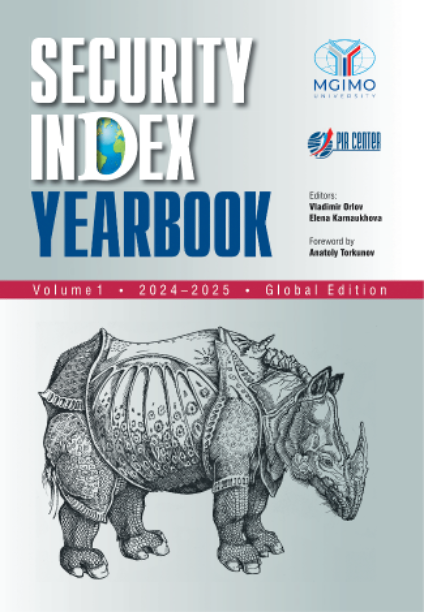
SECURITY INDEX YEARBOOK[1]. VOL. 1: 2024-2025. GLOBAL EDITION
Dr. Vladimir Orlov and Elena Karnaukhova (Editors). Foreword by Dr. Anatoly Torkunov.
MGIMO University & PIR Center. Moscow: Aspеct Press Ltd., 2024
(published in English)
The rapidly changing international security environment is one of the key factors characterizing the current state of international relations. The emergence of new challenges and threats is one of the key elements for further revision of the security architecture. The standard understanding of security and strategic stability is gradually being revised in favor of developing a differentiated approach to defining security as a comprehensive system that includes not only arms control and nuclear nonproliferation, but also such key trends as the militarization of outer space, cyber diplomacy, the factor of international terrorism, as well as other pressing issues on the international agenda.
There is no doubt that the unipolar approach in the context of the development and revision of the global security architecture is losing its relevance and the multipolar model of the changing environment of international relations is a much more priority goal for the countries of the Global South. This trend is additionally reinforced by the growing role of BRICS in the global dimension.
The Security Index Yearbook (2024-2025)is a new joint product of the PIR Center and MGIMO University. It includes the most relevant aspects and topics of the development of systemic global security, touches upon the issues of the development of the institution of multipolarity in the context of understanding the current system of international security through the prism of Russian foreign policy thought. The authors of the Yearbook (and this is more than two dozen leading Russian experts) rightly highlight the following trends in the development of global security at the present stage:
– the collapse of the previously existing system of arms control and strategic stability, which led to the decision on the possibility of deploying medium- and shorter-range missiles on the territory of NATO member countries after the denunciation of the Intermediate-Range Nuclear Forces Treaty (INF);
– the Ukrainian crisis as a fundamental aspect of the intensification of instability of the global security system;
– the build-up of new types of strategic offensive weapons, including hypersonic weapons and new types of conventional weapons, including the development of non-nuclear strategic weapons;
– the factor of international terrorism is a key aspect of the destabilization of the modern security architecture, taking into account the emergence of cyberspace as a potential zone of activity for radical terrorist groups;
– attempts by a number of countries to carry out a comprehensive militarization of outer space in circumvention of the norms of international space law.
The Yearbook comprehensively diagnoses key crises in the global security system related to the reconceptualization of the strategic order. Dr. Andrey Kortunov, Scientific Director of the Russian International Affairs Council[2], noted in one of the chapters of the Yearbook that the Ukrainian crisis that has arisen has further aggravated the crisis of the predominantly European security system. An obvious signal of the intensification of tensions is the statement by Russian President Vladimir Putin in his address to the Federal Assembly in 2023 on the suspension of Russia’s participation in the START-3 Treaty.
The author rightly notes that the resulting collapse of strategic stability in Europe against the backdrop of the Ukrainian crisis has influenced the change in approaches to defining European identity. Moreover, a clear advantage of the work is the conclusion that at present, in the conditions of the existence of a de facto unipolar model of international relations, there is a tendency towards the disintegration of European unity and community, which plays a key role in the political development of Western European countries.
The differentiation of European powers based on their belonging to the “old” and “new” Europe that has been taking place since 2003 has become even more acute and has affected the political instability within NATO. Thus, it can be said that the conclusion about the need for a gradual transition to a multipolar model as a tool for increasing strategic stability and regional security is fully justified.
The Yearbook examines in detail the retrospective and current state of Russia’s strategic relations with key actors in international relations in order to promote the key goal of maintaining peace and security. The authors rightly note the decline of Russia’s constructive relations with the countries of the Global North on issues of developing strategic stability, given the “hegemonic” nature of the strategic behavior of the United States and its allies at the present stage.
The authors of the Yearbook highlight the following promising areas for the development of strategic relations:
– development of Russian-Chinese strategic relations as a key factor in confronting and containing the ambitions of Western countries seeking a complete victory in the Russian-Ukrainian proxy war and inflicting a strategic defeat on Russia. China’s role in resolving the Ukrainian crisis is interdependent with efforts to recreate an effective system for managing the risks of nuclear escalation, as recorded in China’s Position on the Settlement of the Ukrainian Crisis of February 24, 2023[3];
– development of Russian-Iranian strategic dialogue in order to promote the interests of both parties in maintaining cooperation in the field of peaceful nuclear energy. The development of peaceful nuclear infrastructure of the Islamic Republic of Iran is a key aspect of the strategic interests of Moscow and Tehran in the context of countering Western pressure. The formation of the strategic axis “Moscow – Tehran” is an important factor in creating an effective environment for cooperation and developing common positions on the most important priority areas of development of the nuclear industry (including the supply of nuclear fuel cycles, fuel, as well as components for the development of nuclear power plants);
– the rethinking by African countries of the optimal foreign policy course in the context of developing a strategic dialogue has recently transformed into a conscious understanding of the need for Russian-African cooperation to strengthen multipolarity, taking into account the national interests of all entities as sovereign actors;
– against the backdrop of the Ukrainian crisis, Latin American countries are pursuing a more pragmatic foreign policy course, taking into account the priority of strategic relations with Russia, including within the framework of Brazil’s revised course on developing strategic stability within BRICS.
The development of strategic dialogue in the context of developing new principles of global security is a new requirement for adaptation to the new “normality” in international relations. The high role of rethinking the current security architecture is determined by the new priority directions of the foreign policy of the Russian Federation at the present stage. The definition of the Ukrainian crisis as a geostrategic culmination leading to a change in steps to stabilize global security is a justified step for the foreign policy turn of key African countries towards Russia.
The development of artificial intelligence (AI) is a key aspect of the transformation of the security environment. Cybersecurity has become the main factor in ensuring the sustainability of a complex of strategic and information infrastructure facilities, including technological capabilities for undermining security at the present stage. The development of information technologies is actively used by many subjects of international relations to create security clusters taking into account the transformation of conventional weapons systems, as well as to form effective systems for monitoring the military-political activity of a number of global security actors, including tracking modern types of weapons. In this regard, issues of conflict potential in the field of global security are being rethought and raised in the context of identifying new threats that shape the modern international agenda for risk management and preventing crises of strategic stability.
The development of new factors of destabilization of global security is associated with the evolution of armed conflicts and the use of new forms of threats, including the introduction of information technologies and the development of hybrid wars.
The Yearbook rightly characterizes the current security situation as a chaotic environment, which is not characterized by the use of global governance instruments. It presents the most relevant scenarios for the further development of the international political situation in the area of strategic stability, including scenarios of hybridization of the international security regime, intensification of the US-Chinese rivalry in the context of a new arms race, accompanied by elements of chaos in the global security system and geoeconomic confrontation between the key poles of the international system.
It is worth noting that new challenges and threats characteristic of the current stage of global security development form a kind of cascade in which security elements are divided into different clusters that are not homogeneous. This precise definition of modern trends in global security most fully reflects the transformation of the geopolitical environment, which has acquired a chaotic character over the 30 years of the unipolar model.
One of the significant advantages of the Yearbook is the use of infographics and accompanying materials that clearly demonstrate the relationship between key security factors and trends, as well as their role in relation to the issues under consideration. It can be stated that today the Yearbook is one of the key collective studies aimed not only at identifying the main challenges and threats to the current state of global security, but also at their multi-vector analysis in the context of Russia’s foreign policy and strategic perspective. The inclusion of exclusive interviews with Deputy Minister of Foreign Affairs of Russia Sergei Ryabkov, Deputy Head of Rossotrudnichestvo[4] Dr. Dmitry Polikanov, Director of the Institute of Africa of the Russian Academy of Sciences Dr. Irina Abramova in the Yearbook seems successful.
The Yearbook examines in detail the characteristics of the unipolar regime and the possible transition to a multipolar approach in solving the most pressing problems of global security, and proposes new ways of responding to both traditional and new threats and challenges.
The high quality of the Yearbook is ensured by the composition of the authors’ collective, selected by the editor-in-chief Dr. Vladimir Orlov, and the high standard set by the International Editorial Board of the yearbook. It is worth mentioning especially. The Editorial Board is headed by Academician of the Russian Academy of Sciences Dr. Anatoly Torkunov. It includes prominent experts from various countries. It is enough to name the former Minister of Foreign Affairs of Egypt Dr. Nabil Fahmi, the former Ambassador of India to Russia Dr. Venkatesh Varma, and the prominent expert on nuclear issues Dr. Tariq Rauf.
For the unbiased foreign reader (and it is to him that the new edition is primarily addressed), this Yearbook should certainly be put on the shelf, if not pushing aside such classic but flawed “Western” perspective annual publications as, for example, the SIPRI Yearbook, then noticeably pushing them aside. But it will also find a worthy place on the bookshelf of Russian specialists and practitioners in the field of international security.
As they say, we are waiting for the continuation.
[1] Originally published: International Affairs Journal, №4. 2025 URL: https://interaffairs.ru/jauthor/material/3198
[2] As of the time of this writing – Editor’s note.
[3] Also known as “China’s Peace Plan” – Editor’s note.
[4] Also known as “Federal Agency for the Commonwealth of Independent States Affairs, Compatriots Living Abroad, and International Humanitarian Cooperation” – Editor’s note.
