
PIR Post № 7 (21) 2026. Between Paris, London and Washington: Germany in Search of a New Role in European Nuclear Deterrence

September 28, 2026
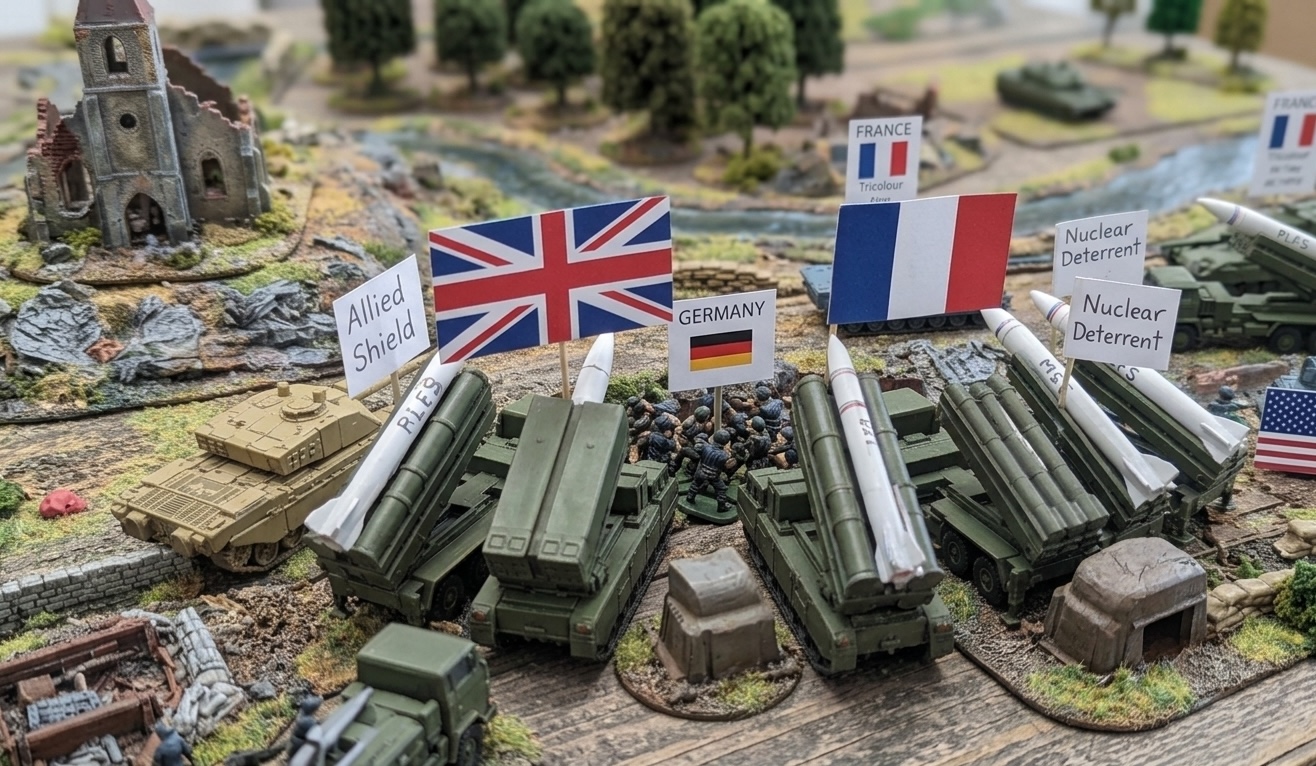
On 26–27 August 2026, British media reported that the government of Friedrich Merz was allegedly exploring options for co-financing the United Kingdom’s nuclear deterrent, including funding related to the modernization of the British Trident submarine force. Other options reportedly under consideration included German financial participation in the UK Defence Nuclear Enterprise, as well as conventional protection of nuclear infrastructure. One example mentioned was the possible deployment of German Patriot air defence systems to protect HM Naval Base Clyde at Faslane. At the same time, The Telegraph stressed that there was no discussion of transferring authority over the use of nuclear weapons.
On 28 August, deputy government spokesperson Steffen Meyer stated that no negotiations were taking place on German financing of the Trident programme. At the same time, the government’s response to questions about possible conventional support for British nuclear infrastructure was less categorical. Berlin confirmed that discussions with partners were taking place, while declining to comment on hypothetical future forms of cooperation.
For decades, Germany’s nuclear policy has rested on a relatively stable compromise. Germany does not possess nuclear weapons of its own and remains bound by its obligations under the NPT, while at the same time participating in NATO nuclear sharing arrangements. US extended deterrence remains a central pillar of German strategy. Even the more ambitious Franco-German initiatives launched in 2026 are framed not as a substitute for the American guarantee, but as a complement to it, and are pursued in close coordination with Washington.
At the same time, it is clear that under current security conditions Germany may see scope for a more ambitious role in European defence. The possibility of German financial participation in the French or British nuclear deterrent has been discussed for years, but the issue has attracted growing attention in German political and expert circles since the institutionalization of both Franco-German and German-British defence cooperation.
For Washington, which has repeatedly called on European allies to increase defence spending and assume greater responsibility for their own security, German support for the British nuclear deterrent could potentially be advantageous. First, London faces well-known budgetary constraints. Second, the United States plays a central role in the maintenance and modernization of the Trident missile system.
For Germany, co-financing the British deterrent could potentially translate into a larger role in NATO nuclear planning and closer coordination with the United States on strategic deterrence in Europe. From Berlin’s perspective, this could offer greater advantages than co-financing the French force. French nuclear forces, unlike their British counterparts, are considerably less dependent on US infrastructure and strategic cooperation. This creates a greater potential for future differences with Washington, even if no major disagreements are visible under the current administration.
Cooperation with the United Kingdom, by contrast, is difficult to portray as an anti-American alternative. The British nuclear deterrent is deeply embedded in the transatlantic security system, while British defence policy continues to emphasize the central role of NATO. The 2024 German-British Trinity House Agreement explicitly defines NATO as the cornerstone of collective defence and presents deeper bilateral cooperation as a means of strengthening the European contribution to the Alliance.
The institutional basis for German-British cooperation has also expanded significantly. The Trinity House Agreement provides for cooperation between the armed forces and defence industries of the two countries, the development of precision strike capabilities, submarine detection systems and other projects. The 2025 Kensington Treaty went further by explicitly providing for bilateral exchanges on questions related to nuclear deterrence.
A second consideration is that closer nuclear cooperation with Germany remains more politically sensitive in France than it is likely to be in the United Kingdom, and any further steps in this direction will require considerable caution from its supporters.
At a press conference on 17 July, President Emmanuel Macron categorically ruled out German co-financing of the French nuclear programme. He stressed that France’s nuclear deterrent would continue to be financed exclusively by France. It is also notable that during the same press conference, journalists directly linked the question of co-financing to the possibility of Marine Le Pen winning a future presidential election.
The French public debate surrounding Franco-German nuclear exercises has also been mixed. A number of French media outlets expressed concern about deeper military cooperation with Germany, a level of controversy that was less visible when France concluded similar arrangements with countries such as Poland or Norway.
For Berlin, the British track therefore potentially offers a way to pursue two objectives that might otherwise appear contradictory: expanding German influence over the emerging European deterrence architecture while at the same time minimizing the risk of political divergence with Washington.
Épaulement as the French Alternative to Nuclear Sharing
The key to understanding the role Paris is offering its partners lies in the concept of épaulement stratégique, which may be translated as “strategic support” or “strategic reinforcement”. President Macron introduced the concept in his speech of 2 March.
Under the French approach, nuclear partnerships are intended to complicate an adversary’s calculations by introducing the possibility that French nuclear deterrence could extend to the defence of a partner in the event of a conflict. Partner states, in turn, contribute to the credibility of the broader deterrence architecture through their conventional capabilities.
French expert Héloïse Fayet has described the US extended deterrence relationships with Japan and the Republic of Korea as among the closest existing analogies to the type of nuclear umbrella France could potentially provide to European partners.
On the conventional side, France identifies three areas of cooperation in particular. During the July press conference, Macron referred to early warning, precision strike capabilities and air defence systems as integral components of this form of strategic reinforcement.
Two Models of German Participation
At present, it cannot be stated with certainty that the United Kingdom is genuinely prepared to offer Germany a financial role in its Defence Nuclear Enterprise. Some British experts argue that co-financing Trident would provide Germany with few significant additional benefits, since the United Kingdom is already bound by its commitments under Article 5 of the North Atlantic Treaty.
Germany’s strategy should therefore probably not be understood as a choice between Paris and London.
A portfolio approach is more likely, with different partnerships serving different strategic functions.
France can offer Germany the deepest European channel for strategic dialogue on nuclear doctrine, escalation management and the interaction between nuclear and conventional capabilities as part of a broader European defence strategy. The concept of épaulement allows Berlin to become a practically significant participant in European deterrence without compromising its non-nuclear status.
The United Kingdom, by contrast, could potentially offer deeper cooperation in the military aspects of nuclear deterrence, together with a more active German role in NATO nuclear planning and substantial opportunities for defence-industrial cooperation under a framework broadly compatible with US strategic interests.
For Germany, such diversification would have an additional advantage. It would reduce Berlin’s dependence on the Franco-German axis as the principal framework for building a European defence policy.
This is especially important given the differences between French and German approaches to European deterrence. France continues to place greater emphasis on strategic autonomy, while Germany seeks to strengthen its position within NATO and to reinforce European security primarily through transatlantic cooperation.
Keywords: Germany; nuclear deterrence; Europe
NPT
E16/NOS – 26/09/28
