
Remarks by Dr. Vladimir Orlov at the Launch of the Security Index Yearbook: Global Edition, Volume 2 (2026-2027), within the Framework of the 1st International Security Forum, Moscow, 26 May 2026
June 12, 2026
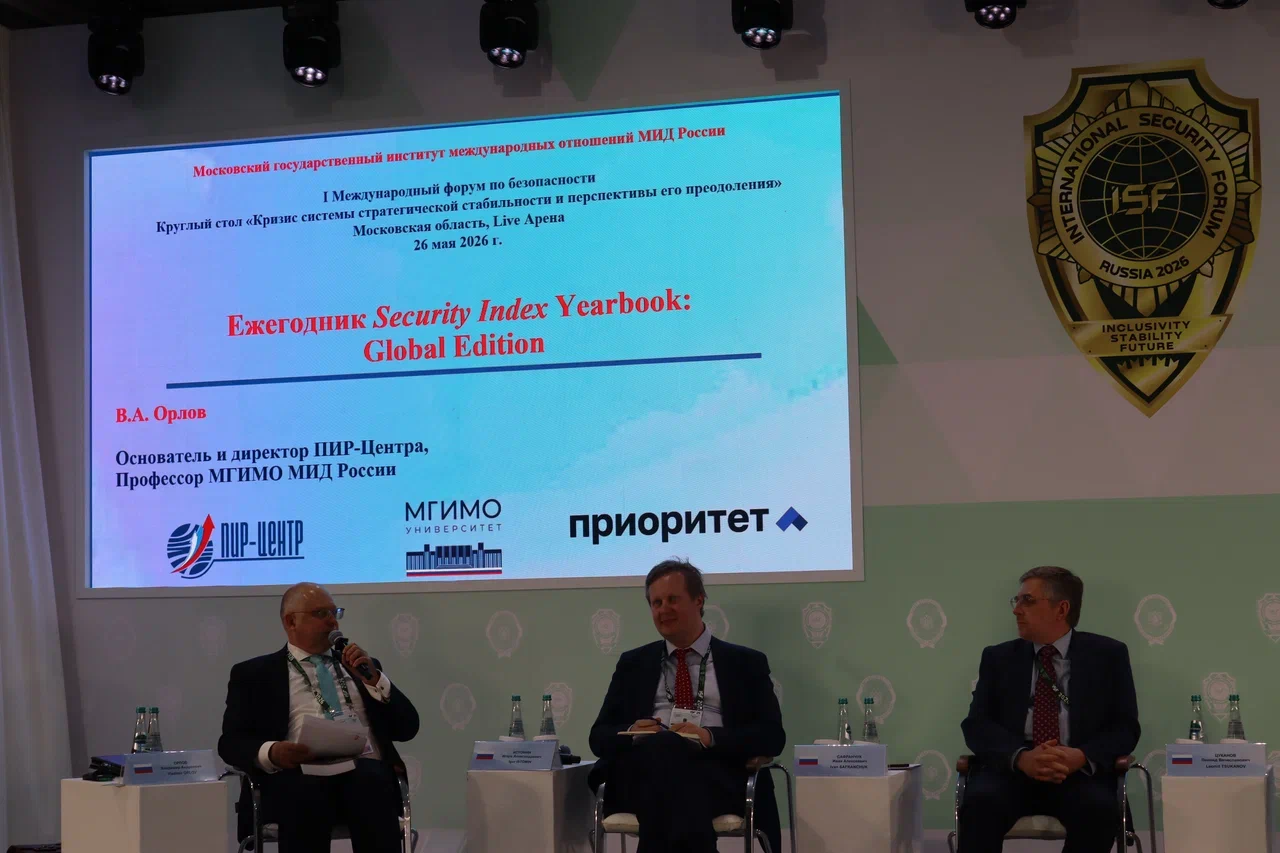
As Editor-in-Chief of the Security Index Yearbook, I believe it is important to say a few words about what this publication is and why we are discussing it today at the First International Security Forum, organized by the Security Council of the Russian Federation, and within the framework of events held by MGIMO University.
Let me begin with a few lines of poetry that serve, in a sense, as an epigraph to the very concept of our Yearbook:
“When you are free
From your spiritual feats
Write down unpretentiously
All that you’ll witness in your life:
War, peace, the rule of sovereigns…”
We are speaking here of an intellectual endeavor undertaken at an exceptionally complex moment in history – a moment that calls for reflection on the problems of global security.
Today we are presenting the second volume of the Yearbook. We are often asked how one can access it and why it was created. This is precisely what I would like to address.
The idea of the Security Index Yearbook emerged from our discussions with Academician Anatoly Torkunov, Rector of MGIMO University. He supported the project three years ago and agreed to chair its International Editorial Board.
The second volume, like the first, opens with a foreword by Academician Torkunov. In it, he reflects on the rise of non-Western centers of power – a process driven not by a rejection of modernization, but, on the contrary, by its successful appropriation and acceleration. These are serious and fundamental questions of contemporary global development.
The overall purpose of the Yearbook is to provide a comprehensive analysis of the most pressing issues of international security facing the modern world, and to contribute to a better understanding of global developments.
Our task is to communicate Russia’s position to the international academic and business communities, to respond constructively to criticism and accusations directed at Russia, and to promote a balanced, expert-based perspective. It is equally important to acquaint a new generation of international relations scholars – both in Russia and abroad – with Russian approaches to the study of global and regional security.
The Yearbook has already been integrated into the educational process of MGIMO’s master’s programs.
A special role is played by the International Editorial Board, which brings together leading experts from different countries. Many of those present here today are either members of the Editorial Board, authors of the Yearbook, or participants in the broader author and editorial team. There are no accidental people in this project.
Recently, one of the members of our Editorial Board, Nabil Fahmy, former Minister of Foreign Affairs of Egypt, was appointed Secretary-General of the League of Arab States. This is further evidence of the high level of those involved in the project.
As for the concept of the second volume, while maintaining continuity with the first, it introduces several important innovations. The covers may differ in color, but they preserve a common visual and conceptual line. The Yearbook remains a recognizable periodical publication with its own distinct identity.
We have expanded the visual component, adding materials connected with the European historical tradition. It seemed to us that certain parallels between that period and the present moment deserved attention.
The main conceptual distinction of the second volume is its move away from an exclusively European security perspective toward a broader discussion of the Eurasian security architecture. We do not exclude European security issues; rather, we seek to view these processes more holistically, across the wider Eurasian space.
Special attention is given to the growing interconnection between security and advanced technologies. We are not waiting to be told that we are relying on outdated approaches; instead, we are trying to work ahead of the curve.
Compared with the first volume, the second includes a new thematic section devoted to Russia’s cooperation in strategic areas with specific regions of the world. In this volume, the focus is on Africa. We believe that such targeted and in-depth regional studies are highly productive.
The Yearbook consists of several major parts.
Part I, “Global Security in the Times of Transition to a Multipolar World,” addresses global security issues.
Part II, “Regional Security & Russia’s Interests,” examines regional security and Russia’s relations with specific countries and regions. It analyzes the dynamics of Russia’s interaction both with allied states and with countries pursuing unfriendly policies toward Russia.
Part III, “Featuring: Russia – Africa,” is devoted to Russia’s relations with the countries of the African continent. Particular attention is paid to cooperation in high technologies, peaceful nuclear energy, and interaction with the states of the Sahara-Sahel region.
Part IV, “Under the Microscope,” offers a detailed analysis of specific international security issues. It includes such topics as the Russia-Mongolia strategic dialogue and Australia’s nuclear ambitions.
Part V, “Security Dialogues & Trialogues,” reflects our belief that it is important to hear not only academic voices, but also the views of statesmen and leading experts from Russia and other countries. That is why interviews occupy a significant place in this section.
Part VI, “Back to the Future,” turns to earlier publications that have acquired renewed relevance today. This includes, among other things, works devoted to the Iranian issue.
Part VII, “Forecasting Global Security,” offers a serious structural analysis of future trends in global development. In my view, it is one of the most interesting sections of the second volume.
Finally, for readers interested in the academic discourse in Russia and beyond, Part VIII, “From Russia with Books,” presents reviews of major books and publications in both Russian and English.
Reader feedback is also of great importance to us. There is nothing worse than an editorial team becoming trapped in its own belief that everything it does is flawless. That is why we listen carefully to the views of our readers from different regions of the world.
Another practically useful section is Part X, “In the Spotlight: Top International Security Events Chronology: Year 2024-2025.” In it, we offer our own Russian perspective on key international developments. Too often, such chronologies are shaped exclusively within a Western narrative and then reproduced around the world. We are seeking to change this tendency.
The second volume includes 29 chapters by 32 authors. I am sincerely grateful to all our authors for their contribution to the development of this project.
For me, as Editor-in-Chief, it is particularly important that the geography of our authors extends far beyond Russia. We have invited researchers, interviewers, and experts from different parts of the world – from both Western and non-Western countries. The key requirements are professionalism, constructiveness, and readiness for serious dialogue.
The geography of the topics covered in the Yearbook is equally broad. In effect, we are dealing with a truly global scope.
We have already received numerous responses from readers in different countries – researchers, military analysts, diplomats, and representatives of the academic community.
Although our main target audience consists of experts, government officials, and university communities around the world, we also keep in mind our Russian readers, who follow the development of the project closely.
It is especially encouraging to see support from leading Russian specialists and diplomats. Among those who have already highly assessed the Yearbook are Nabil Fahmy, as well as representatives of the Russian diplomatic service and international organizations.
Our efforts to engage the younger generation of researchers around the world are producing visible results. From Somalia to France and China, we see young readers taking an interest in the issues raised in the Yearbook.
A number of reviews of the first volume have already been published in the Russian and international expert community. Among the platforms that have responded to the project are International Affairs, Russia in Global Affairs, Pathways to Peace and Security, and other respected publications.
The first volume also received broad coverage in the media and among analytical centers. References to and citations of the second, newly published volume are already beginning to appear.
The digital version of the publication is already available to readers, while the distribution of the printed edition around the world is only beginning. We know that the Yearbook is awaited in many countries and international centers.
