
TECTONIC SHIFTS: RUSSIAN NAVIGATION OF THE EMERGING WORLD ORDER

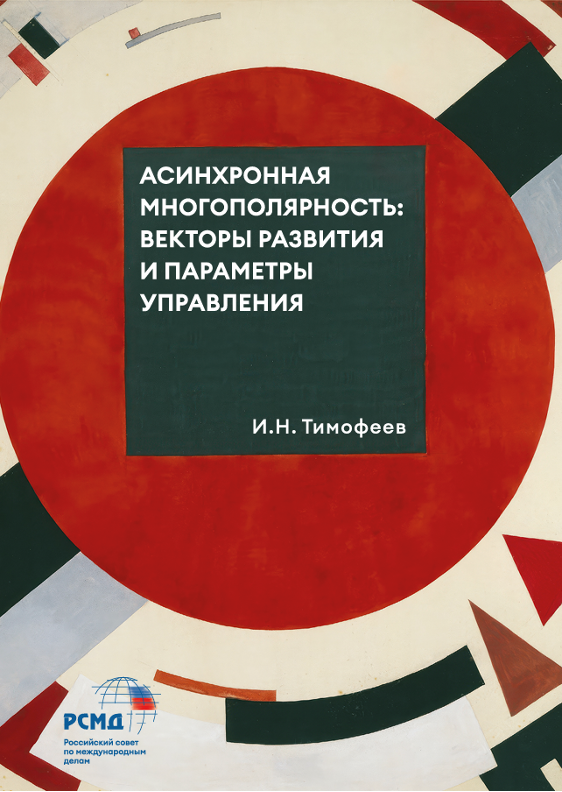
Asynchronous Multipolarity: Control Parameters and Development Vectors
Ivan Timofeev; edited by: Igor Ivanov
Russian International Affairs Council (RIAC), 2025.
(published both in Russian and in English)
The world is undergoing a radical transformation of international order. While its causes, starting points, and scale may be debated, the fact of change is undeniable. It affects both domestic and international levels, reshaping all aspects of our lives: social, political, and financial. The monograph “Asynchronous Multipolarity: Development Vectors and Control Parameters” by Dr. Ivan Timofeev, Director General of the Russian International Affairs Council (RIAC), brings together his articles from 2022 to the beginning of 2025, a period many Russian experts view as the start of radical changes in the international system. The author examines the issues of the formation of a new world order, the dynamics of Russia’s interaction with the outside world, and the phenomenon of sanctions as an instrument of coercion. Avoiding over-theorization, he offers a practical analytical view of processes that define the future of international relations and are the subject of active expert discussions.
Summary of the Monograph
The monograph consists of 5 sections: New Realities of the World Order; Russia and the countries of the Global Majority; Russia, the West and the Rest of the World in the Context of the Ukrainian Crisis; Sanctions against Russia; Russia on the Threshold of the New.
The first section introduces the current state of the international system. Timofeev argues that Fukuyama’s “End of History”[1] is over; History now follows its usual course, with periodic disruptions from conflicts between centers of power. Balance-of-power diplomacy is back, and the Russia-West confrontation will drag on for decades, regardless of the outcome in Ukraine. Multilateral diplomacy failures cannot be blamed solely on the West; other countries also pursue self-interest at the expense of the collective good. Russian policy is security – and realism-oriented, avoiding ideology to maintain goal-oriented rational behavior instead of value-rational behavior. Here, the author also introduces the “asynchronous multipolarity”: a world that became multipolar in military dimension, with the West still retaining financial and technological dominance.
The Ukraine conflict raised nuclear escalation risks and aggravated long-standing arms control issues, but a new Cold War-style arms race is unlikely. The competition will be qualitative. In the current conflict, Russia maintains certain military and scientific advantages, but its industrial and human potential is vulnerable. Addressing this will require a concentration of resources, mobilization of forces, modernization of institutions (including combating corruption) and industry, avoiding Stalinist approaches. And although US-Russia relations show cautious improvement, the process is slow, fragile, and easily interrupted. So, no hopes on Donald Trump.
The second section, “Russia and the countries of the Global Majority”, focuses on Russia’s turn to the Global South amid sanctions and conflict with the West. This will be a long journey: engagement with the Global Majority cannot instantly solve Russia’s problems. Key Russia’s goals include building independent power centers, modernizing via cooperation with non-Western countries, securing borders with NATO countries, and building an economy less dependent on Western institutions. A full break with the West is impossible, including due to cultural and human ties. Deeper non-Western engagement demands patience, openness to learning from them, and new skills. Russia will remain at the intersection of both worlds.
The author argues that international tensions are only starting, as the showdown between the two key rivals, the US and China, is still ahead. Outcomes of Russia-West and US-China dynamics, as well as the ability to manage competition and rivalry, will define the future world order.
Meanwhile, BRICS and other partners help Russia avoid isolation. Dr. Ivan Timofeev emphasizes the need for independent financial mechanisms but points to barriers: weak BRICS institutionalization, low prioritization of the alternative financial model by other countries, controversies, and low trust. Gradual development of new financial systems through bilateral and multilateral projects offers a more realistic path, which can be scaled within BRICS and the region later.
After sketching the global context, the author turns to Russia’s core concern – security. In section “Russia, the West and the Rest of the World in the Context of the Ukrainian Crisis”, Dr. Ivan Timofeev first provides a quick analysis of who benefits from the conflict in Ukraine. While Ukraine and Russia bear the heaviest losses, others may gain. The EU loses Russian energy but finds stimulus for the union’s consolidation. The US profits from NATO’s revival and demand for arms and energy, though distracted from Asia. China becomes Russia’s main partner; the bond is asymmetrical, but Moscow has no alternatives. The crisis creates both risks and chances for countries. However, the gains can be easily erased by escalation, up to a direct Russia–NATO clash.
For Moscow, security, not ideology, is key, with Ukraine the central challenge. The Special Military Operation (SMO) became a bifurcation: it entrenched confrontation with the West with no return to the “2021 reality” and strengthened the Chinese partnership. An extreme scenario is possible, which is Russia’s limited nuclear use against Ukraine if long-range missiles cause severe[2] losses and damage to Russia. Whatever the overall conflict outcome, Ukraine remains the most vulnerable and suffering element in the equation.
Intermediate conclusion: Russia has shown it can comprehensively defend its interests by military, diplomatic, and economic means, accept major costs, and remain a resilient international player with an army of contractors and volunteers that allow large operations without mass mobilization.
Discussing the Russia-West confrontation, one cannot ignore sanctions against Russia, unprecedented in scale, speed, and coordination since February 2022. A section of the monograph “Sanctions against Russia” stresses they failed to achieve their core aim: altering Moscow’s course on Ukraine. The Kremlin retained its determination to continue military actions, though the economic toll was heavy: restricted access to finance and technology, disrupted trade, and higher business costs. The crisis was eased by domestic measures and prior infrastructure, but the transition to a new development model will be long and painful.
Sanctions accelerated Russia’s pivot from the West towards China and other “friendly” states. Ultimately, sanctions proved ineffective in forcing political change in a major power. They seriously constrained the economy and defense industry but did not cripple Moscow’s capacity for strategic action, supported by third-country neutrality. At the same time, sanctions may reshape the global economy by undermining the dollar-centered system. The author notes that little research addresses sanctions lifting or easing, while China’s case suggests possible scenarios.
Today’s sanctions policy evolves amid the breakdown of the world order, demanding fundamental theoretical reflection and fresh analytical frameworks.
The final chapter discusses ideas emerging after the start of the special military operation: the “Russian rebel” against the West, the concept of state-civilization, and Eurasian security architecture. The author frames the conflict in Ukraine as Russia’s quest for recognition, sovereignty, and protection of its interests, emphasizing the absence of economic motives. The main domestic challenge for Russia is not military victory but formulating a development strategy that preserves a market economy and an open, mobile society; mere opposition to the West and mimicry of Soviet practices would only worsen existing problems.
The idea of a “state-civilization” offers a theoretical basis for a foreign policy alternative to the liberal, socialist, or conservative paradigms. While it has advantages, the author notes serious limitations and contradictions, leaving realism as the practical guide for now until the new idea is seriously developed.
With the Euro-Atlantic security system destroyed, a new Eurasian framework based on equality, indivisibility, and multidimensional security is needed. Economic security will be crucial but insufficient to guarantee broader security. Many questions remain about the Eurasian security concept, and the author expects a long process of its gradual development. Russia just proposes building a new security architecture together based on cooperation and respect for diverse interests, setting a starting point, demonstrating an alternative through trust and collaboration rather than coercion and domination.
Conclusion
The strength of the monograph is the author’s ability to ground even some theoretical and abstract issues in practical reality. Dr. Ivan Timofeev carefully and thoughtfully examines various problems, avoiding both overconfidence and alarmism. Special attention is given to Russia: the author openly acknowledges existing challenges, analyzes them calmly without yielding too much to political trends, and critically reacts to some state’s ideas, like, for instance, the state-civilization promoted by Russian leadership.
The assessment of external actors is similarly balanced: he avoids oversimplification, does not reduce all problems to the US/West, and does not see automatic salvation through aligning with the Global South. His approach prompts reflection, showing that researchers and experts should be a bit humbler in their evaluations, recommendations, and forecasts.
The continued relevance of the collected articles, written over several years, highlights the author’s professionalism. Some points triggered internal debate and additional questions, as a good book should. At times, certain issues felt underexplored, but, understandably, one book cannot cover everything.
A couple of moments hinted at the author’s wishful thinking, such as optimistic expectations for universal benefits from alternative payment systems for BRICS and other countries or hopes that China could emerge as a fully alternative center in the global system.
Dr. Ivan Timofeev brings together many key events that shape Russia and are shaped by it, aiming to provide an objective assessment of what is happening. This monograph serves as a foundation for exploring where Russia (and, perhaps, the world) might head next.
The book is valuable for international readers studying Russia professionally or academically. It compiles the main elements of the Russian perspective on international relations and Russia’s role in them through an expert-academic lens. It is also useful for domestic experts as a benchmark for comparing their own worldview with that of a prominent scholar. Dr. Timofeev demonstrates that much intellectual work lies ahead for international affairs professionals, and this monograph inspires such work.
I would like to conclude the review with the quote from the monograph: “We are not angels and therefore cannot teach others from above. But we can think about a better future and create it together, not instead of everyone else.”[3].
[1] Fukuyama argues that the spread of Western-style liberal democracy throughout the world marks the end point of humanity’s sociocultural evolution and the formation of a final form of government. In Fukuyama’s view, however, the end of history does not mean the end of eventful history, but the end of a century of ideological confrontations, global revolutions, and wars, and with them the end of art and philosophy – Editor’s note.
[2] The definition of “severe” remains unknown.
[3] Original (in Russ.): «Мы не ангелы, а потому и не можем свысока учить других. Но нам доступно думать о лучшем будущем и создавать его вместе, а не вместо остальных».
