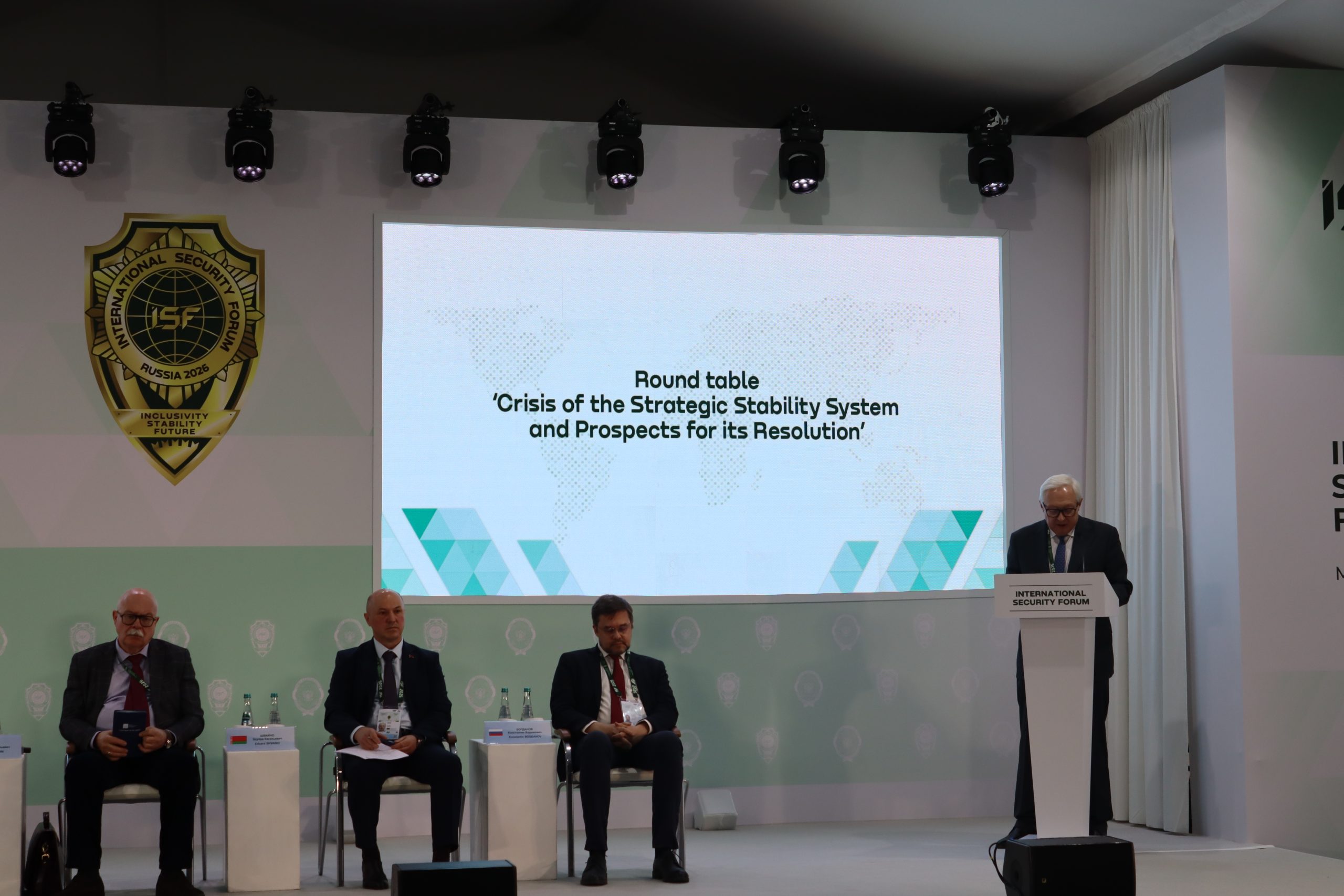
Dmitry Trenin – President of the Russian International Affairs Council (RIAC); Research Director of the Institute of World Military Economics and Strategy at HSE University; Leading Research Fellow at the Sector for Non-Proliferation and Arms Limitation of the Center for International Security at IMEMO RAS; Member of the PIR Center Executive Board:
- During the Cold War, the goal was to eliminate the possibility of a nuclear war by neutralizing the potential benefits for any nation that might launch a first massive nuclear strike against its adversary. It was a time of a certain stability, with the main struggle being waged on the periphery. The disappearance of the fear of nuclear weapons creates significantly broader opportunities for their actual use.
- A multipolar world already exists, but a multipolar world order has not yet been formed. A struggle is underway, the outcome of which remains not entirely clear. In the long term, US hegemony will inevitably weaken, as it cannot be maintained indefinitely.
- We must approach the analysis of global events as an analogue of a world war. In doing so, one of the key objectives must be risk management. It is necessary to preserve the existing mechanisms that work toward stabilization, yet the old schemes are no longer effective. A new Yalta or a new Helsinki is impossible under current conditions. We should strengthen the deterrence system, raise the level of intimidation, and allow for the use of escalation for the sake of de-escalation. This might prove to be the last argument capable of preventing a nuclear war.
- It is necessary to strive for the creation of regional security systems.
- Today, numerous opportunities exist to use non-nuclear means to achieve strategic objectives.
- Strategic stability can be maintained, yet there is a threat of one of the sides losing its positions.
- The Security Index Yearbook is used in the educational process of the “International Security” Master’s program co-hosted by MGIMO University and the PIR Center. The authors of the second volume of the Security Index Yearbook 2026-2027 (Global Edition) have shifted away from the analysis of purely European security toward the discussion of Eurasian security. The publication includes a thematic section on cooperation with specific regions of the world.
Konstantin Bogdanov – Head of the Sector for Strategic Analysis and Forecasting at the Primakov National Research Institute of World Economy and International Relations (IMEMO) of the Russian Academy of Sciences (RAS):
- We lack a clear definition of strategic stability. At the same time, strategic stability itself is expanding in its manifestations, although its core remains unchanged. Strategic stability is a characteristic of the nuclear deterrence system.
- We talk a lot about a multipolar world, and it often sounds like a panacea. However, a multipolar world is a world of high conflict and constant balance of power. The more strategic cultures you try to institutionalize as equal, the more potential generators of conflict arise.
- Strategic stability as an idea has not changed for about 60 years. In the context of an emerging multipolar world, we have every reason to dramatically intensify strategic dialogue, striving for a better mutual understanding of each other’s strategic cultures by various parties.
- From my perspective, the most adequate model could be a complex “matryoshka” (nested) structure with a legally binding core and a clear format for bilateral agreements—specifically Russian-American and Russian-Chinese. In the longer term, negotiations on limiting nuclear weapons in Europe between Russia and European states are also possible. Such a system could create a synchronous logic of interaction without undermining the significance of existing agreements.
H.E. Ahmed Salem Al-Wahishi, Ambassador Extraordinary and Plenipotentiary of the Republic of Yemen:
- Currently, there is an “elephant in the room” in the Middle East—a war that continues both within the region itself and in the straits. We see that serious challenges are emerging regarding the implementation of the provisions of the UN Convention on the Law of the Sea. At the same time, we believe that international law remains the very tool capable of protecting our interests.