
№ 28 (76), 2026. A launch of the Security Index Yearbook: Global Edition, Volume 2 (2026-2027), prepared jointly by MGIMO University and PIR Center held as part of the 1st International Security Forum.
June 12, 2026
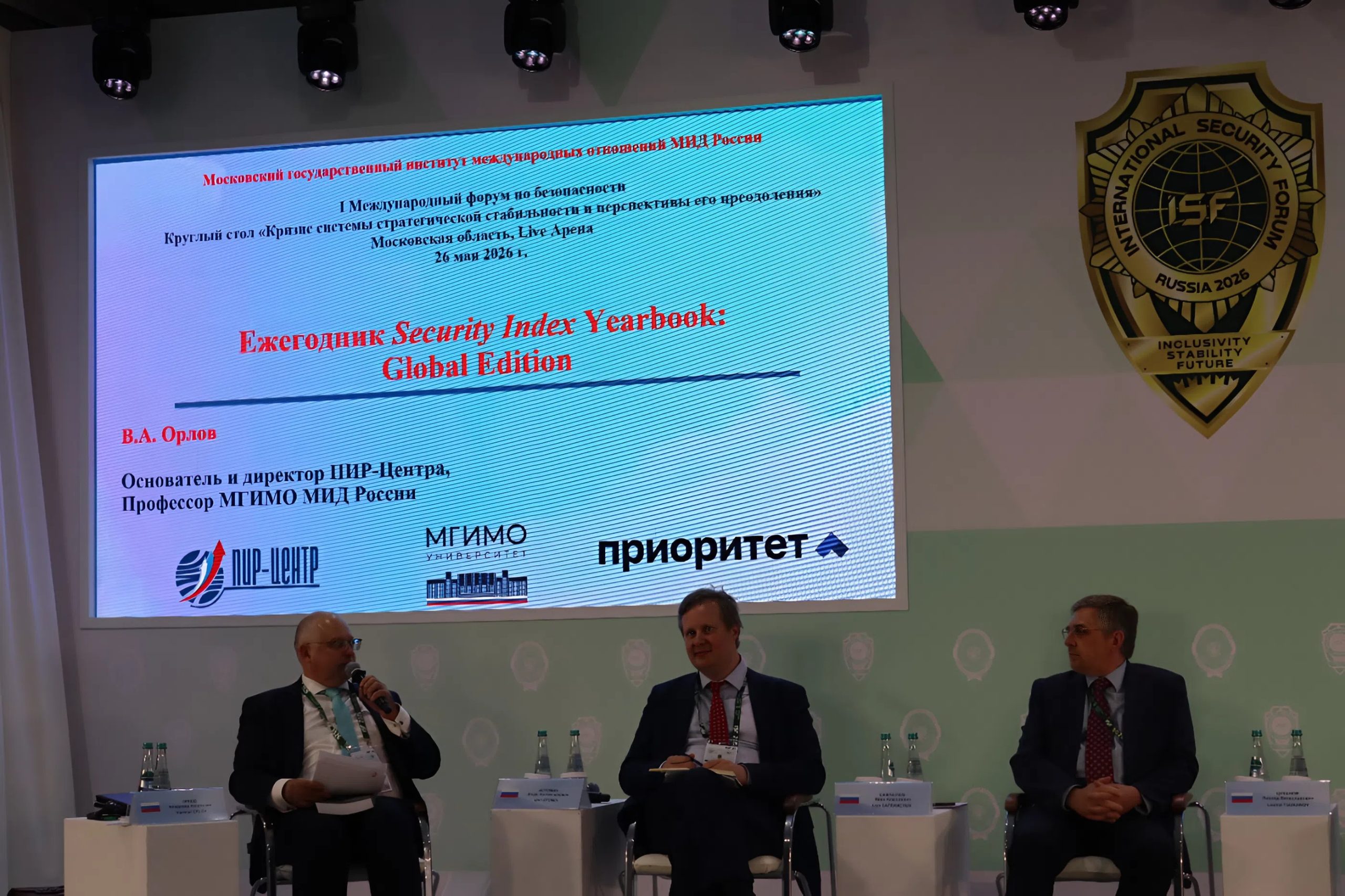
MOSCOW, JUNE 12, 2026. PIR PRESS. «Our task is to communicate Russia’s position to the international academic and business communities, provide constructive responses to criticism and accusations directed at Russia, promote a balanced, expert-based perspective, and familiarize the younger generation of international relations scholars with Russian approaches to the study of global economic and regional security issues. The key innovation of the second volume is its shift away from an exclusive focus on European security toward a discussion of the architecture of Eurasian security. While not excluding European issues, we take a broader view of the entire Eurasian space, paying particular attention to the interrelationship between security and emerging technologies», – Dr. Vladimir Orlov, Editor-in-Chief of the Security Index Yearbook, Professor at the Department of Applied International Analysis of MGIMO University of the Russian Ministry of Foreign Affairs, and Founder and Director of PIR Center.
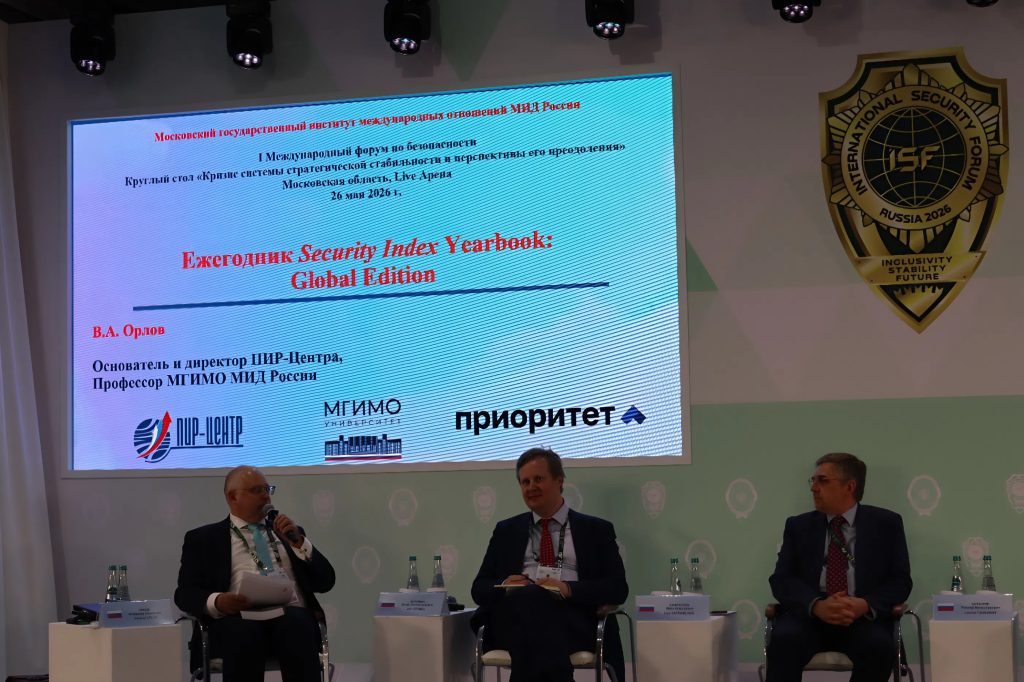
On May 26, the thematic roundtable “The Crisis of the Strategic Stability System and Prospects for Overcoming It” was held at Live Arena as part of the 1st International Security Forum. The event was organized jointly by MGIMO University and PIR Center.
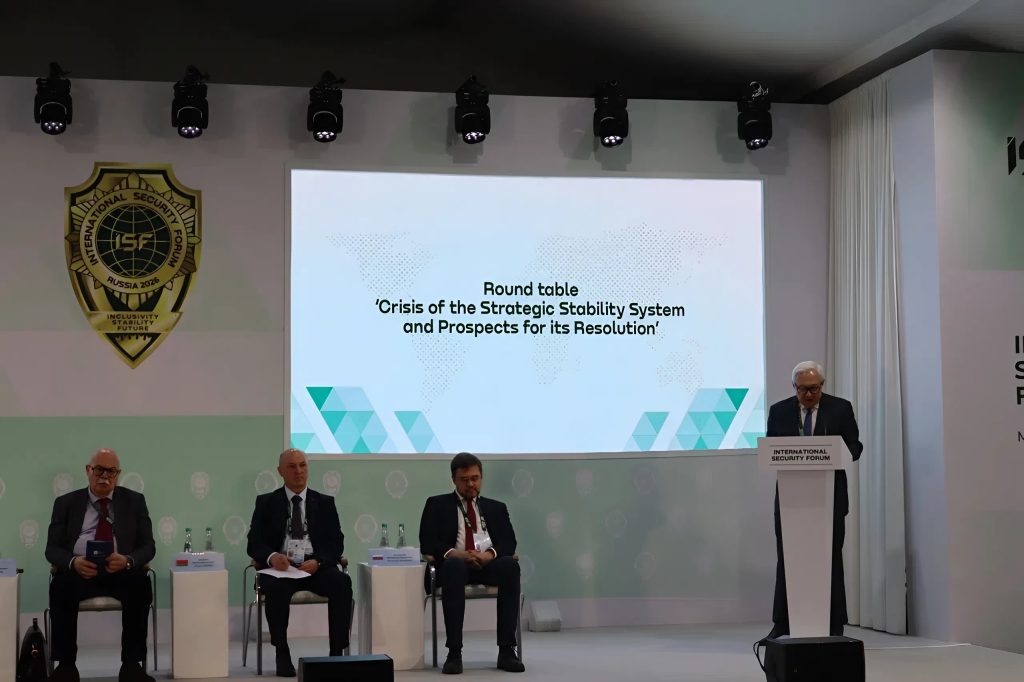
The discussion was opened by Sergey Ryabkov, Deputy Minister of Foreign Affairs of the Russian Federation and a member of the Editorial Board of the Security Index Yearbook. The speakers also included Dr. Dmitry Trenin, President of the Russian International Affairs Council, Director of the Institute of World Military Economy and Strategy at HSE University, member of PIR Center Executive Board, and author of Chapter 1, Russia’s Foreign and Security Priorities in the Era of World Turbulence; Eduard Shvaiko, Head of the International Security Governance Section of the State Secretariat of the Security Council of the Republic of Belarus; and Dr. Konstantin Bogdanov, Head of the Strategic Analysis and Forecasting Section at the Center for International Security of the Primakov National Research Institute of World Economy and International Relations (IMEMO RAS).
In their remarks, the participants examined the state of strategic stability amid the transformation of the world order, the emergence of nuclear multipolarity, rising international tensions, and changes in the architecture of global security. Particular attention was paid to the prospects for arms control and to possible scenarios for the development of the international system in the coming years.
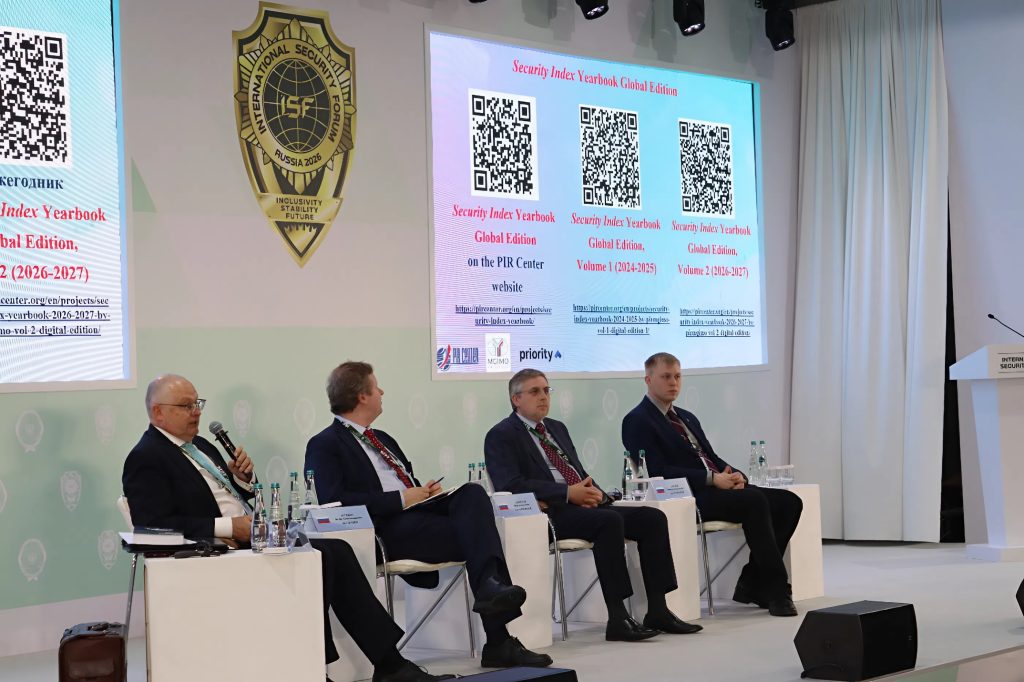
On the sidelines of the discussion, the second volume of the Security Index Yearbook: Global Edition, Volume 2 (2026-2027) was also presented. An expanded digital edition of the publication is already available to readers. Although the project was launched only recently, in 2024, the Yearbook has already earned recognition within the expert community both in Russia and abroad. Today, each new edition is eagerly anticipated by specialists, researchers, and practitioners in the field of international security, serving as strong evidence of the project’s relevance and of the high regard for the work of its Editorial Board.
Digital Edition of the Volume Two includes 10 sections and 29 chapters, prepared by 32 experts from Russia and other countries. The authors include renowned Russian experts in international security, ministers (including Belarusian Foreign Minister Maxim Ryzhenkov), deputy ministers (including Deputy Foreign Minister Sergey Ryabkov), ambassadors, and former presidents (including former Kiribati leader Teburoro Tito).
The second volume of the Security Index Yearbook is a significant contribution to the analysis and understanding of processes developing from different perspectives and angles. The methodology employed in compiling this volume is highly modern and relevant. I had the opportunity to familiarize myself with its contents during the preparation stage. I strongly encourage both specialists and anyone interested in this field – which, to a great extent, influences the peace and well-being of our lives – to pay close attention to this publication and to properly acknowledge its authors and editors when the presentation takes place.
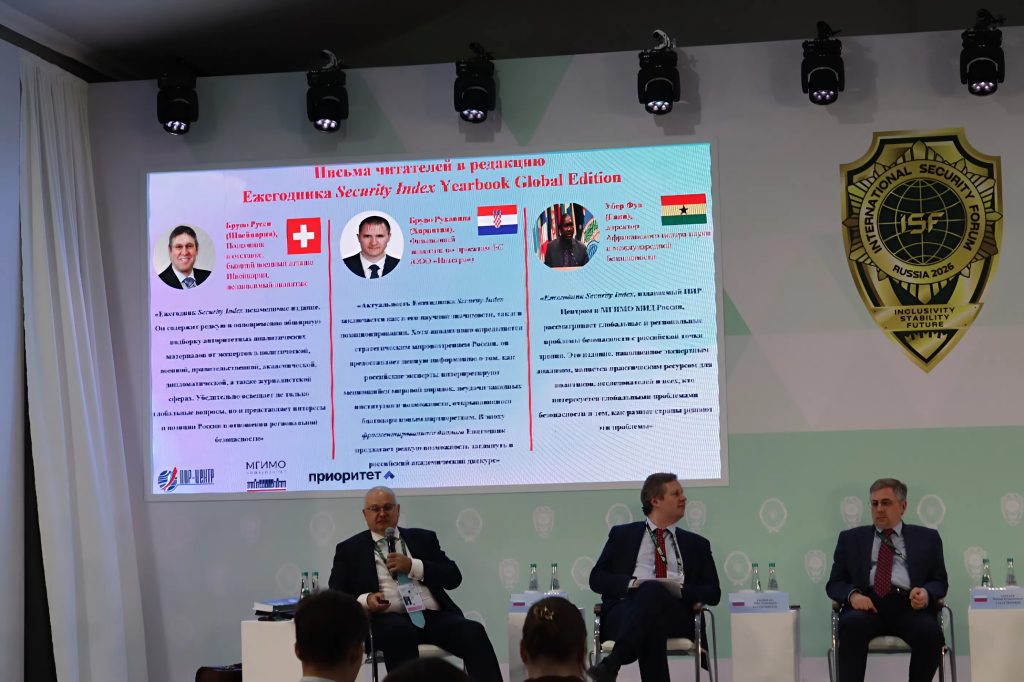
The Yearbook covers a broad range of global security and arms control issues (including international information security and the military application of AI technologies), as well as the dynamics of Russia’s relations with key global political powers (China, the United States, leading Middle Eastern powers, etc.).
Volume 2 devotes special attention to Africa, examining relations with the region through the lens of high technology and resource wars. Some of these issues are explored, among other things, through interviews with Russian and foreign experts, diplomats, and political figures. This allows for a comprehensive view of the issues raised, from both the inside and the outside.
Dr. Vladimir Orlov, Editor-in-Chief of the Security Index Yearbook, Professor at the Department of Applied International Analysis of MGIMO University of the Russian Ministry of Foreign Affairs, and Founder and Director of PIR Center, presented the second volume of the publication, jointly prepared by MGIMO University and PIR Center. According to Vladimir Orlov, the Yearbook was conceived as a platform for comprehensive analysis of current international security challenges, the promotion of the Russian expert perspective, and the development of dialogue with the international academic and expert community.
The Editor-in-Chief emphasized that the principal conceptual innovation of the second volume is the shift from a predominantly European focus toward a broader examination of the architecture of Eurasian security. At the same time, the publication places greater emphasis on the relationship between security and emerging technologies and introduces a special thematic section dedicated to Russia’s cooperation with African countries.
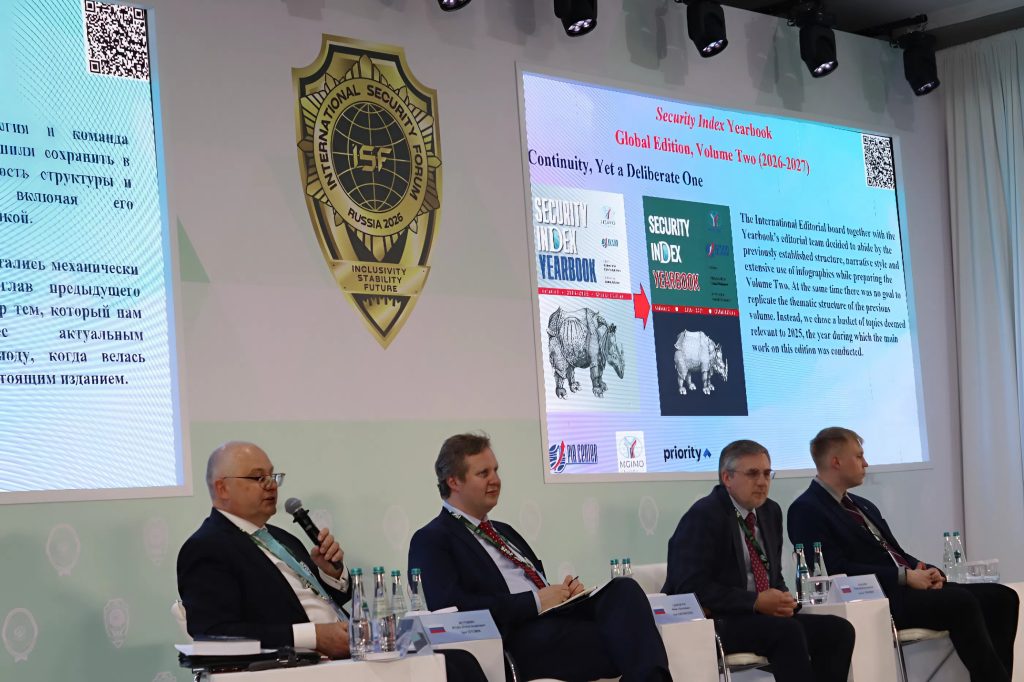
Dr. Vladimir Orlov placed particular emphasis on the international character of the project. The second volume brings together contributors from Russia and other countries, while its content covers a broad range of topics, including global and regional security, Russia’s relations with major centers of power, thematic studies, interviews with statesmen and experts, analytical reviews, and book reviews.
According to Vladimir Orlov, the Yearbook has already gained recognition both within the expert community and in educational institutions, and its readership continues to grow in Russia and abroad. Concluding his remarks, he noted that the project’s greatest value lies not only in the publication itself but also in the creation of a platform for professional discussion on the key challenges facing contemporary international security.
Dr. Leonid Tsukanov, Executive Editor of the second volume of the Yearbook and Consultant at PIR Center, devoted his presentation to the consequences of the escalation between Iran and Israel and its impact on security in the Middle East.
According to Leonid Tsukanov, the parties to the conflict perceive the situation differently and hold differing views on the conditions required for its resolution. At the same time, it is currently impossible to determine a clear winner, as each side assesses the outcome through the lens of its own military, political, and diplomatic achievements and therefore regards its actions as successful.
The Executive Editor also highlighted the role of Iran-aligned groups, the reactions of regional states, issues surrounding Iran’s nuclear program, and the significance of the Strait of Hormuz for regional security. He further emphasized the growing importance of information confrontation and digital instruments, which, despite expectations of large-scale cyber escalation, have thus far remained secondary factors compared with more traditional instruments of pressure.
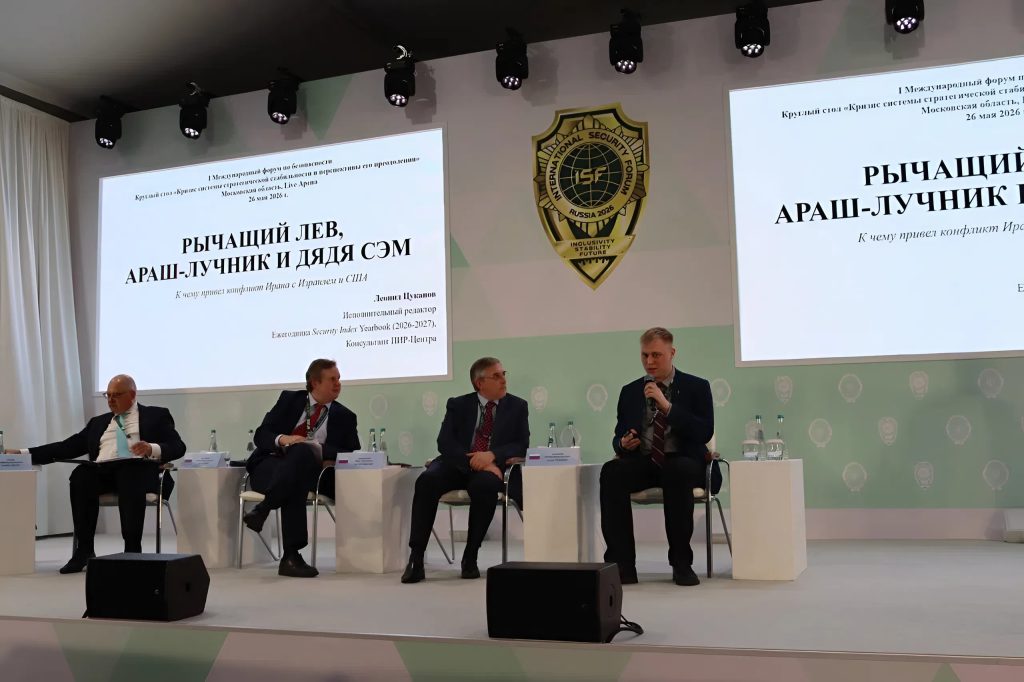
Speaking about the prospects for a settlement, Dr. Leonid Tsukanov emphasized that opportunities for diplomacy remain, although the risk of further escalation is still high. In his view, Russia has the potential to act as a mediator and could contribute to the development of long-term security mechanisms in the region.
Dr. Igor Istomin, Head of the Department of Applied International Analysis at MGIMO University of the Russian Ministry of Foreign Affairs, member of PIR Center Advisory Board, and author of Chapter 29, Times We Do Not Choose: Leading Powers, Intense Rivalries and the Global Security Landscape, examined contemporary international security through the lens of historical cyclicality.
According to the expert, following the end of the Cold War, the world has once again entered a phase of intense rivalry among major powers, with questions of military power, strategic balance, and interstate competition returning to the forefront of international politics. At the same time, challenges such as terrorism, migration, and socio-economic instability continue to remain highly relevant.
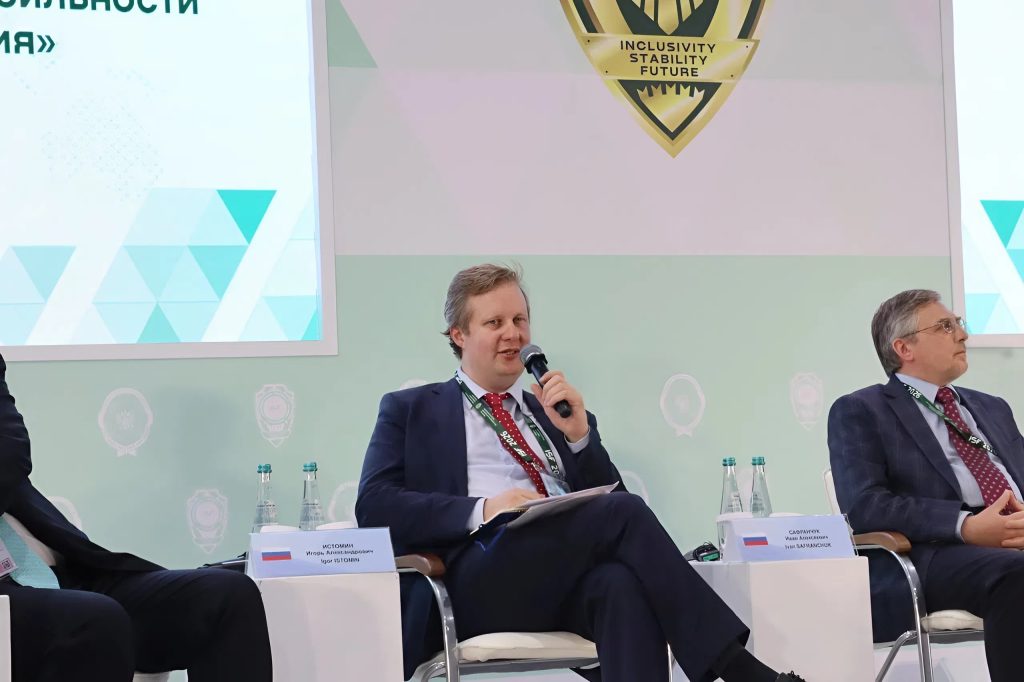
Dr. Igor Istomin noted that the current period of tension is part of a recurring historical cycle and that further intensification of competition among the world’s major centers of power should be expected in the coming years. He identified relations between Russia and the West, China and the United States, and China and India as the principal axes of geopolitical tension.
The expert paid particular attention to the European dimension, which he considers the most dangerous in terms of the potential for military escalation. According to Istomin, the contemporary world has entered a prolonged period of intense great-power rivalry, and this factor will shape the global security agenda for years to come.
Dr. Ivan Safranchuk, Leading Research Fellow at the Institute for International Studies of MGIMO University and a member of PIR Center Advisory Board, presented the findings of the International Hierarchy Expert Survey, an international research project involving more than 200 experts from over 50 countries each year. Safranchuk is also the author of Chapter 19, Wind of Change: World Order Transformation Through the Prism of Expert Assessments.
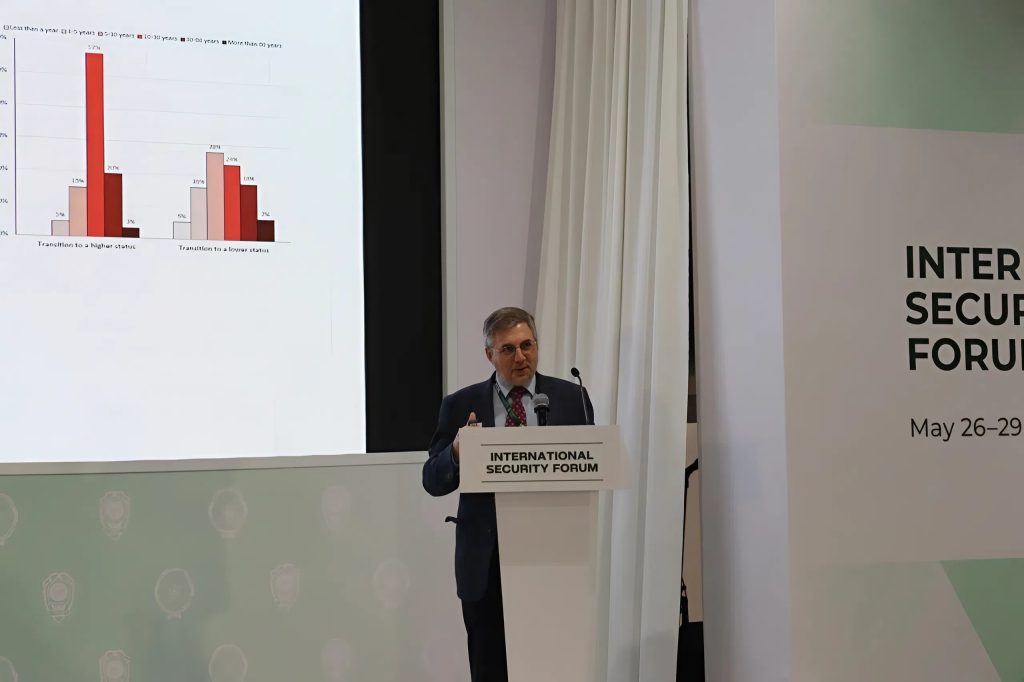
According to the expert, one of the central challenges of the contemporary world is the combination of deep economic interdependence among states with growing political and ideological fragmentation. Under these conditions, the search for new models of international order capable of reconciling sovereignty, development, and global interconnectedness has become one of the most important tasks facing the expert community.
For general inquiries regarding the Security Index Yearbook, please contact Dr. Leonid Tsukanov, Executive Editor of the Security Index Yearbook and Consultant at PIR Center, at tsukanov@pircenter.org.
Keywords: Security Index; Global Security
SIY
E16/SHAH – 26/06/12
