Security Index Yearbook 2026-2027 by PIR&MGIMO Vol.2 Global Edition
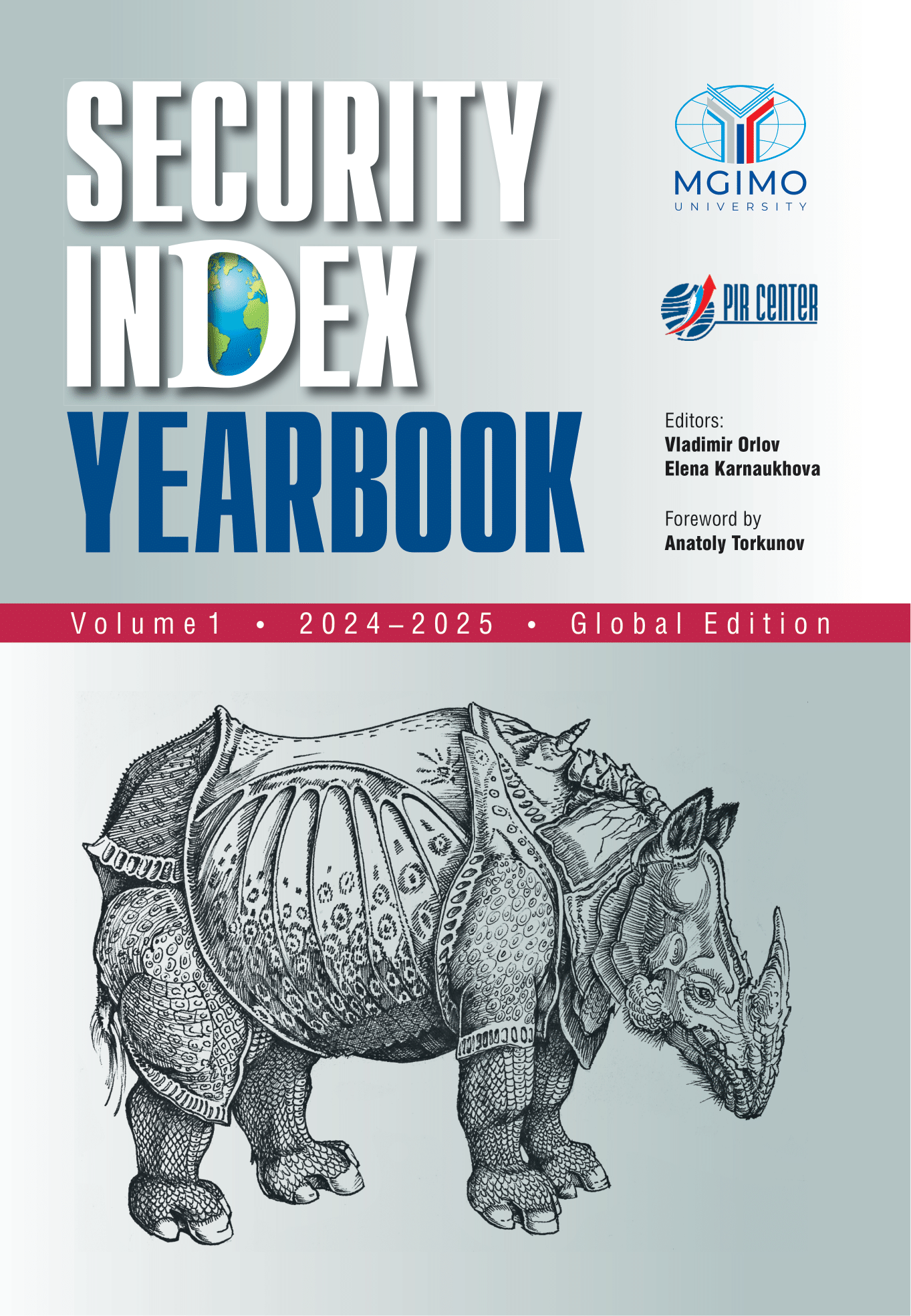
Security Index Yearbook 2026-2027 is a unique collection of analytical materials on the most burning issues of the global and regional agendas in times of growing international tension and Russian approaches to them. This volume highlights the issues of global concern such as international terrorism, nuclear weapons and strategic arms control agenda, nonproliferation of weapons of mass destruction, new types of conventional weapons, space security, and cyber diplomacy. In terms of regional security, it concentrates on Russia-China relations, the Middle East, Russia-Iran relations, the assessment of BRICS prospects, new developments in the relations between Russia and African countries, and security dialogue between Russia and the states of Latin America, to mention just a few. It also contains book reviews and the chronology of recent events in global and regional security.
Security Index Yearbook 2026-2027 Vol.2 Global Edition was officially launched on the sidelines of the 1st International Security Forum and XXIV International School on Global Security in Zvenigorod
Acad. Anatoly Torkunov,
Rector of MGIMO University
The international landscape is increasingly moving away from the model of a global, centralized modernity. The rise of non-Western centers of power – driven not by a rejection of modernization but, on the contrary, by its successful appropriation and acceleration – has contributed to the decentering of modernity itself. In place of a single ‘center’ and a hierarchy of ‘peripheries’, a world of multiple civilizational actors is taking shape. Crucially, these civilizations differ not merely at the level of culture, symbols, or values, but at a more fundamental level: in their social ontologies and epistemologies – how political communities are imagined, how authority is constituted, how order is justified, and how knowledge about international reality is produced and validated. This raises a consequential question for international scholarship and practice alike: what kind of global order can emerge among civilizational states, and which principles and institutions can sustain it under conditions of increasing plurality?
Dr. Vladimir Orlov,
PIR Center Founding Director,
Professor at MGIMO University
“We do not choose our times. Great dynamism is the parent of turbulence and unpredictability. We do engage in forecasting global trends, and we do find it necessary. At the same time, we do not practice pseudo-scientific charlatanry through prophecies and divination; such an approach is banned in our Yearbook. We have therefore chosen the contrary one – it is aligned with the principle articulated by Alexander Pushkin via the character of the chronicler Pimen: to write down unpretentiously all that you’ll witness in your life – war, peace, the rule of sovereigns. It is precisely the principle of unpretentious direct analysis – without much ado! – that has guided our review of the latest global and regional security developments covered in this Yearbook.”
Key words: Global Security; Security Index Yearbook
SIY
E16/NOS – 26/08/26