
№ 6 (9), 2026. How Germany Learned (not) to Love the Bomb. A German Perspective on the History and Prospects of Germany’s Nuclear Policy

April 22, 2026
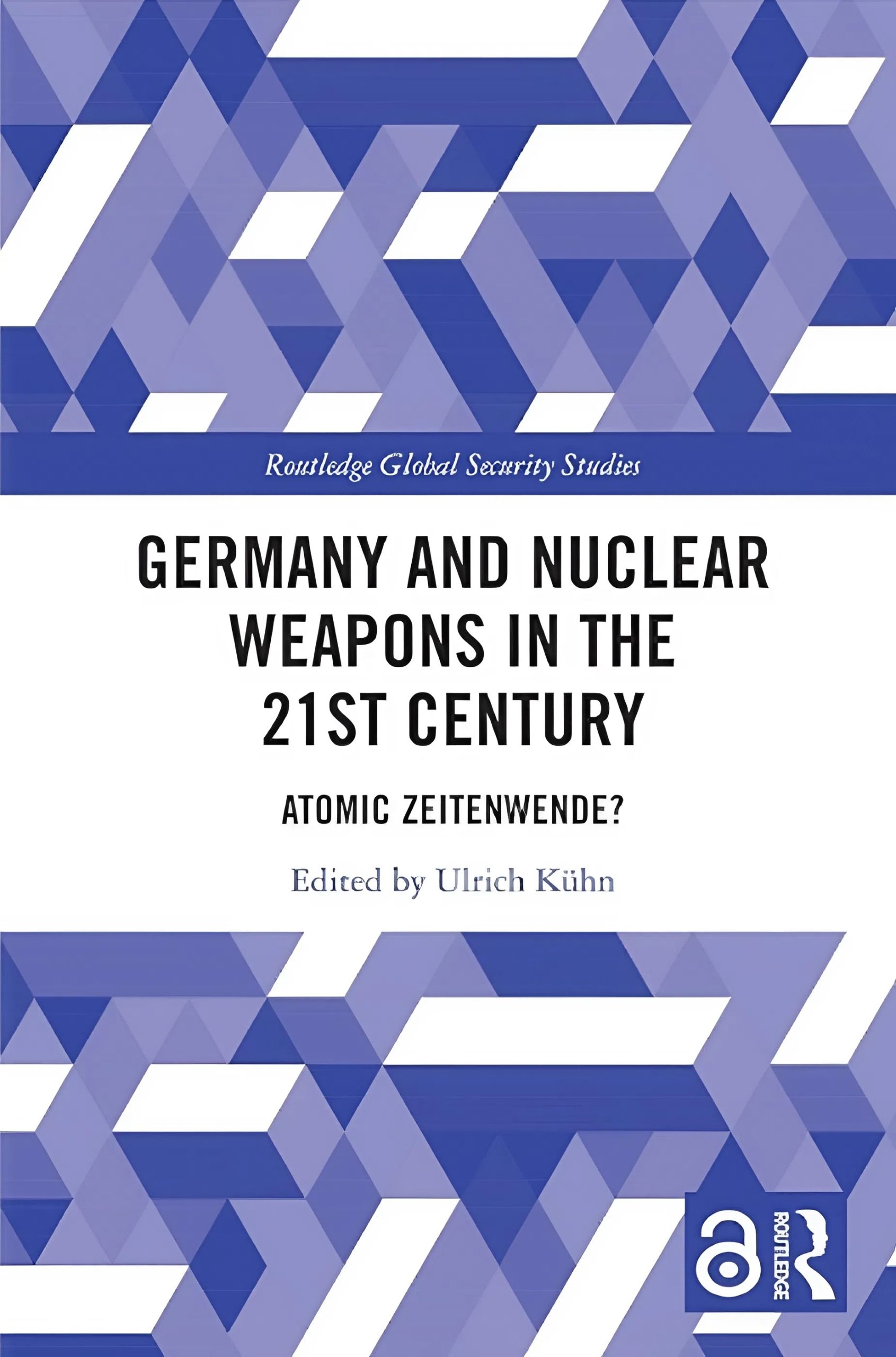
Germany and Nuclear Weapons in the 21st Century: Atomic Zeitenwende? / U. Kühn (Ed.) Abingdon: Routledge, 2024.
ISBN: 978-1032376394
In light of intensified discussions about “European deterrence” and the credibility of the US nuclear umbrella in Europe, the book Germany and Nuclear Weapons in the 21st Century: Atomic Zeitenwende?, published in 2024, is of particular interest. Edited by Ulrich Kühn, it is a representative collection of works united by a common theme: the history, current state, and prospects of the nuclear policy of the Federal Republic of Germany (FRG). Substantionally, perspective, the book examines such topics as Berlin’s course in the field of nuclear nonproliferation, arms control, and disarmament, Germany’s role in maintaining the US extended nuclear deterrence system in Europe and, in particular, NATO’s nuclear sharing, as well as domestic political discussions on these issues. The comprehensive approach and focus on the current stage endow the study with significant scientific novelty.
Ulrich Kühn is the head of the “Arms Control and Emerging Technologies” program at the Institute for Peace Research and Security Policy in Hamburg. The overall team of authors includes more than 10 experts from various countries, including Germany, Austria, Sweden, the Czech Republic, and the USA. It is worth noting that among them is Harald Müller, a professor, member of the PIR Center Advisory Board since 1997, and one of the leading German experts on nuclear nonproliferation. Notably, a concise foreword was written by Catherine Kelleher – one of the leading US experts on arms control and Russia – in January 2023, just weeks before she passed away.
The structure of the book is quite logical and consists of four main parts, in addition to the introduction and conclusion authored by Kühn. The first part is introductory and focuses on analyzing the contemporary context within which German security policy is transforming. The second part centers on issues of nuclear deterrence in German policy, while the third touches upon the second important element – arms control and disarmament. Finally, the fourth and concluding part is devoted to issues of nuclear nonproliferation.
Conclusions about the nature of the international environment surrounding the FRG predictably boil down to the consequences of the special military operation (SMO), which is assessed extremely negatively – in Liana Fix’s words, as a “system transforming war”. There are systematic references to alleged nuclear threats from Moscow that require an appropriate response, but which, it turns out, for some reason do not work. Alongside this, the formation, according to Robert Legvold, of two axes of a new Cold War – US-Russia and US-China – as well as the increasingly rapid development of disruptive dual-use technologies noted in Amy Nelson’s chapter, compel Germany to adapt to new conditions.
This adaptation essentially has two dimensions: ideological and practical, with the introductory part of the book focusing more on the former. It implies the end of the German foreign policy culture of a “civilian power,” which involved, among other things, an emphasis on anti-militarism and restraint in security policy. It is being replaced by a “military” (but supposedly not bellicose) Germany, aware of its responsibility for its own security and that of its allies. At the same time, a number of other elements of a “civilian power” – multilateralism and atlanticism – remain intact. Having begun to think differently about international politics, Berlin also took corresponding practical steps. In this section and further on, special note is made of such measures as the Germany’s acquisition in 2022 of nuclear-capable F-35s to replace obsolete Tornados, the creation of the European Sky Shield Initiative, and a general increase in defense investments.
Elements of new German policy regarding tackling the “Russian threat” are explored in subsequent chapters, among which, in our view, Tobias Bunde’s work stands out for its particular depth and originality. Turning to historical experience, he highlights Berlin’s balancing act between “fears of abandonment” and “fears of entrapment” as a constant in German security policy. The first fear boils down to German uncertainty about the US readiness to come to its aid in the event of a conflict, while the second refers to apprehensions about the FRG being inevitably and destructively drawn into a conflict between the US and the USSR/Russia, and consequently to the desire to have a voice in matters concerning German security – including nuclear planning within NATO. The first fear played a significant role in the deployment of US nuclear weapons in Europe in the 1950s, while the combination of the two fears contributed to the formalization of the “nuclear sharing” system and the creation of the Nuclear Planning Group (NPG) in 1966. Both fears also determined the existence of two seemingly contradictory foreign policy priorities: the “fear of abandonment” justified the importance of German participation in the US extended nuclear deterrence system in Europe, while the “fear of entrapment” fueled emphasizing nuclear disarmament as an essentially correct goal.
According to Bunde and several of his colleagues in the book, simultaneous emphasis on deterrence and disarmament – the so-called “not only, but also” policy (sowohl-als-auch-politik) – characterized the FRG’s nuclear policy up until 2022. The SMO determined a shift in favor of deterrence considerations, which is primarily illustrated by the already mentioned purchase of F-35s, as well as the provisions of the first National Security Strategy of 2023, which emphasize the necessity of nuclear deterrence for the foreseeable future. The reverse shift took place at the turn of the 2000s–2010s (up until the 2014 Ukrainian crisis), when the then-head of the German Foreign Ministry, Guido Westerwelle, spoke in favor of the complete withdrawal of American nuclear weapons from the FRG. True, according to the book’s authors, NSNW deployed in Europe should be viewed rather as a symbol of transatlantic solidarity.
Barbara Kunz and Ulrich Kühn posed a more radical question: could the “Zeitenwende” (turning point) in German policy announced by Olaf Scholz in 2022 push Germany to create own nuclear deterrent or, at the very least, to engageof an independent European deterrence system? They answer both questions with two “no”s. Although current stockpiles of highly enriched uranium in Germany would allow for the production of 14 nuclear warheads in a rather short time, a German nuclear path is currently impossible due to “many barriers and extreme costs”. European deterrence relying on France is unrealistic due to difficulties in adapting Paris’s nuclear doctrine and the “visceral Atlanticism” of German elites, who are skeptical of Emmanuel Macron’s ideas regarding a European “strategic dialogue”. It is noteworthy that the authors highlight the factor of likely retaliatory measures from Russia as yet another obstacle to both decisions. However, Kunz and Kühn still recommend that Berlin participate in the “strategic dialogue,” viewing it as a supplement to the American nuclear umbrella. Stimulating the discussion in this regard is Kühn’s reference to the reservation made by the FRG upon signing the NPT, interpreting the NPT as “not infringing on a possible future European nuclear weapons option”.
Other arguments by Kühn (Chapter 11) concerning German “nuclear latency” and its role in shaping German nuclear policy deserve attention. According to the author, despite the technical capability to create nuclear weapons, at the turn of the 1990s-2000s the FRG refused to instrumentalize it as a means of deterrence or an argument in favor of preserving nuclear power, due to a favorable international environment, the robustness of American security guarantees, membership in the NPT, and domestic opposition to nuclear energy following the tragedies in Chernobyl and, later, Fukushima. Nevertheless, it is acknowledged that a deteriorating security environment could create conditions for a return to nuclear power and, consequently, “nuclear latency”.
The third part begins with a more overarching article by Wolfgang Richter on German role in maintaining the arms control system in Europe up until the withdrawal of the US and Russia from the Open Skies Treaty. Two recurrent themes can be traced: the first is Berlin’s constructive approach, attempting to use all opportunities to preserve the arms control system, and the second is the mutual blame of the US and Russia for its collapse. It is remarkable in the contemporary context that a role in the destruction of the INF Treaty and the Open Skies Treaty is seen not only for Moscow but also for Washington. The German anti-crisis policy on this track essentially amounted to attempts to convince the US (whether the administration of George W. Bush or Donald Trump) of the flaw in their unilateral approach, which ended in failure, and Germany was forced to follow the course of US policy. Influence on Russia also took place, but yielded no results.
Katja Astner and Moritz Kütt transferred Tobias Bunde’s thought on the deterrence-disarmament dynamics to a specific case: the negotiations on the conclusion of the TPNW and its subsequent fate. Caught in a vise between two polar considerations, Berlin ultimately managed to smooth the rough edges and, without being a member of the TPNW, moved away from its initial (in 2017) harsh criticism of the treaty as contradicting the goal of general disarmament, while simultaneously emphasizing the importance of deterrence at the current stage. A distinctive feature of Astner and Kütt’s work is their “thought experiment” – an attempt to envision the procedure for the FRG’s accession to the TPNW. According to the authors, technically and legally this is entirely possible; the problem lies in the political difficulties already outlined. Deserving of attention is the thesis that neither the TPNW nor the Washington Treaty includes provisions that would make it fundamentally impossible for a NATO member state to join the TPNW. Although, of course, the FRG would have to withdraw from the NPG.
Regarding nonproliferation, Harald Müller has quite comprehensively demonstrated the evolution of Germany’s role from a “troublemaker” to a “good citizen” in relation to the nuclear nonproliferation regime. The overall constructive role of the FRG at the NPT Review Conferences is emphasized (for example, the refusal to veto in 2000, despite disagreements on the issue of atomic energy’s environmental issues, or the creation in 2010 of the “Friends of the NPT” group). Beyond the review process, the FRG also played a proactive role, as illustrated by the “Wiesbaden Process,” established under Resolution 1540 and aimed at improving cooperation between national export control authorities and industry. Nevertheless, the author admits that at times the FRG behaved more like a “troublemaker”: in 2005, due to insufficient attention from NPT participants to negotiations on the Fissile Material Cut-off Treaty and the ratification of the Comprehensive Nuclear-Test-Ban Treaty, Germany allegedly facilitated Russia’s use of its veto power.
Harald Müller, like Cornelius Adebahr, also touches upon the subject of the Joint Comprehensive Plan of Action (JCPOA). The general take of the authors is that concluding the agreement would have been impossible without the proactive role of the FRG. Adebahr delves relatively deeper into this issue, noting, among other things, that Berlin sought to use the success of the JCPOA negotiations as a political asset needed to justify the necessity of Germany’s membership in the UN Security Council. Furthermore, a fairly detailed historical background is provided, emphasizing, among other things, the FRG’s role in laying the very foundation for the Iranian nuclear program. Finally, it is noteworthy that both Müller and Adebahr strongly oppose the “P5+1” formulation, preferring “E3+3” as the name for the negotiating format on the Iranian nuclear dossier.
Some other conclusions by the authors of the book seem somewhat less relevant to us, although not lacking in importance and originality. For instance, Michal Onderco examined public opinion in the FRG and identified a general trend toward greater public support for the policy of nuclear deterrence since the beginning of the SMO, and even for the prospects of employing nuclear weapons in various forms in the event of an escalation of the conflict with Russia. However, these findings are somewhat neutralized by the author’s own assertion that German foreign policy, as a rule, does not align with public opinion. Onderco finds an explanation for this state of affairs in the “responsiveness-responsibility” dichotomy: the first element implies satisfying voters’ wishes, while the second implies taking into account longer-term national security interests. Combined with the relatively low importance of nuclear topics themselves for German voters, it turns out that even the trend toward more “hawkish” positions among the German public, and especially the youth, does not have a direct impact on the German leadership’s course.
Finally, the work of Giorgio Franceschini on the evolution of the Green Party’s views on nuclear deterrence and disarmament is worth noting. In line with other authors’ conclusions regarding the general evolution of German nuclear policy, Franceschini also concludes that the tenets of the Greens developed within the framework of balancing two polar flanks: pragmatists (acknowledging the importance of nuclear deterrence at the current stage) and dogmatists (exclusive focus on disarmament), with the former having won out due to the deterioration of the international environment. Currently, the Green Party’s philosophy in the nuclear sphere thus boils down to “pragmatic abolitionism”. However, in our view, studying the corresponding views of a single party – even a ruling one – has its limitations for a general understanding of Germany’s nuclear policy.
Summarizing, we cannot but note that reading the book reveals several leitmotifs that go beyond individual chapters and parts. First, it is the decomposition of the FRG’s nuclear policy into two constantly competing groups of considerations: deterrence versus disarmament. The dominance of one element or the other depends on the specific state of the international environment; in other words, more threats mean more deterrence, and vice versa. Moreover, the second element, although it fades into the background, never disappears; there is a constant balancing act.
Second, as a consequence, German nuclear policy largely appears reactive; that is, it boils down to responding to changes in the environment. The end of the Cold War led to an increased emphasis on disarmament, while the Ukrainian crisis led to the return of the dominance of the deterrence policy.
Third, with regard to the “deterrence” element, enormous attention – without exaggeration – is paid to the Scholz government’s decision to purchase F-35s. It is precisely this step that is presented as an indicator of the FRG’s readiness to rely more heavily on the American extended deterrence in Europe and to contribute to it. This is quite justified, as it is not merely a situational purchase, but a long-term investment based on a political choice.
Fourth, although the book is devoted to the FRG’s nuclear policy, the elephant in the room is the Ukrainian conflict. Surely, the FRG’s unpleasant decisions concerning militarization and reliance on deterrence are based on the securitization of the alleged “Russian threat,” with not only the overall conduct of hostilities in Ukraine but also specifically Moscow’s “nuclear threats” being presented as an element of the latter. However, no one specifies what specific threats are being referred to – they simply exist, and they must be faced. In extraordinary circumstances – even by creating a national nuclear deterrent.
Fifth, let us return to the title of the book, which raises the question of prospects for an “atomic Zeitenwende”. For the team of authors, it is entirely possible from a technical standpoint, but many related issues hinge on the need for political will and Berlin’s readiness to incur significant economic and military-political costs. In other words, if the NPT regime loses legitimacy and is “shaken” to a certain degree, and threats to German security remain at their current level or exacerbate further, Berlin will with sufficient probability decide to create its own nuclear weapons, or at least a European deterrent. It is no coincidence that in the conclusion, Kühn clarifies that “there is no atomic Zeitenwende yet”. In a maximally simplified form, the conclusion of the authors can be presented as follows: nuclear nonproliferation is not sacrosanct, but a situational and pragmatic choice for Germany. And trends are already visible for a revision of this choice.
The main body of the authors’ conclusions is quite well-founded, original, and relevant, containing, among other things, a critical attitude toward certain aspects of the FRG’s modern nuclear policy as well as its history. However, weak points in this work do still exist.
Thus, one cannot fail to note a certain internal contradiction: on the one hand, the SMO is postulated as nothing short of a “system transforming war,” accompanied by the already mentioned “nuclear threats” from Moscow. However, at the same time, it is openly stated that these nuclear threats do not work. In this regard, the question arises: if these threats are already yielding nothing, why should Germany change anything in its own policy and attempt to deter them more effectively? Ultimately, is it all much ado about nothing? “Nuclear threats” from Russia are mentioned numerous times, but they are nowhere specified; there is not a single reference to any Russian doctrinal document or statement by the head of state.
An element of politicization is therefore indeed present in the book, which is perhaps inevitable in the current conditions, although it does not quite align with the spirit of scientific inquiry. Essentially, the considerable number of practical recommendations to the German leadership – whether it be intensifying the “strategic dialogue,” participating in joint air force exercises with France (with a nuclear dimension), and other issues of responding to the “Russian threat” –can also be attributed to the politicized dimension of the work. Tobias Bunde’s own recommendation to enter the “strategic dialogue,” by the way, allows one to identify a second internal contradiction, since he himself states that European deterrence is a “myth”. If this is an unrealistic prospect and a “myth,” then why try in that case?. Probably, Bunde himself would try to answer this rhetorical question by pointing to the importance of general coordination between Paris and Berlin on security issues and improving the bilateral climate, as well as the fact that the “strategic dialogue” can concern more than just the prospect of building European deterrence. But, in our view, that is exactly the essence of the dialogue
One can also argue with the thesis that the TPNW in principle allows for the accession of a NATO member state to the treaty. Even in the event of the FRG’s eventual withdrawal from the NPG and the removal of American nuclear weapons from its territory, such a step would contradict the very spirit of the Treaty, since NATO itself would remain a nuclear alliance with a corresponding doctrine.
In any case, again, the conclusions in the reviewed work are overwhelmingly relevant and distinguished by scientific novelty. The book Germany and Nuclear Weapons in the 21st Century: Atomic Zeitenwende? is characterized by an abundance of factual material and, at the same time, quite profound analysis, despite the aforementioned shortcomings. Compared to the heuristic value of the book, they are non-critical and allow the work to be recommended for reading by all experts interested in nuclear non-proliferation, arms control, and the FRG’s security policy.
Keywords: Nuclear Nonproliferation; Arms Control; European Security
NPT
E16/SHAH – 26/04/22
