
№ 17 (61), 2026. Russia, the U.S., and China in a Changing Strategic Landscape: Interview with Thomas Graham by Alina Pashina on the Margins of the XII International Scientific and Expert Forum “Primakov readings”

June 29, 2026
Exclusive Interview

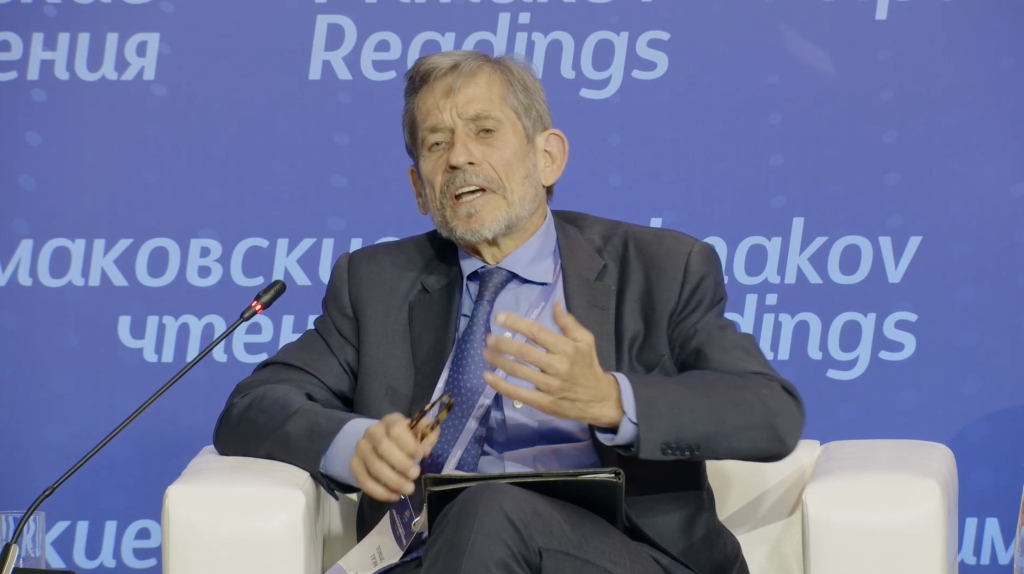
The dialogue between the Russian Federation and the United States is nearly frozen. At the same time the strategic landscape is becoming increasingly complicated with growing China and rapid spread of new technologies. In these conditions are there any prospects for restoring communications on arms control – we discussed with Dr. Thomas Graham, Distinguished Fellow, Council on Foreign Relations (USA).
The interview was conducted by Ms. Alina Pashina, PIR Center intern.
Alina Pashina: The first question is about the risk of escalation. Both Moscow and Washington often stick to maximalist positions. Where would you draw the line where a simple bargaining position ends and the real threat of a complete breakdown in communications and unintended escalation begin?
Thomas Graham: Well, it begins when there’s absolutely no diplomatic contacts between Washington and Moscow. I’m not pleased with the level of contacts at this point, but there continue to be conversations at the highest levels between the two presidents, between national security advisors and so forth and I think that provides something of a break against escalation.
The threat of escalation is not so great between the United States and Russia at this point, as it is between Europe and Russia as a consequence of the Ukraine conflict. That is where I see the real risk at this point.
The United States could play a role of helping to lower the temperature, but it would have to be more actively engaged diplomatically than it is at this point.
Alina Pashina: As for arms control, is the collapse of the arms control system a permanent condition or can it be rebuilt? And if it can be rebuilt, what new elements would it need to include?
Thomas Graham: I think the arms control regime will be rebuilt over time. There’s significant support within the American political establishment. Even if President Trump allowed the new START agreement to expire, he still said that what he supported was trilateral negotiations, and I think that is unrealistic at this point.
Nevertheless, there is continuing recognition that strategic stability is critical to the interest of the United States. We presume it’s also true for Russia. We need to find a way to bring China into the discussions over time. However, beyond that, we all need to recognize that the strategic landscape is much more complicated than it was 40 or 50 years ago, where arms control was an issue only between the Soviet Union and the United States.
Clearly when we are talking about nuclear weapons, China is a player. When we talk about cyber weapons, there are a much broader range of countries that would have to be included in the discussion. Artificial intelligence is going to have a dramatic impact on weaponry and the way the U.S. has fought. So, we need to think more broadly about what arms control is, who needs to be engaged, and we may need, at the end of the day, several different fora to deal with the full range of issues that need to be discussed as a matter of arms control.
Alina Pashina: Speaking about arms control and multilateral negotiations, do you believe they are feasible? This is particularly relevant given China’s stance, which demands either a reduction in existing capabilities by other powers or a pause until China reaches a certain level.
Thomas Graham: There are already some discussions going on between Washington and Beijing about how to talk about these things, but not actually discussions about the substance. However, China is building up its nuclear forces. How rapidly there are different estimates in Russia and in the United States.
At some point China will have to be brought into the conversation. That is a matter for both Washington and Moscow. Not necessarily coordinated between Moscow and Washington, I would presume that at some point, Russia would have questions, for example, about the character of the Chinese nuclear arsenal. Despite all the talk of a strategic alignment at this point, there are fundamental questions that must be answered about how China looks at that arsenal, how it’s going to work. With all those questions that form the content of US-Russian arms control negotiations, the strategic level over the past 60–70 years.
Alina Pashina: Shifting from global to regional level, how should the US and Russia manage competition in regional theatres to prevent them from undermining the broader strategic stability framework?
Thomas Graham: We ought to be discussing regional competition. One of the challenges is managing the competition responsibility. We know there’s going to be competition. We’re two big countries. We have different histories. We have different worldviews. Competition is almost inevitable. The question is whether that competition is managed responsibly or whether it’s allowed to get out of control to the extent that it poses a risk of major escalation and war between our two countries.
I don’t think anybody in Washington or Moscow in a responsible position wants to see war between our two countries. In fact, if you look at the developments in the Ukrainian conflict over the past four years it’s clear that each side has dealt very carefully on issues that they thought might elicit an escalatory response from the other side. So, we need to set up more normal diplomatic relations, regional conflicts need to be on the agenda as they were throughout most of the Cold War, and we need to use that to make sure that each side understands what is driving the other side, where the red lines are, and then, as I said, managing expectations, managing policy to preclude as much as possible the risk of serious escalation.
Alina Pashina: What will be the most practical, actionable first step for the US and Russia to take right now to start de-escalating tensions?
Thomas Graham: There are actually a couple of things. First, I am an advocate of restarting Strategic Stability Talks, I think that would be very important. In addition, if we put together a more comprehensive negotiating process for the Russia-Ukraine conflict, that would also tend to lower the risk of escalation.
So, what we need is serious dialogue, one on an ongoing conflict that has serious consequences for both countries, and then on the long-standing issue that’s existential for both countries, the strategic stability.
I think we’ll eventually get there, but it’s not going to be tomorrow or the day after tomorrow.
Keywords: Arms control; Strategic stability
AC
E16/NOS – 26/06/29
