
CHAPTER 13. “IN THE RHYTHM OF HIGH-TECH”: DEVELOPMENT OF ADVANCED TECHNOLOGIES IN AFRICA AND THE ROLE OF RUSSIA

African nations’ place in the international relations system is evolving. The area is increasingly seen as a quickly growing market for advanced technologies – although a couple of decades ago it was associated mainly with instability and geopolitical conflicts. Experts have been discussing the “New Africa” since the 2000s, and it is slowly taking shape and “declaring its rights” to a portion of the high-tech market. In light of this, it is critical to evaluate the present standing of African nations in the high-tech industry as well as the potential contribution of Russia to the region’s continuous change.
Three high-tech categories are proposed to be examined in this article: “cybersecurity and emerging technologies” (with a focus on the development of cyber incident response systems, the financial technology sector, and the artificial intelligence (AI) market as the fastest growing industries), “space research” and “biotechnology”. In addition to being of the utmost interest to their African counterparts, the listed groups are also the subject of fierce competition between Russia and other superpowers, necessitating continual monitoring.
It is also needed to track the dynamics of the development of the high-tech market in Africa and record its transformations – at least in “broad strokes”.
Cybersecurity and Emerging Technologies: Quickly but Out of Sync
As the world becomes absolutely digital, African states are increasingly focusing on developing national capabilities in the areas of international information and cyber security. Due in major part to the development of mobile infrastructure, Internet penetration in Africa has dramatically increased over the past ten years. This growth in connectivity has, in turn, positioned Africa as an emerging market for ICT-actors, including cloud service providers, telcos, and equipment vendors.
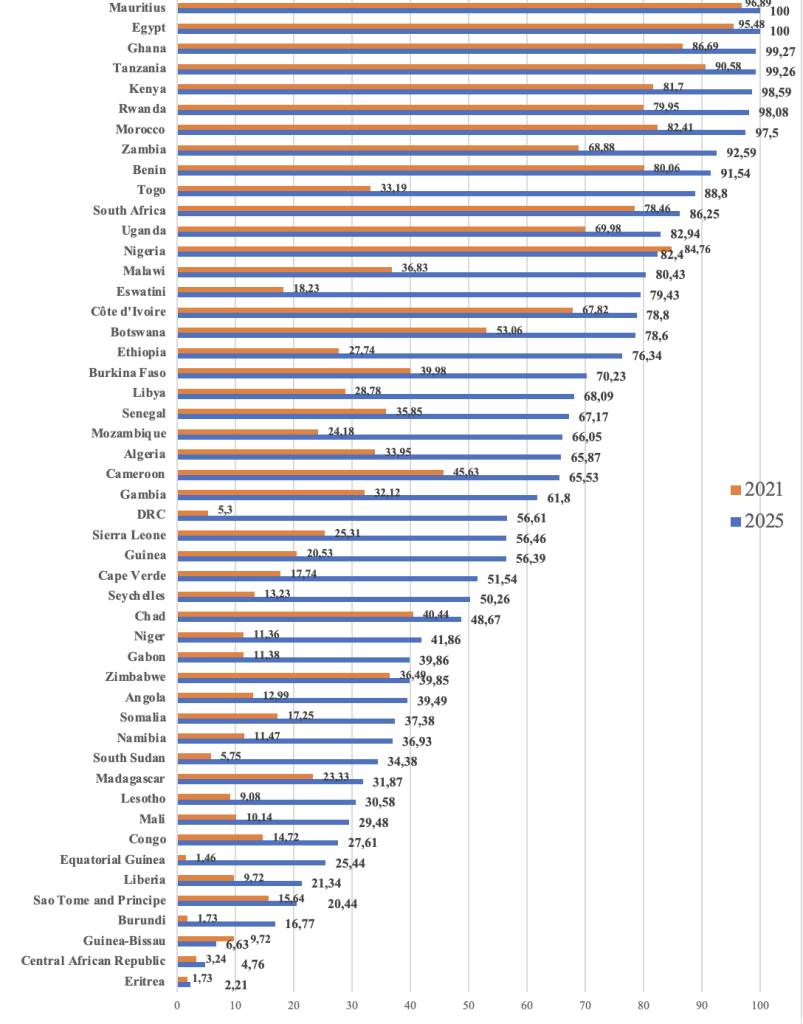
In terms of digital security, Mauritius and Egypt are the leading powers in the region (who reached the stage of absolute cyber readiness to early 2025)[1]. Their high positions are explained by its systematic efforts to develop a national legal framework for digital security, as well as its focus on public-private partnerships and international cooperation. In addition, the top ten cyber powers in Africa include Ghana, Tanzania, Kenya, Rwanda, Morocco, Zambia, Benin and Togo[2].
Overall, the vast majority of African countries have increased their information and cybersecurity capabilities in the last few years. Some of them have done so quite significantly. For example, Togo has shown sprinting pace, with its overallcyber readiness score increasing more than 2.5 times (from 33.18 to 88.8 points), Ethiopia (2.8 times), Eswatini (4.4 times), the DRC (10.6 times), and Equatorial Guinea (17.5 times).
Only two African states showed a weakening of their indicators: Guinea-Bissau (from 9.72 points in 2021 to 6.63 in 2025) and Nigeria (from 84.76 points in 2021 to 82.4 in 2025)[3]. In both cases, this was due to the authorities’ reduced attention to the development of a specialized legislative framework and its adaptation to new digital challenges.
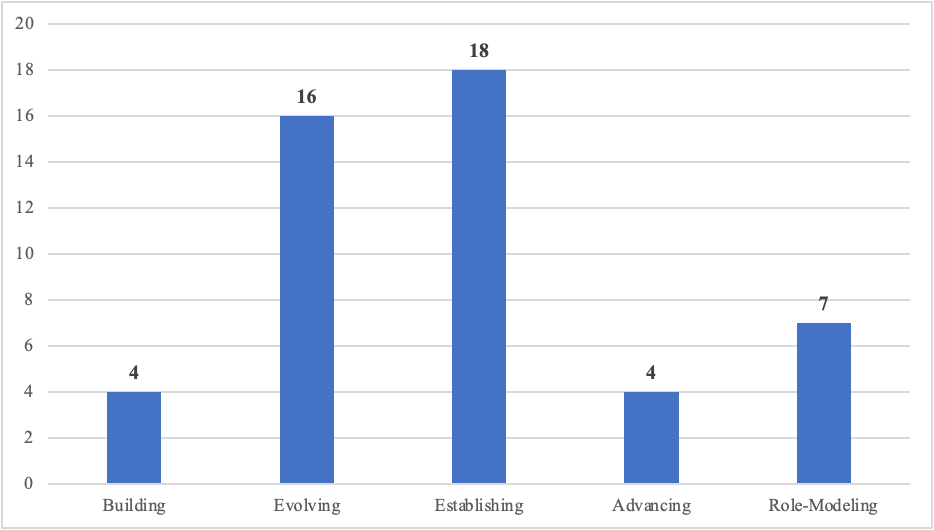
At the same time, even taking into account the noticeable technological breakthrough, the region lags behind both European and Asian competitors. Thus, according to estimates by the International Telecommunication Union (ITU), only seven African countries[4] are included in the group of Role-Modeling players whose aggregate cyber readiness indicators have reached the maximum value or are close to it[5]. At the same time, about 60% of the countries in the region still occupy the “middle” position (that is, they have a well-built national cybersecurity system and are able to cope with the main challenges from the digital space, but do not anticipate the risks).
A common problem for most African countries in matters of developing digital projects remains the poor adaptation of the legislative framework to the rapidly changing realities of the digital world. In addition, the vast majority of regional players do not have a long-term strategy for developing competencies in the field of information states, and the powers between the responsible institutions within the states is unevenly distributed: duplication of functionality and bureaucratization of the system remains a common occurrence.
At the same time, it is inappropriate to think that the digital sector of Africa is in a stagnant state: the presence of acute problems encourages national governments to forcefully strengthen its most sensitive components. Thus, in 70% of the countries in the region, a legislative basis for the protection of personal data has been formed; another 10% of countries are actively working in this industry. In addition, every second state in Africa has created Computer Emergency Response Teams (CERTs) – in a number of countries, there are also private and industry monitoring groups[6].
It is also important to mention the consolidating role of regional organizations – first and foremost, the African Union, on the basis of which modular projects and recommendations are being elaborated for the development of national competencies in the field of cybersecurity, and measures are being taken to improve the qualifications of decision-makers in the digital sector.
African countries are showing an increased interest in the FinTech industry. This area is significantly ahead of other technological sectors of the continent’s economy in terms of development. As of the middle of 2025, Africa is “home” to over 500 FinTech startups, half of which were created between 2019 and 2025. The most popular areas in the region are payment processing and e-wallets, alternative lending tools, and various wealth management solutions.
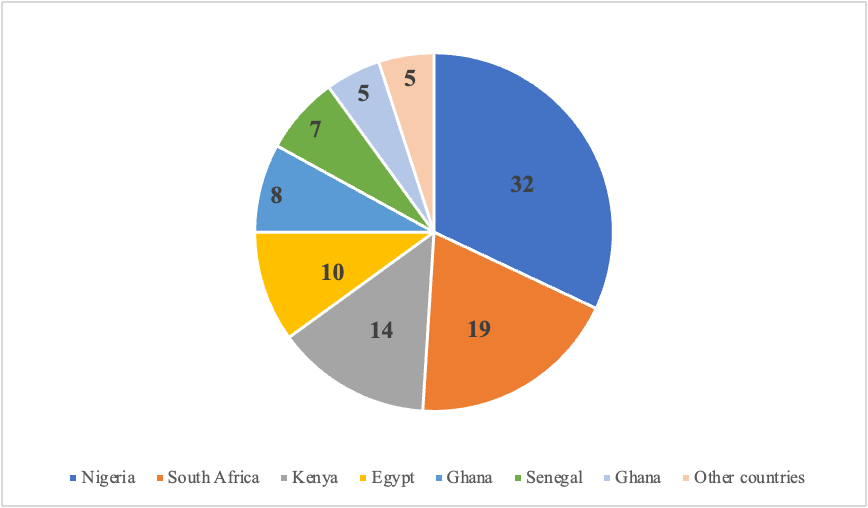
The financial technology market of Africa relies on three countries – Nigeria, Kenya and South Africa: they have the largest number of startups. Senegal and Tanzania are also demonstrating success in developing specialized solutions. Other regional players prefer to purchase ready-made products. The largest investors in the African fintech market are American and Chinese companies.
Dwell separately on the artificial intelligence sector. As recent measurements by Google and Ipsos show, African countries are more loyal to “AI expansion” (compared to representatives of EU or Asian countries – including those that surpass African players in terms of scientific and technological development), positioning them as a tool for accelerating national economies and optimizing production processes[7].
At the same time, the real level of readiness of the states of Africa to implement new technologies – in terms of the adaptation of national institutions and the regulatory framework – still leaves much to be desired. Thus, as of mid-2025, no more than 25% of the countries in the region can boast of the readiness of national legislation for the “AI revolution”, no more than 20% of the countries have specialized long-term development strategies; only a few regional players (South Africa, Nigeria, Egypt and Kenya) are ready to systematically export their own technical solutions to the global market[8].
Space Research: Small Steps Tactics
African countries are striving to join the exploration of outer space on an equal basis with other powers. Since the first launch of the first African satellite (Nilesat-101, Egypt, 1998), more than $4.7 billion has been spent on space projects in Africa, and this amount is growing in arithmetic progression from year to year.
There are 22 national space agencies operating on the Continent, most of which are concentrated on developing satellite projects: this sector is the main focus of efforts for the countries of the region. As of mid-2025, 67 satellites have already been launched from Africa. The leaders in terms of the number of launches are Egypt and South Africa – they account for up to 40% of all launched satellites.
It should be noted that the emphasis on the development of space programs (primarily satellite) in Africa is explained by the desire to improve food and climate security, as well as to solve problems in the telecommunications sector, ensuring more stable and high-quality communications and television and radio broadcasting.
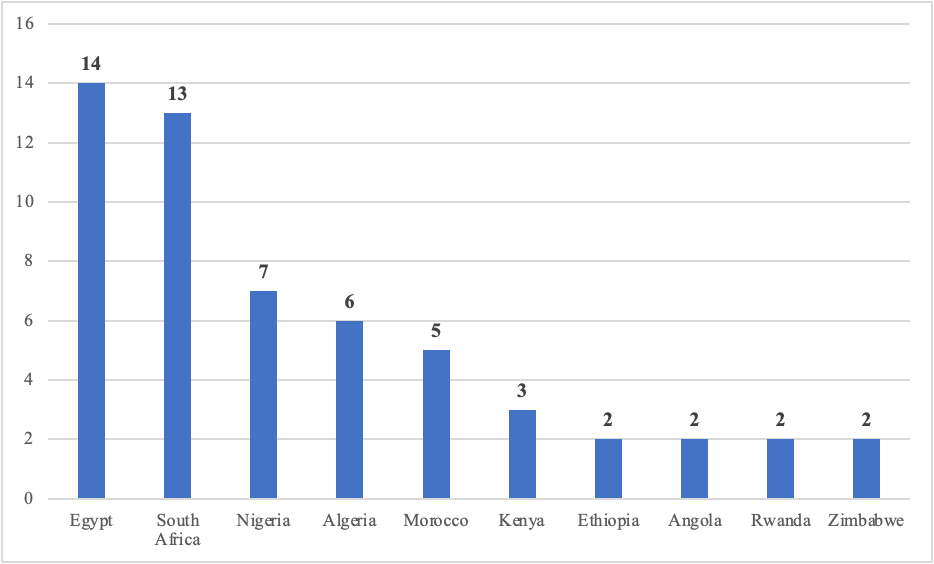
African countries are seeking to pool each other’s scientific and technical potential to ensure more effective development of the space sector. Including under the auspices of regional integration platforms. The foundations of Africa’s “continental” space agenda were laid back in early 2016. Then, at the 26th session of the Assembly of the African Union (AU), the “African Space Policy and Strategy” was adopted – the organization’s supporting document and a key benchmark in the development of the space sector. The document emphasizes the importance of space for achieving sustainable development, emergency management, monitoring climate change and socio-economic growth. A year later, in 2017, the African Space Agency Act was adopted, establishing the legal framework for overseeing space activities.
The apogee of the development of space cooperation on the Continent was the establishment of the African Space Agency (AfSA), whose activities officially began in November 2025, involves 55 players (54 African countries and the unrecognized Sahrawi Arab Democratic Republic, SADR)[9], with Egypt playing the leading role. Cairo not only agreed to be one of the pillars of the overall space project, sharing scientific and technical developments with its neighbours, but also provided a platform for the creation of the agency. It is expected that in the coming years, AfSA will become a “link” in Africa’s cooperation with Europe and other international partners.
Of course, despite the rapid development of local science and the deepening of interstate cooperation, the capabilities of African countries in the space sector are still limited. In the ranking of the competitiveness of national space programs, African players are noticeably behind both European and Asian competitors. Relatively high positions are occupied by Nigeria (23rd place), Egypt (27th place) and South Africa (33rd place)[10]. However, even they are rated by experts as no higher than the second level (out of seven possible)[11]. In this sense, regional players remain dependent on superpowers, which gives rise to a discussion among African alarmists about “space colonialism”[12].
However, there is still a way out of the technological trap that pessimists talk about. For example, one of potential development drivers of the African space industry in the near future could be the so-called “NewSpace” – a system of private space agencies operating without being tied to government projects. According to the reports of the “Space Africa” project, there are already more than 300 space startups registered in the region (which is almost ten times more than five years ago[13])[14]. However, their distribution is still uneven: more than 40% of specialized companies are registered in South Africa and about 25% in Egypt, another 24% is the combined figure of Mauritius and Nigeria. Kenya is also showing interest in space startups, but at the moment only a couple specialized company has been created there[15]. The remaining African players so far prefer to invite foreign NewSpace companies rather than establish their own.
Biotechnology: a Quiet Revolution
The prospects for the development of the biotechnology market in Africa have traditionally served as a basis for discussions both in the academic community and among decision-makers. The prevailing opinion in the region at the moment is that it is especially important for African countries “not to be late” and to occupy their niche in the biotechnology industries in a timely manner – both to ensure national security (its food and epidemiological components) and the stability of the region as a whole[16].
South Africa is a recognized regional trendsetter in the field of biotechnology. The country leads in the number of patented solutions in the field of advanced pharmaceuticals[17], and also allocates the largest funding for the development of medical programs, which is part of efforts to comprehensively restructure the national economy[18]. The long-term strategy for expanding the biotech sector of the Republic provides for the concentration of forces and resources on the development of not only crop production and pharmaceuticals, but also the entire biomedical and biotechnological complex, including the creation of genetically modified products[19]. Certain qualitative growth has been demonstrated by Rwanda, Senegal and Ghana, which have consolidated their efforts in the field of vaccine and serum development.
The agricultural sector has traditionally been the focus of efforts for most African countries. It provides employment for more than 60% of the workforce and about 15–20% of the total national GDP of most African countries[20]. And given the rapid growth of the local population (with the prospect of crossing the mark of 2,5 billion people by 2050[21]), the focus on increasing the technology and efficiency of processes in the agro-industrial complex is acquiring strategic importance.
Today, African farmers (especially smallholders who cultivate no more than two hectares of land) face rapidly depleting soils, unstable yields, and natural threats[22]. Given ongoing climate change, exacerbated by political and economic instability in parts of Africa, food security continues to decline. New hotbeds of tension are emerging.
Genetic modification (also known as GMO) can help mitigate some of the challenges in the agricultural sector and improve the efficiency of land cultivation. It allows modifying or adding genes that provide desired characteristics, such as resistance to pests or the ability to tolerate drought. GMO methods are faster and more reliable than any other main methods of traditional breeding, where the results can take several decades. In the context of the intense competition for crop yields, typical of Africa, genome editing is gradually turning from a taboo topic into a completely natural production process. Especially after the COVID-19 pandemic, which disrupted traditional production chains and brought a number of countries in the region to the brink of famine.
It is not surprising that some African countries that had previously criticized genetic engineering have changed their position and amended their national legislation accordingly. Nigeria was one of the first to take this step, allowing genome editing in 2022[23]. A few months later, Kenya (where the ban on the production and circulation of GMO products had been in effect for more than ten years) and Malawi took similar steps [24]. And in 2023, Ghana joined the group of GMO-tolerant countries[25].
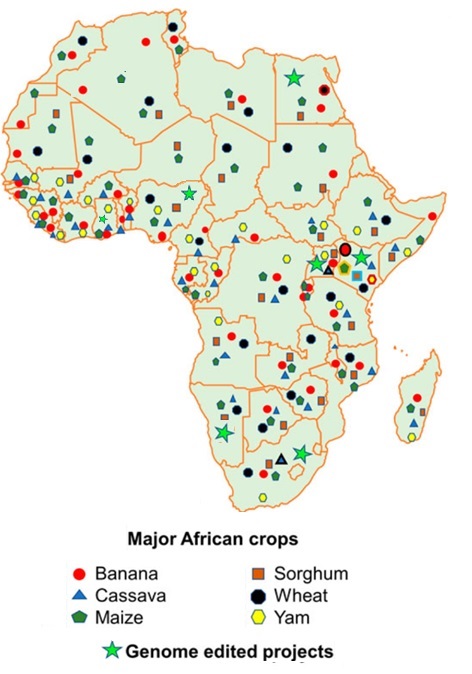
As of 2025, at least seven countries in Africa are conducting ongoing research in the field of genome editing, with the palm of primacy belonging to Nigeria, South Africa and Egypt. The most active donor of genome editing technologies for African partners is China, where the production of modernized crops is put on stream[26].
At the same time, despite the noticeable qualitative transformations that have occurred in the biotech industry of Africa, the development of the market is still associated with significant risks: many investors do not show much interest in developing contacts with African biotech centers, fearing the impact of political and economic upheavals typical for the region. In addition, the biotech industry of African countries is experiencing an acute shortage of qualified personnel – a “brain drain” occurs both abroad and to African countries with a more developed medical technology market.
Different Backgrounds – Common Features
As has been mentioned above several times, African countries have different starting positions in high-tech industries. This is due to both historical and political-economic reasons. In addition, each country in the region has its own unique starting landscape, which has laid down the specifics of the approach to the development of the high-tech sector, as well as the priorities of international cooperation in this area.
However, there is a number of factors that are common to all African countries without exception.
The first is a focus on intensifying international cooperation. African countries view interaction with external partners as a guarantee of achieving leadership in the technological race and strive to expand their “contact portfolio” as much as possible. Often trying to balance between competing forces (between Türkiye and France, India and China, the US and China, etc.) and receive dividends from both “camps”.
This factor also explains the inclination of African players to purchase ready-made (in some cases, partially ready-made) technological solutions instead of developing their own. This tendency is especially strong in the sectors of digital security and biotechnology, where the vast majority of African players are in a catch-up position and do not yet have sufficient scientific, technological and personnel reserves. Of course, some countries are making confident steps towards technological independence, challenging competitors at the global level (for example, South Africa in the field of biotechnology, Mauritius in the cybersecurity sector, Nigeria in the financial technology sector, etc.), but even they do not rely solely on their own developments. On the contrary, they see diversification of the “technological portfolio”as a measure necessary to strengthen national scientific and technical potential without compromising economic development[27].
Another common theme among African states is the underlying fear of a new pandemic similar to or worse than COVID-19. While the global pandemic has given the region’s tech market a major boost, it has also been a major stress test for African players, slowing economic growth and leading to the curtailment of a number of significant initiatives. Africa is trying to prepare for a new challenge of this kind in advance.
This fear is also projected onto the high-tech sector and is expressed, in particular, in the desire to integrate the maximum number of advanced technological solutions into production processes without their preliminary testing (which often leads to the use of interchangeable or mutually exclusive solutions within the same enterprise). This trend is especially noticeable in countries that have faced serious economic or socio-political risks during the pandemic (Egypt, Namibia, Morocco, Nigeria, etc.), but is also not alien to those who have ultimately passed the main threat.
Finally, all African players without exception are faced with manifestations of neocolonialism. Western counterparts are still inclined to perceive Africa as a field of struggle for influence and a sales market for new technologies; an arena of confrontation between Russia and the US, Europe and Türkiye, the US and China. At best, as a junior partner. However, not as an equal player with its own interests and priorities[28]. Asian players (India and China) are trying to broadcast an alternative approach[29], but their generous offers, as a rule, hide a double bottom. This irritates Africans – especially the younger generation, who are striving to secure the right of the countries of the region to acquire technological sovereignty, and not its surrogates[30].
A basic understanding of the above factors, which partly shape the outlook of African players on the high-tech market, is important when building contacts with the region and finding “initial points of contact” with promising partners.
Russia – Africa: Where is the Window of Opportunity?
Russia’s approach to building relations with Africa has undergone significant changes in recent years. Since 2019, when the first “Russia-Africa” summit was held, the number of areas of interaction covered within the framework of the multilateral dialogue has gradually expanded[31]. The high-tech sector is no exception: Moscow is interested in increasing the export of its own solutions to African markets (especially in light of the ongoing foreign policy reorientation of the region’s states).
The accelerated rapprochement is facilitated, among other things, by the fact that Moscow and the African powers have generally coinciding views on the global security landscape (including challenges related to the development of high-tech industries)[32], and also largely converge in their assessments of the prospects for the transformation of the global economy. In addition, Russia supports the desire of the countries of the region to gain full technological sovereignty (without “neo-colonialist overtones”), which appeals to regional players striving for independence and equality with the Old World.
…We reject so-called technological colonialism. That means that we do not make our partners dependent on Russian technical solutions. On the contrary, we are helping them create their own, sovereign national nuclear industry. This includes training personnel and establishing centers of excellence. Moreover — we’re sharing experience and knowledge in developing other cutting-edge 21st-century industries, including nuclear medicine, digital systems, electric transport, and new materials. As a result, we’re helping our partners make a real leap forward in development, take the economy to a new level of efficiency, and ultimately improve people’s quality of life.
Vladimir Putin
President of Russia
September 25, 2025
https://tass.com/economy/2021319
The greatest demand for Russian experience today is observed in the digital security sector. Despite the fact that in the ITU cyber readiness rating published in the fall of 2024, Russia in the global standings was inferior in terms of the aggregate indicator to eight African countries (Mauritius, Egypt, Morocco, Ghana, Tanzania, Kenya, Rwanda and Zambia)[33], its practical experience (especially in terms of improving national potential and regulatory activities) is still irreplaceable – especially in matters of repelling massive cyberattacks against critical information infrastructure and developing the social dimension of digital security[34]; domestic FinTech and E-Government solutions are of particular interest[35].
At the same time, in the sphere of artificial intelligence and software development, Moscow is still in a catch-up position – behind the leaders of the race, China and the United States. Cooperation with African countries in this sector is mostly intermittent. On the other hand, thanks to the development of import substitution tools, Moscow is gradually reducing the gap and is looking for possible points of expanding partnership – both at the interstate level and through big business[36].
Space is another potential area for a more systematic application of efforts. Moreover, Moscow has been interested in supporting African space dreams for several years now. The current task that Moscow sets on the Continent is to more systematically involve African states in the development of scientific and manned space projects and national satellite programs, including relying on the capabilities of AfSA. The long-term goal of Russian-African cooperation should be the creation of a separate orbital module as part of the Russian Orbital Station (ROS). And here, despite the change in the leadership of Roscosmos in February 2025, the continuity of ideas will be preserved[37].
At the same time, in the area of space research, the question of the prospects for Russia to build a new cosmodrome on the Continent remains unresolved. Despite the fact that by the end of the year the first candidate for the implementation of these plans (Zimbabwe) appeared[38], the project is still in its initial stages; it will not be fully implemented before 2034.
As for the biotechnology sector, there is still increased attention to the advanced pharmaceutical sector (in terms of vaccine development and production)[39]. Russia positions “vaccine diplomacy” as a natural response to the unstable epidemiological situation in Africa and demonstrates its readiness to fight the most serious threats (malaria, dengue fever, etc.) shoulder to shoulder with Africans. It is assumed that over the next few years, the parties will work on localizing drugs and deploying production chains in African countries[40].
Further expansion of presence in the market of solutions for the agro-industrial complex of the African countries also looks promising. As of mid-2025, every third regional power demonstrates interest in purchasing biotechnology for the needs of the agro-industrial complex. At the same time, individual players (Mali, Nigeria and Ghana) are ready not only to purchase, but also to jointly develop advanced solutions for the agricultural sector [41], which opens an additional window of opportunity for Moscow.
Conclusion
The technological dimension of African countries is in the stage of active transformation. The overwhelming majority of regional states consider the high-tech sphere as a potential growth zone and express readiness to invest in its development; actively adopt the experience of foreign partners.
At the same time, it is too early to talk about a full-fledged “high-tech transition” in the region: no more than half of the regional powers can boast of stable positions in high-tech industries, while only a few of them (South Africa, Egypt, Nigeria, Ghana, Kenya) are able to fully compete in the global market and permanently hold one or several high-tech niches.
Russia’s importance and its involvement in African high-tech projects are growing – although sanctions and the “long-term absence” of stable conductors of its interests in the region (due to a combination of historical reasons) significantly limit the effectiveness of the onslaught. Moscow is still in a catch-up position in the race for influence on the African continent, competing with both Western and Asian players.
However, even taking into account the sanctions, Moscow has a more advantageous position in the region compared to most Western competitors (since it is less susceptible to the influence of the “colonialist discourse”), and is therefore closing the gap faster than was predicted in the late 2010s. And the focus on intensifying dialogue with mid-level entrepreneurs and the economic community of the region as a whole should contribute to further strengthening of its positions.
[1]Global Cybersecurity Index (GCI) 2024 // ITU. URL: https://www.itu.int/en/ITU-D/Cybersecurity/Documents/GCIv5/2401416_1b_Global-Cybersecurity-Index-E.pdf
[2] Ibid.
[3] Ibid.
[4]Taking into account Egypt and Morocco, which are included in the group of Arab countries by the ITU.
[5] For comparison: ITU experts classify 20 European countries and 11 countries in the Asia-Pacific region as belonging to the “Role-Modeling” group.
[6] AfricaCERT. URL: https://www.africacert.org/african-csirts/
[7]Our life with AI: The reality of today and the promise of tomorrow // Google Reports. URL: https://static.googleusercontent.com/media/publicpolicy.google/en//resources/our_life_with_ai_google_ipsos_report.pdf
[8] Concluded on the basis of an analysis of national approaches to the development of the AI sector in African countries (including the regulatory framework, institutional system, economic landscape, etc.).
[9] African Space Agency. URL: https://africanspaceagency.org/
[10]Countries with Space Programs 2025 // World Population Review. URL: https://worldpopulationreview.com/country-rankings/countries-with-space-programs
[11] This category includes countries that are developing the space industry and participating in the satellite launch program. See: Countries with Space Programs 2025 // World Population Review. URL: https://worldpopulationreview.com/country-rankings/countries-with-space-programs
[12]Africa can’t stay out of the space race // Institute for Security Studies. May 7, 2021. URL: https://issafrica.org/iss-today/africa-cant-stay-out-of-the-space-race; Decolonization in the second space age // Danish Institute for International Studies. February 24, 2025. URL: https://www.diis.dk/en/research/decolonisation-in-the-second-space-age
[13] NewSpace Africa Industry Report (2019) // Space in Africa. URL: https://africanews.space/newspace-africa-industry-report/
[14] NewSpace Africa Industry Report (2024) // Space in Africa. URL: https://spaceinafrica.com/product/newspace-africa-report-2024/
[15]Ibid.
[16] See: L’Afrique ne peut pas se permettre de rater la révolution du gène // VivAfrik. February 5, 2019. URL: https://vivafrik.com/2019/02/05/lafrique-ne-peut-pas-se-permettre-de-rater-la-revolution-du-gene-a24301.html (in French).
[17]Since 2007, South Africa has consistently accounted for at least 85% of biotech solutions patented on the African continent. See: Boitumelo S. Investment performance of the South African biotechnology industry and potential financing models // University of the Witwatersrand. URL: https://wiredspace.wits.ac.za/items/136dc910-6c4c-4997-9ddc-0b00134317b2
[18]In strategic planning documents, in particular, it is noted that the transition to an innovative vector of development is being carried out in modern South Africa in order to improve the standard and quality of life of the country’s population (primarily the previously discriminated black majority) and to solve social problems. See: The Bio-Economy Strategy // Science and Technology Department (South Africa). September 10, 2014. URL: https://www.gov.za/sites/default/files/gcis_document/201409/bioeconomy-strategya.pdf
[19]Ibid.
[20] Africa Agriculture Status Report (2025). URL: https://agra.org/publications/africa-agriculture-status-report-aasr/
[21]By 2050, a quarter of the world’s people will be African – this will shape our future // the Guardian. January 20, 2022. URL: https://www.theguardian.com/global-development/2022/jan/20/by-2050-a-quarter-of-the-worlds-people-will-be-african-this-will-shape-our-future
[22]Mahmoud M. Managing Threats to Food Security: Water and Agricultural Resilience in North Africa // Middle East Institute. May 27, 2025. URL: https://www.mei.edu/publications/managing-threats-food-security-water-and-agricultural-resilience-north-africa; Top 5 Challenges with Agriculture in Africa and How ThriveAgric is Tackling Them // ThriveAgric. February 5, 2024. URL: https://thriveagric.com/resources/hectare/top-5-challenges-with-agriculture-in-africa-and-how-thrive-agric-is-tackling-them
[23]CSOs commend Senate for considering bill that seeks to regulate GMOs in Nigeria // CAPPA. April 20, 2020. URL: https://cappaafrica.org/2022/04/20/csos-commend-senate-for-considering-bill-that-seeks-to-regulate-gmos-in-nigeria/
[24]Updates on Global Regulatory Landscape for Gene-Edited Crops // ISAA.Inc. January 24, 2024. URL: https://www.isaaa.org/blog/entry/default.asp?BlogDate=1/24/2024
[25]Ibid.
[26]China is embracing genetically modified crops. Africa, what are you waiting for? // Agricultural Economics Today. January 3, 2025. URL: https://wandilesihlobo.com/2025/01/03/china-is-embracing-genetically-modified-crops-africa-what-are-you-waiting-for/
[27] See: From digital dependence to digital sovereignty // T20 South Africa. September 5, 2025. URL: https://t20southafrica.org/commentaries/from-digital-dependence-to-digital-sovereignty-south-africas-g20-opportunity-in-the-age-of-ai/
[28] Nicaise A. The Challenges of Combating Neocolonialism in Africa // Valdai Discussion Club. February 7, 2025. URL: https://valdaiclub.com/a/highlights/the-challenges-of-combating-neocolonialism/
[29]Thus, India (which positions itself as a power that suffered from colonialism in the past) in its dialogue with Africa is based on the “Kampala Principles” formulated by Prime Minister Modi in 2018. Their main element is Delhi’s public renunciation of “benefits in return” and its opposition to the “selfish donors” of the region (which, as a rule, mean China, the United States and European players). See: Prime Minister’s address at Parliament of Uganda during his State Visit to Uganda // Ministry of External Affairs. Government of India. July 25, 2018. URL: https://www.mea.gov.in/Speeches-Statements.htm?dtl/30152/Prime+Ministers+address+at+Parliament+of+Uganda+during+his+State+Visit+to+Ugand; China, on the other hand, builds its policy based on economic cooperation – the mega-project “One Belt, One Road” and related political and philosophical concepts (for example, the “Community of Common Destiny”). See: Maslov A. “It is practically impossible to overtake China in investments in Africa” // RIAC. July 25, 2023. URL: https://russiancouncil.ru/analytics-and-comments/comments/obognat-kitay-po-investitsiyam-v-afrike-prakticheski-nevozmozhno/ (in Russ.).
[30] Nicaise A. The Challenges of Combating Neocolonialism in Africa // Valdai Discussion Club. February 7, 2025. URL: https://valdaiclub.com/a/highlights/the-challenges-of-combating-neocolonialism/; Neocolonialism is holding Africa back from true independence // Queen’s University Journal. January 21, 2025. URL: https://www.queensjournal.ca/neocolonialism-is-holding-africa-back-from-true-independence/
[31]Russia-Africa Partnership Forum Action Plan 2023–2026 // President of Russia. July 28, 2023. URL: http://en.kremlin.ru/supplement/5971
[32]Concluded based on an analysis of national security and cybersecurity strategies, as well as military and economic planning documents of African states.
[33]Most of these countries (except Zambia) are included in the “Role-Modeling” group, while the Russian Federation and Zambia are assigned to the lower “Advancing” group. ITU experts explain the decrease in the aggregate indicator of the Russian Federation and its transfer to the “Advancing” group by a drop in technical measures and international cooperation, which is due to the strengthening of the sanctions and a decrease in the intensity of international contacts between the Russian Federation and Western countries in the cybersecurity profile. See: Global Cybersecurity Index 2024 // ITU. September 15, 2024. URL: https://www.itu.int/en/ITU-D/Cybersecurity/Documents/GCIv5/2401416_1b_Global-Cybersecurity-Index-E.pdf
[33] Ibid.[34]Chernyshenko: By 2030, Russian websites will be subject to cyberattacks every 2 seconds // TASS. April 16, 2024. URL: https://tass.ru/obschestvo/20560057 (in Russ.).
[35]See: Russia to help Africa digitalize government services // HSE Daily. URL: https://daily.hse.ru/post/rossiya-pomozhet-afrike-v-ciphering-government-services (in Russ.); Suef K. Digitalization as a way to overcome inequality in Africa // Russia in Global Affairs Journal. January 31, 2024. URL: https://globalaffairs.ru/articles/czifrovizacziya-v-afrike/ (in Russ.).
[36]Russia and Africa Must Grow Together – in Language, Values, and AI // Sputnik Africa. June 12, 2025. URL: https://en.sputniknews.africa/20250612/1074132006.html; Sberbank is to share its AI solutions with African countries // Summit Africa. URL: https://summitafrica.ru/en/news/sber-podelitsja-svoimi-narabotkami-v-sfere-iskusstvennogo-intellekta-so-stranami-afriki/ (in Russ.).
[37]Roscosmos proposed to African countries the creation of national modules for ROS // RIA Novosti News Agency. June 30, 2023. URL: https://ria.ru/20230630/moduli-1881562484.html (in Russ.); Africa will strengthen Russian capabilities in space // Business newspaper “Vzglyad”. July 26, 2023. URL: https://vz.ru/world/2023/7/26/1222786.html (in Russ.); Roscosmos Chief to hold talks with heads of South African and Egyptian space agencies // African Initiative. April 26, 2025. URL: https://afrinz.ru/2025/04/glava-roskosmosa-provedet-peregovory-s-rukovoditelyami-kosmicheskih-agentstv-yuar-i-egipta/ (in Russ.).
[38] Zimbabwe hopes to build its own spaceport with Russia’s help // TASS. December 10, 2024. URL: https://tass.ru/kosmos/22624663 (in Russ.)
[39] See: Russian scientists and doctors help Africa fight epidemic outbreaks // Russian Gazette. July 27, 2023. URL: https://rg.ru/2023/07/27/priroda-cheloveka.html (in Russ.); Russia to create vaccine production in the Republic of Congo // TASS. July 28, 2023. URL: https://tass.ru/obschestvo/18395381 (in Russ.); Implications of conflict on vaccination in the Sahel region // BMJ Global Health. January 30, 2025. URL: https://gh.bmj.com/content/10/1/e016496 etc.
[40]The Ministry of Health announced Russia’s readiness to establish localization and export of drugs in Africa // TASS. July 27, 2023. URL: https://tass.ru/obschestvo/18382723 (in Russ.)
[41]Russian farmers named technologies that they are ready to implement in Africa // Russian Gazette. August 2, 2023. URL: https://rg.ru/2023/08/02/rossijskie-agrarii-nazvali-tehnologii-kotorye-gotovy-vnedriat-v-afrike.html (in Russ.); Africa is interested in the latest Russian technologies, especially for the agro-industrial complex // TRIDGE. April 1, 2025. URL: https://www.tridge.com/news/africa-is-interested-in-the-latest-russian-t-hqiakc
