
CHAPTER 26. LONG TIME NO FIND. IRAN AND ITS NUCLEAR PROGRAM (2024)

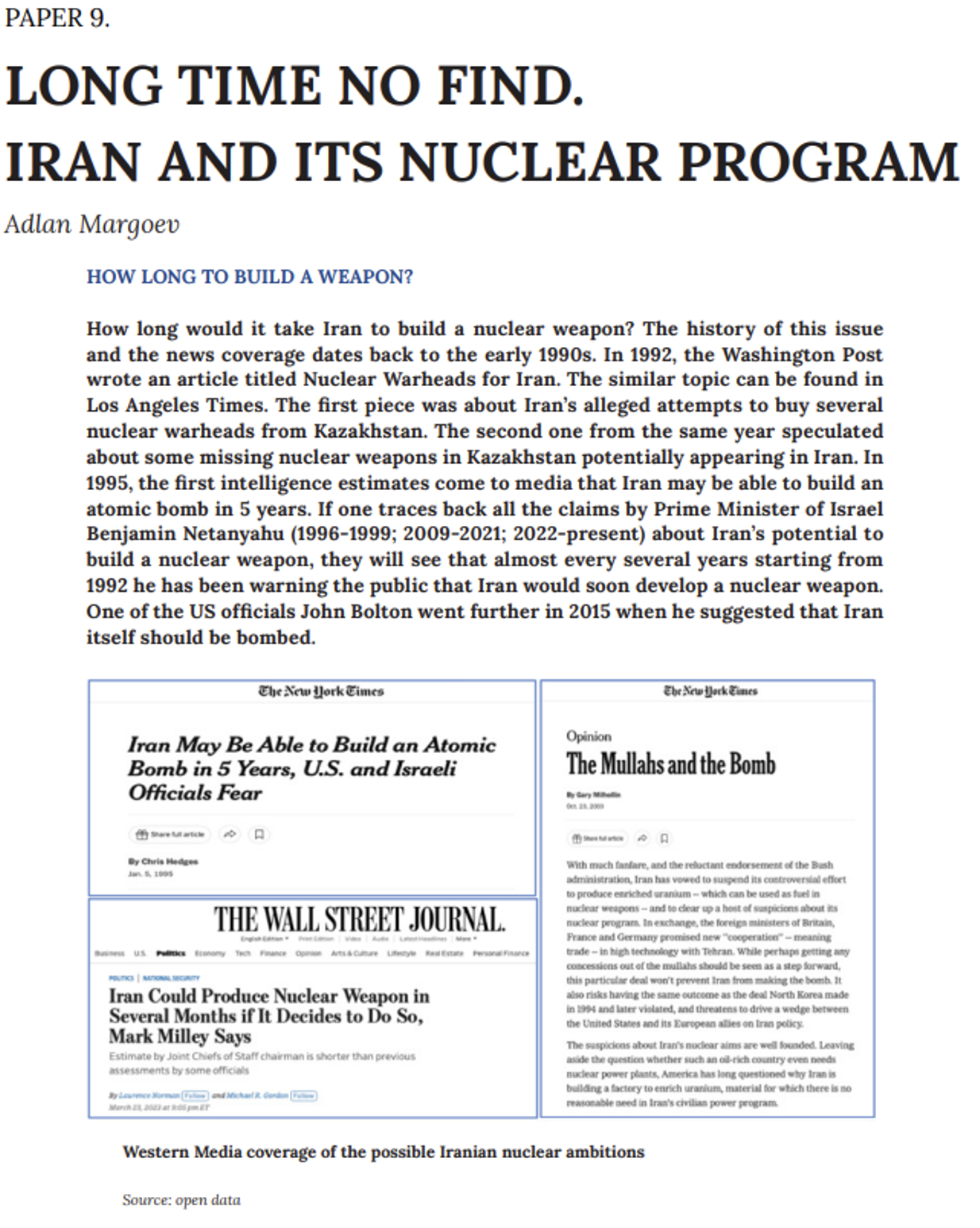
How[1] long would it take Iran to build a nuclear weapon? The history of this issue and the news coverage dates back to the early 1990s. In 1992, the Washington Post wrote an article titled “Nuclear Warheads for Iran”. The similar topic can be found in Los Angeles Times. The first piece was about Iran’s alleged attempts to buy several nuclear warheads from Kazakhstan. The second one from the same year speculated about some missing nuclear weapons in Kazakhstan potentially appearing in Iran. In 1995, the first intelligence estimates come to media that Iran may be able to build an atomic bomb in 5 years. If one traces back all the claims by Prime Minister of Israel Benjamin Netanyahu (1996-1999; 2009-2021; 2022-present) about Iran’s potential to build a nuclear weapon, they will see that almost every several years starting from 1992 he has been warning the public that Iran would soon develop a nuclear weapon. One of the US officials John Bolton[2] went further in 2015 when he suggested that Iran itself should be bombed.
When would Iran be ready to produce a nuclear weapon? Even the US intelligence community was confused with its own assessments. In 2005, its experts estimated with high confidence that Iran was determined to develop a nuclear weapon despite the international obligations. But in 2007, they understood that Iran was not prepared to do so. If we turn to the 2007 US National Intelligence Estimate Iran: Nuclear Intentions and Capabilities, we will see how different the assessment of Iran’s nuclear program became in 2007, and that means even some of the strongest intelligence communities in the world are not exempt from making mistakes.
| 2005 IC Estimate | 2007 National Intelligence Estimate |
| Assess with high confidence that Iran currently is determined to develop nuclear weapons despite its international obligations and international pressure, but we do not assess that Iran is immovable. | Judge with high confidence that in fall 2003, Tehran halted its nuclear weapons program. Judge with high confidence that the halt lasted at least several years. (DOE and the NIC have moderate confidence that the halt to those activities represents a halt to Iran’s entire nuclear weapons program.) Assess with moderate confidence Tehran had not restarted its nuclear weapons program as of mid-2007, but we do not know whether it currently intends to develop nuclear weapons. Judge with high confidence that the halt was directed primarily in response to increasing international scrutiny and pressure resulting from exposure of Iran’s previously undeclared nuclear work. Assess with moderate-to-high confidence that Tehran at a minimum is keeping open the option to develop nuclear weapons. |
Those who do not have access to confidential information can rely on the data from official organizations like the International Atomic Energy Agency (IAEA). According to the final assessment of the possible military dimensions of Iran’s nuclear program that was delivered by the IAEA in December 2015, there was a range of activities relevant to the development of a nuclear explosive device in Iran prior to 2003, but these activities did not advance beyond the feasibility in scientific studies, as well as gaining some of the technical competencies and capabilities, and the Agency did not have by December 2015 any relevant information about the development of a nuclear explosive device after 2009[3].
There is an analytical frame that is often used in media and some of the official documents, especially in the US, that is called the breakout time. Basically, breakout time refers to the ability to take nuclear material and enrich it to a point when they would have enough material to produce the first nuclear explosive device. The calculation is based on the measurement called separative work unit (SWU), that is the amount of effort that nuclear scientists have to make in order to enrich a certain amount of nuclear material to a certain level with the aim to produce the first nuclear explosive device.

It would take Iran 96 SWUs to enrich 33 kg of uranium enriched to 60 percent, which they currently have, and up to 20 kg enriched to the 90 percent level. Then if they want to build the second nuclear explosive device from the same pool of 60 percent enriched uranium, they need to spend another 96 SWUs to enrich additional 33 kg of 60 percent uranium and bring it to 90 percent. You can see from the table that Iran could produce at least five nuclear explosive devices from the material that it had as of September 2023.
| For Iran’s __ nuclear weapon | It could draw from its stockpile of ___ | It would draw ___ from this stockpile | To make ___ enriched to 90% | It would require ___ of effort | For a total effort of ____ |
| First | 121.6 kg up to 60% U-235 (~54%) | 33.6 kg | 20 kg | 96 SWU | 96 SWU |
| Second | 33.6 kg | 20 kg | 96 SWU | 192 SWU | |
| Third | 33.6 kg | 20 kg | 96 SWU | 288 SWU | |
| Fourth | 20.8 kg | 12.4 kg | 59 SWU | 467 SWU | |
| 535.8 kg up to 20% U-235 (~18%) | 39.8 kg | 7.6 kg | 120 SWU | ||
| Fifth | 104.7 kg | 20 kg | 315 SWU | 782 SWU |
What lacks here in this assessment is that it is not only about enriching nuclear material to provide enough material for a nuclear explosive device. It is also about the design and the construction of the nuclear explosive device and integration of that first nuclear explosive device and the consequent ones into a ballistic missile delivery system that would make it a nuclear weapon. Those types of calculations are not easily made. It is not about the math. It depends on many different factors.


Regarding nuclear infrastructure, Iranians have a variety of facilities ranging from uranium milling sites and fuel production sites to research and power reactors, but they do not have a full closed nuclear fuel cycle. That means there is no refabrication of irradiated fuel for plutonium extraction. So, if the Arak heavy water reactor is not operated based on its original design, the plutonium path is not an optimal solution for Iranians should they consider developing a nuclear weapon.
Why Iran Seeks an Advanced Nuclear Program
Why does Iran seek an advanced nuclear program? Is it all about the political system in Iran since 1979? Not at all.
The story goes back to the 1950s, when Iran was considered one of the US allies in the Middle East. After the delivery of the Atoms for Peace speech, American President Dwight Eisenhower (1953-1961) decided to engage Iran in the spread of peaceful nuclear technology. It was the United States that agreed around 1958 to deliver the first research reactor to the University of Tehran. But the key nuclear developments in Iran took place after 1974, around the time when the Indian peaceful nuclear explosion test took place.
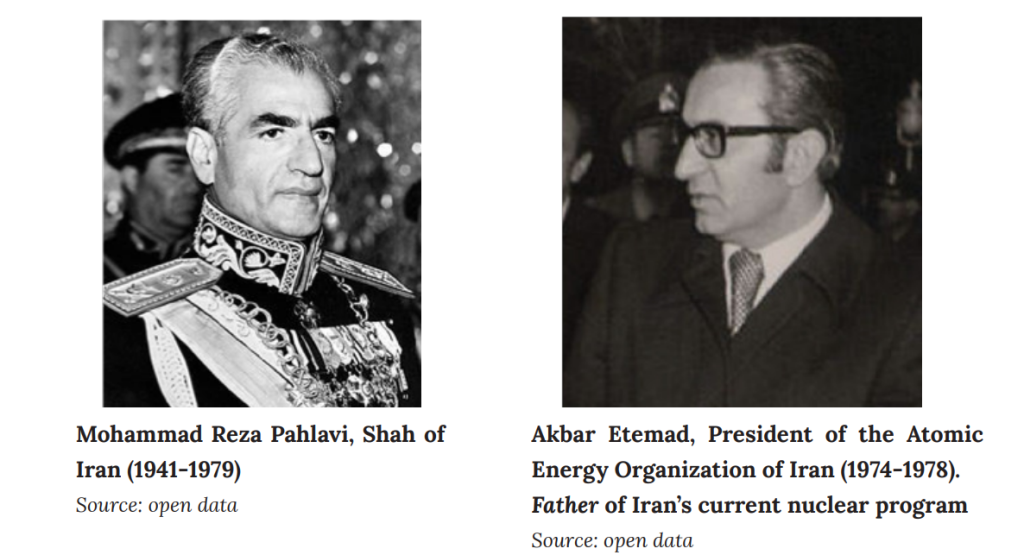
The memoirs of people involved in the court politics and some of the interviews of Mohammad Reza Shah demonstrate that in 1950-1970s the Iranians thought of developing an advanced nuclear program. In case the regional situation deteriorated and posed a threat to Iran’s national security, the Shah reserved the option to go nuclear. However, there was no condition back then to motivate the Iranians to choose the military path.
After the 1979 Revolution, most of the contracts between Iran and its international partners, vendors from the United States, Germany, France, and other countries, were canceled either by those partners or by Iran itself. In fact, Ruhollah Khomeini, the First Supreme Leader of Iran (1979-1989), was against nuclear technology and wasteful contracts that Iran made with those countries.
But in 1980, Saddam Hussein started a war with Iran in which he used chemical weapons on the battleground. Iran received almost no support from the international community to fight back, and some of the Iranian officials decided that it would be better to revitalize the nuclear industry in case they would have to develop a nuclear weapon as an ultimate guarantor of national security. Nuclear weapons were not considered as the primary option, but Iran was interested in developing a certain level of technology that would, in case of a dire security situation in the region, help Iran to defend itself from the adversaries in the Middle East.
If we summarize some of the reflections on this issue under both the Shah and the Supreme Leader, we will see several parallels in Iran’s motivation for developing a nuclear industry. The first one is an ultimate defense in case Iran has to develop a nuclear weapon. Second, regardless of the military or peaceful way of developing technology, being an advanced country in terms of technology, nuclear industry, and knowledge economy was considered as a matter of prestige both before 1979 and afterwards. And, third, there is a motivation of Iran to develop a nuclear industry for the energy and non-energy applications. Iran is still suffering from the lack of electricity in certain regions, and despite being an oil- and gas-rich country, it sees value in building more power generation infrastructure in the country. Non-power applications of nuclear energy, such as in medicine, drive forward science and engineering in Iran. So, Iran’s advanced nuclear program is about security, prestige, and scientific progress, regardless of the political system.
A Short-lived Success of the Iran Nuclear Deal
In 2015, after more than 13 years of negotiations, the parties managed to reach an agreement, called the Iran nuclear deal, or the Joint Comprehensive Plan of Action (JCPOA). But its success happened to be short-lived.
Prior to this agreement, Iran had around 19.000 centrifuges, of which 13.000 centrifuges were dismantled and stored under the IAEA supervision under the deal. Iran was also prohibited from using many advanced centrifuges that it had already developed for research purposes. The Fordo enrichment facility was to be converted to a radioisotope production and research facility with the participation of the Russian nuclear industry representatives. So, for 15 years enrichment could take place only at Natanz. The cap for the stockpile of enriched uranium was set at 300 kg of uranium enriched to 3.67 percent. This secured a year-long breakout time for Iran, meaning for as long as the JCPOA was in full force, if Iran decided to develop a nuclear weapon, it would need at least one year to enrich enough nuclear material for its first nuclear device. Never since the collapse of the JCPOA has such a long break-out time been restored. In exchange for that, the United States and the European Union agreed to lift sanctions against Iran’s nuclear program, oil industry, etc. Non-nuclear sanctions were kept intact.
| Enrichment | For 10 years operating centrifuges reduced to 5,060 IR-1 machines, total machines is 6,104 IR-1sExcess centrifuges (over 13,000) dismantled and stored under IAEA monitoringFor 15 years level of uranium enrichment capped at 3.67 percent uranium-235For 15 years enrichment only at NatanzFor 10 years no production of additional IR-1 centrifugesBetween years 11-13 Iran can replace IR-1s with the equivalent capacity of IR-6 and IR-8 machines and limits lasting to years 14-15 | Monitoring and Verification | By 15 October 2015 Iran fully implements PMD “roadmap” agreed with IAEAFor 10 years approval of the purchase of dual-use materials by the Joint Commission working groupFor 25 years continuous monitoring of lran’s uranium mines and millsFor 20 years continuous monitoring of lran’s centrifuge production facilitiesFor 15 years Joint Commission oversight of IAEA access requests to inspect undeclared sitesPermanent prohibition of certain weaponization-related activitiesImplementation and eventual ratification of an additional protocol to Iran’s safeguards agreementPermanent implementation of modified Code 3.1 of the Subsidiary Arrangements to its Safeguards Agreement |
| Uranium Stockpile | For 15 years the stockpile is kept under 300 kilograms of 3.67 percent enriched uranium in total (all forms)Excess enriched uranium sold, shipped abroad for storage, or diluted to natural uranium levelsUranium oxide and scrap material enriched up to 20 percent fabricated into fuel for Tehran Research Reactor, blended down, or shipped out | Joint Commission | For 25 years Joint Commission (composed of P5+1, EU and Iran for a total of 8 voting members) will hold quarterly meetings, or by request, to oversee the dealDispute resolution mechanism within 35 days; 15-day dispute resolution mechanism within the Joint Commission, with optional 15-day ministerial review and/or arbitration opinion from a 3-member panel, followed by 5-day review of the arbitration opinion. If there is no resolution and the complaining party sees the action as “significant non-performance,’ the unresolved issue can be treated as grounds to cease performing commitments in whole or part, complaining party will notify UN Security CouncilAny party can go to the UN Security Council to put sanctions back in place if there is noncompliance by vetoing a resolution calling for the continuance of sanctions |
| Fordow | Converted to research facility for stable isotope production with Russian cooperation1,044 IR-1 centrifuges in six cascades will remain here, 328 for production, the remaining 700 are idleFor 15 years no introduction of uranium at the facility | UN Sanctions | UNSC resolution 2231 endorsing JCPOA outlines termination of all previous resolutions targeting lran’s nuclear program — 1696 (2006), 1737 (2006), 1747 (2007), 1803 (2008), 1835 (2008), 1929 (2010) —on implementation day.For 10 years sanctions are subject to snapback by veto of a resolution calling for the continuation of suspensionAfter 10 years UN will cease to be seized of Iran’s nuclear fileFor 5 years the heavy arms embargo will remain in placeFor 8 years the ballistic missile restrictions will remain in place |
| Advanced Centrifuge Research and Development | For 8.5 years Iran may conduct research with uranium on a single IR-4, IR-5, IR-6 and IR-8 centrifuge at NatanzAfter 8.5 years test up to 30 IR-6s and 30 IR-8sAfter 8 years manufacture up to 200 IR-6s and 200 IR-8s centrifuges without rotorsFor 10 years Joint Commission review and approval of changes to the research and development plan | U.S. Sanctions | Cease the application of economic sanctions against lran’s oil and banking sector allowing Iranian banks and companies to reconnect with international systemsWill remove designation of certain entities and individualsAllows for licensed non-U.S. entities that are owned or controlled by a U.S. person to engage in activities with lran permitted under JCPOAAllows for the sale of commercial passenger aircraft to IranAllows for license for importing Iranian-origin carpets and foodstuffs into United StatesUnited States takes appropriate measures to address laws at state or local level preventing full implementation of JCPOA – United States will actively encourage officials to adhere to JCPOA policyFor 8 years after Adoption date, or sooner if IAEA concludes that all nuclear activity in Iran remains peaceful, U.S. will seek legislative action to terminate/modify nuclear related sanctionsU.S. sanctions on Iran targeting human rights, terrorism and missile activities remainUnited States can impose additional sanctions for non-nuclear issues (terrorism, human rights, etc.) |
| Arak Reactor | Remove and disable the original core of the Arak reactorReplace the core of the Arak reactor to reduce weapons-grade plutonium output, certified by the Joint CommissionFor 15 years no reprocessing of spent nuclear fuel with an intention to never reprocessPermanent commitment to ship out spent nuclear fuelFor 15 years no heavy-water reactors in IranFor 15 years no accumulation of heavy water in IranConstruction of hot cells or shielded glove boxes of certain specifications subject to approval of the Joint Commission | EU Sanctions | Terminate all provisions of the EU Regulation related to Iran’s nuclear programIncludes: financial and banking transactions; transactions in Iranian Rial; provision of U.S. banknotes to Iranian government; access to SWIFT; insurance services; efforts to reduce Iran’s crude oil and petrochemical product sales; investment; transactions with Iran’s energy and shipping sector; trade in gold and other precious metals; trade with lran’s automotive sectorRemoves individuals and entities designated under sanctionsEU refrains from re-introducing sanctions terminated under JCPOA (Iran views any re-introduction as grounds to cease performing its commitments)Refrain from policy intended to adversely affect normalization of economic relations with IranFor 8 years after adoption day or at the finding of the IAEA broader conclusion EU’s arms embargo and restrictions on transfer of ballistic missiles remain |
The JCPOA negotiation led to success thanks to at least four factors.
First, a lot depended on the coherence of domestic political cycles in Iran and in the United States as the key opponents in this process. When the first clandestine nuclear facilities were revealed around 2002 in Iran, President of Iran was Mohammad Khatami (1997-2005), who was considered to be a reformist politician, ready to engage with the world and with the United States as well. But the US President George W. Bush (2001-2009) was not ready to respond to any diplomatic gesture by the Iranians. Then President Mahmoud Ahmadinejad (2005-2013) came to power in Iran, and despite the fact that US President Barack Obama (2008-2017) was ready to engage in diplomacy with Iran, it was Iran’s turn to reject diplomatic efforts. Only around 2013, under the second administration of President Obama and the first administration of Iranian President Hassan Rouhani (2013-2021), the two sides managed to handle the domestic politics and secure the agreement. And according to the memoirs of some Iranian politicians, handling this domestic environment, in many cases, was more difficult for them than working at the same table with their opponents. So, when the domestic political cycles matched in Iran and in the US, the deal became possible.
Second is the compartmentalization of Iran’s nuclear dossier from all of the other issues that spoiled the relations between Iran and the West. When the negotiators prioritized the nuclear dossier as the most pressing issue on the agenda, the success became possible. Otherwise, piling up everything in one negotiation process would be counterproductive; it would be impossible to reach a package solution to the issues that caused disagreements between Iran and the West.
Third, the step-by-step and reciprocity approach suggested by the Russian Federation around 2011 played a positive role. The negotiators could not handle all the issues at the same time, including due to mutual lack of trust. The only viable solution was to move forward by small reciprocal steps and see if the other side is delivering on its promises. That set the right pace for the negotiations after 2013 that led to the 2015 success.
Four, it was not only sanctions that motivated Iran in 2013 to come to the negotiation table with the sincere expectations of moving forward together. The Obama administration, for the first time in more than a decade, offered a real incentive to the Iranians. Apart from removing sanctions, they recognized Iran’s right to enrich uranium and develop other aspects of its indigenous nuclear industry. Of note, in 2005 the previous successful round of talks between Iran and the E3 – France, Great Britain, and Germany – failed in large part because of US unwillingness to recognize Iran’s right to peaceful uses of nuclear energy under the Nuclear Nonproliferation Treaty (NPT).

However, the deal happened to be unsustainable because of at least two reasons. First, due to the above-mentioned mismatch in domestic political cycles. Unfortunately for President Rouhani and all the JCPOA negotiators, the second presidency of Hassan Rouhani overlapped with the first and so far the only presidential term of Donald Trump (2017-2021) who left the agreement despite the United Nations Security Council (UN SC) Resolution № 2231 in support of the deal. The Iranians were deprived of the benefits under the JCPOA. The second reason for its unsustainable nature was the lack of balanced verification and enforcement mechanisms.
The strongest monitoring and inspections regime was created for Iran to check every single aspect of its nuclear program, but there was no verification mechanism for sanctions removal because it never existed. It was hard to measure how sincerely one would remove sanctions, whether the removal would work, whether there was enough outreach to banks and companies for them to safely resume business with the Iranians. Signing executive orders and removing sanctions on paper was not enough; it required a lot of effort in practice, something nobody could measure with the same success as an inspector of the IAEA at any nuclear facility in Iran. The enforcement mechanism had its fallacy as well: if Iran decided to leave the JCPOA, other parties to the JCPOA would treat Iran as if it violated the agreement. The snapback mechanism could automatically return all sanctions that were imposed on Iran under the auspices of the United Nations since 2006. Meanwhile, the United States faced no pressure for simply leaving the agreement that it had been working on tirelessly with the other participants of the deal. Violation could be considered worse than not abiding by the agreement at all. Hence, for future agreements with Iran, the latter would require a more balanced mechanism of verification and enforcement.
Why the Six Countries and Iran Negotiated
One can see at least six stages in which negotiations over Iran’s nuclear program evolved over the past 30 years.
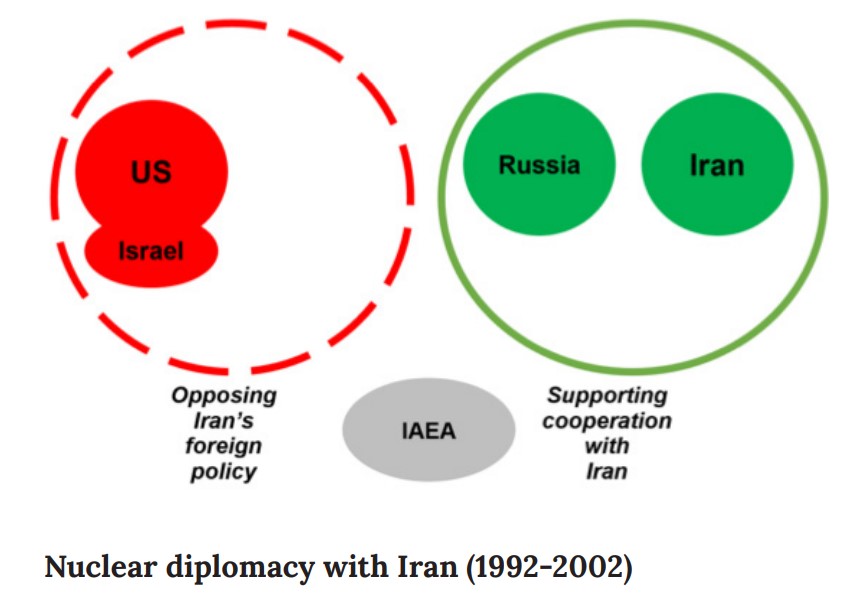
1992-2002. The United States and some of its allies, for example, Israel have been the most prominent advocate of containing Iran’s nuclear program. They both opposed Iran’s nuclear program development and regional policy. As it was previously mentioned, since the early 1990s Benjamin Netanyahu has been constantly warning about the pace of development of Iran’s nuclear program. Thanks to the lobbying in the US Congress, Israel had a very prominent role in the US domestic debate on Iran as well.
By the end of the 1990s, Russia remained the only partner of Iran in the nuclear industry thanks to the construction of the Bushehr Nuclear Power Plant. The agreement on that was signed in 1995. There was no diplomatic process on Iran’s nuclear program in 1990s, but this issue was among the top three that Russian and the United States discussed throughout the 1990s. The IAEA was involved in the discussions as well as an impartial technical body, and it traced many of the aspects of Iran’s nuclear program development.
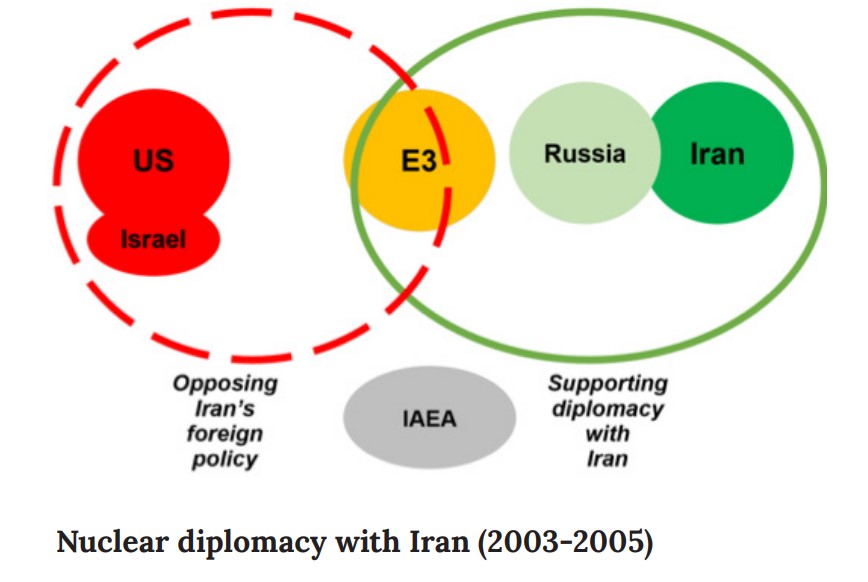
2003-2005. The situation changed after 2002 when the first clandestine nuclear facilities were revealed in Iran, and the multilateral negotiation started. The European states – France, Germany, and Great Britain, or E3 – were the first to volunteer as negotiators with Iran. They signed two successful declarations, the 2004 Tehran Declaration and the 2005 Paris Declaration that secured progress in the talks.
However, in 2005, under heavy influence of the United States, the Europeans made a final offer to Iran with a provision that prohibited uranium enrichment in Iran for ten years after signing the document. Iran rejected the offer since it was imbalanced in nature.
At that time the E3 happened to be in between two circles. They sincerely supported nuclear diplomacy with Iran, but at the same time they shared concerns with the United States, Israel, and some other allies and partners in the Middle East regarding Iran’s regional policy. For the time of the talks and since then, Iran’s nuclear program was effectively monitored by the IAEA for the negotiators to understand the technical realities on the ground. Of course, there were many questions about Iran’s past activities, some of which remain to be clarified today, but from the nonproliferation standpoint their relevance for today’s nuclear activities in Iran and the current level of the program remains limited, if not marginal.
Russia did not play a role in talks between the E3 and Iran, but it did support diplomacy with Iran at the IAEA. The US under the Bush administration preferred to stay away from the diplomatic process led by the European countries. So, the IAEA was a venue for some of the heated political debates that are going on today as well.
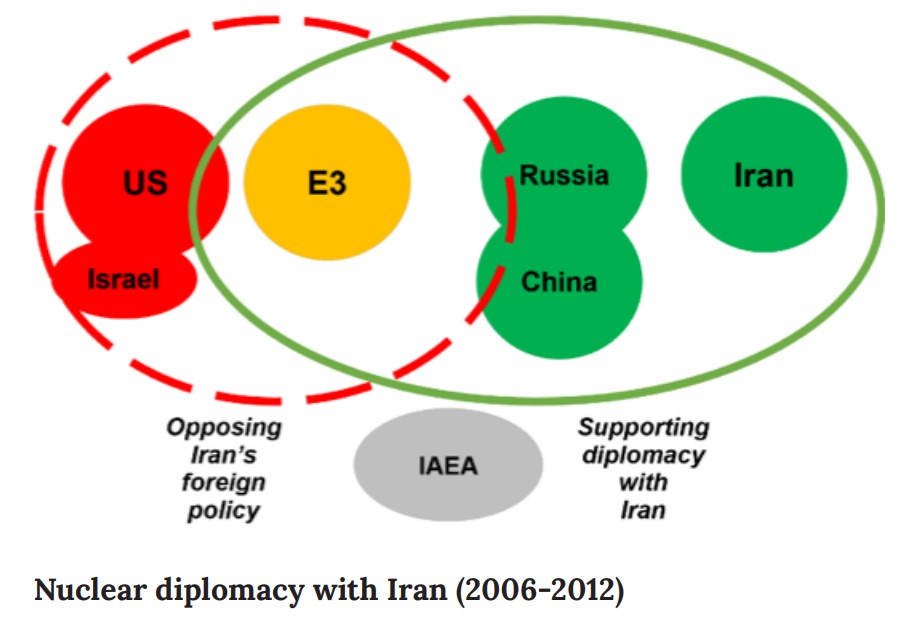
2006-2012. The situation further deteriorated when the administrations of George Bush and Mahmud Ahmadinejad severely disagreed with one another. Under mounting US pressure, Iran’s President made bold statements and strongly defied the West, which drove the E3 closer to the United States. The E3 lost their agency at a point when they suggested that Iran suspend the enrichment for ten years. Iran’s confidence in the Europeans as the key mediators in this process faded away, and the failed talks led to the transfer of the Iranian nuclear dossier from the IAEA to the UN SC. All the permanent members of the UN SC had to engage, including the United States, Russia, and China, because they had to agree on every single aspect of the future sanctions regime on Iran.
That period of negotiations is called either E3/EU+3 (EU as a coordinator of this process), or P5+1, meaning the five permanent members of the UN SC, and Germany that was part of this process since 2003. Iran was unwilling to abide by the initial UN SC resolution that required Iran to pause its nuclear activities and open up the venue for diplomacy. Having refused to surrender, as it perceived the situation, Iran faced four UN SC resolutions imposing universal legally binding sanctions.
Russia and China appeared in a delicate position between the US and Iran: they had enough empathy towards the Iranians but at the same time, they had to defend the status of both the NPT and the UN SC. When Tehran defied the UN SC, Moscow and Beijing had to agree on further international sanctions against the Iranian nuclear program. But at every instance, the two countries tried to water down the language in a way that would leave some space for future diplomatic efforts with the Iranians. If it had no constructive impact on Iran’s position, they moved forward.
In 2010, the last UN SC resolution introduced the harshest sanctions on the Iranian economy. In 2012, the European Union introduced the heaviest European sanctions coordinated with the United States. That period saw a lot more unhelpful events, including cyberattacks against Iran’s key enrichment facility, the assassination of its nuclear scientists, which seemingly led to an impasse.
Until 2012, no meaningful diplomacy could be envisioned on Iran’s nuclear program. But the Obama administration made a secret attempt to negotiate with Iran. The consultations took place in Oman and opened up the opportunity for the rest of the negotiators to engage back in the talks.
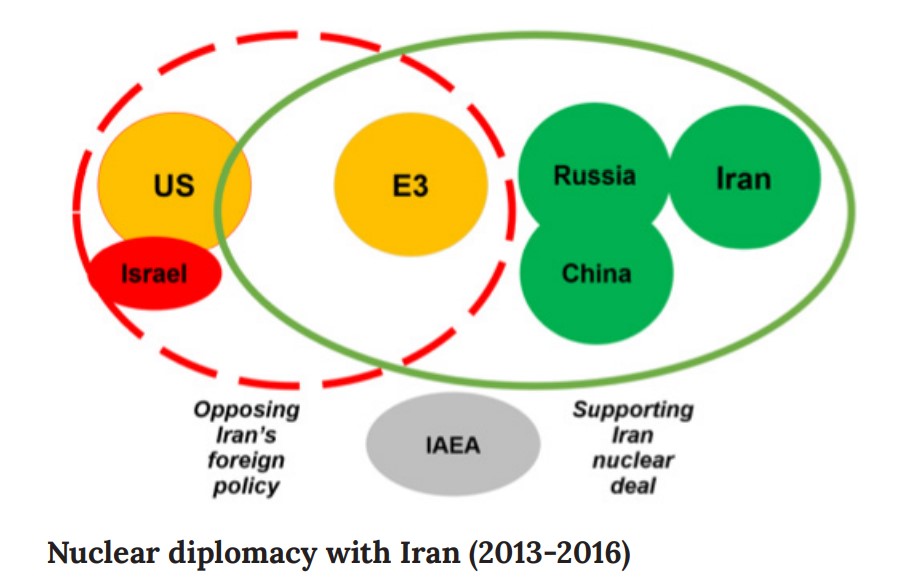
2013-2016. Based on the step-by-step and reciprocity approach, the parties first concluded the Joint Plan of Action (JPA) in 2013, and on July 14, 2015, reached the Joint Comprehensive Plan of Action. The IAEA held a separate track of negotiations with Iran: the successes on the diplomatic track and on the technical track of negotiations reinforced one another.
The United States and E3 are colored yellow in the chart because, despite supporting diplomatic efforts on Iran’s nuclear program, they shared concerns about Iran’s regional policy and its missile program. These concerns were among the reasons why the deal unraveled in the next period.
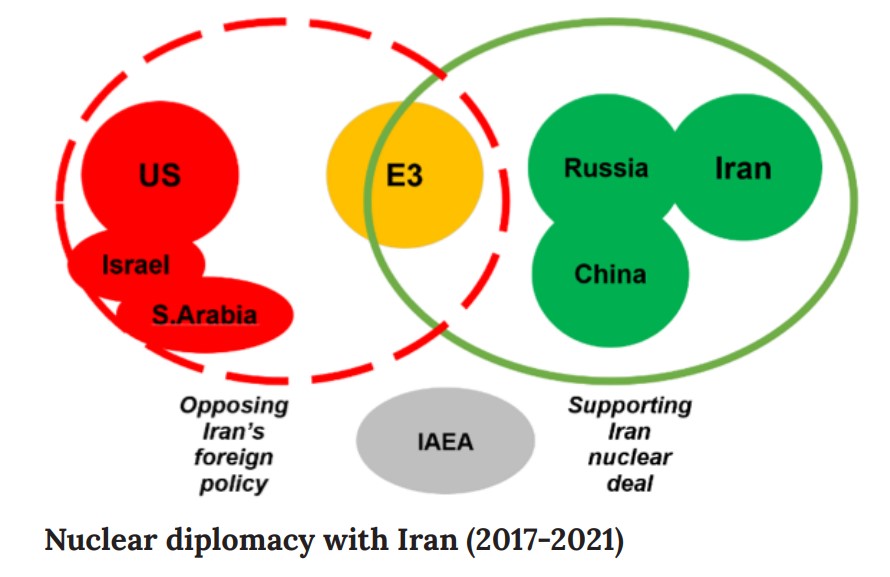
2017-2021. When Donald Trump became President of the United States in 2017, his administration rejected the compartmentalization approach. At first point, the Europeans opposed those developments and defended the deal they had struggled to secure for over a decade. All of a sudden, the Europeans happened to be on the same page with Russia and China with respect to the Iran nuclear deal, but they could not act independently. The E3/EU proved incapable of acting without the support of the United States, which demonstrated their irrelevance to the Iranians.
Meanwhile, the Russian and the Chinese relationships with Iran got stronger. Conversely, Saudi Arabia had cut diplomatic relations with Iran because of domestic political disagreements and joined the ranks of the JCPOA opponents. Under President Joe Biden, talks on the revival of the JCPOA resumed and almost resulted in an agreement in August 2022, but issues extraneous to the talks spoiled the opportunity. The IAEA as a technical body could not solve the political problems. Instead, those disagreements spilled over the technical discussions at the IAEA over Iran’s past nuclear activities.
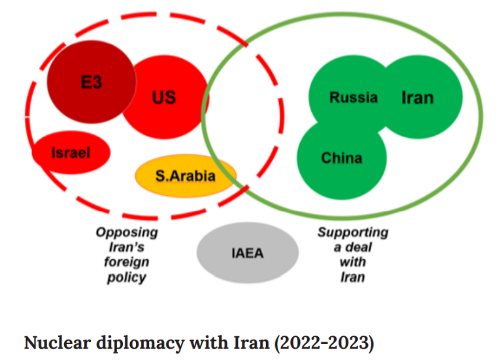
2022-2023. In fall 2022, two developments precluded the revival of the JCPOA and made the United States and the E3 refuse to continue the talks. First, Iran’s government suppressed domestic protests that became violent and turned into an anti-regime movement in Iran. Second, Iran was believed to supply drones to Russia, whether before or after February 24, that were used on the battlefield in Ukraine. The logic of compartmentalization did not work for the JCPOA.
However, after the public statements by the US and European officials that the JCPOA was no longer on agenda, the United States continued non-public talks with the Iranians on the exchange of five detainees on each side. Switzerland, Qatar, Oman, Iraq, and some other countries were involved until the two agreed on a solution in the summer of 2023. The agreement was called an understanding and was not put on paper. Otherwise, it would have to be approved by the US Congress under the Iran Nuclear Agreement Review Act (INARA Act) that was adopted in the Obama times. Apart from the prisoners exchange, South Korean banks released six billion dollars to Iran. The money was transferred to a bank in Qatar, where Iran could have access to the money with the approval of the United States and no violation of its sanctions.
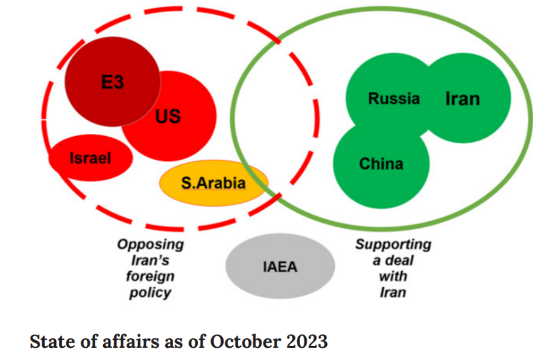
The understanding was no substitute for the JCPOA. It was an understanding that the US and Iran could make small reciprocal steps to overcome the deadlock. But in October 2023, the Israeli-Palestinian conflict erupted with a new wave of violence: Iran and the United States supported the opposite parties, which postponed any progress on the revival of the JCPOA.
Dangerous Absence of a Deal
The JCPOA is currently in force only in legal terms, but no party is fully abiding by the agreement. The situation is often called no deal, no crisis, but amid multiple conflicts and crises in the region it can hardly last for too long.
As for the other actors, Russia currently is developing a close cooperation with Iran. China is the trading partner number one for Iran. Saudi Arabia is marked in yellow because it restored the diplomatic relationship with Iran.
The new round of escalation between Israel and Palestine creates a dangerous situation in which Iran is interested in supporting Palestinians, and Israel is waging its own military operation in Gaza. And potentially, those hostilities could spread around other countries of the region as well.
This leads to a greater risk of military confrontation between Israel and Iran, as well as the proxy forces that are considered either pro-Iranian or at least receiving some support from Iran. The risky part in terms of Iran’s nuclear program is that if a direct conflict between Israel and Iran erupts in the region and would directly affect the security of the two states, then there is a greater risk that Iran would accelerate the development of its nuclear program.
At least nine questions can be posed to consider negative scenarios around Iran’s nuclear program[4].
What impact could a direct military conflict between Iran and its adversaries like Israel have on the security in the region and beyond, as well as on intertwining character of international economy with the Hormuz Strait being the communication line for those who are exporting or importing oil and gas resources? Any conflict in the region, like a new tanker war, like the seizure of those tankers, the closure of the Strait, would cause destabilization not only in terms of the regional security but also international economy, and would disrupt the oil prices.
If Iran feels compelled to leave the NPT, would the P5 countries react unanimously? We know that in some cases like the DPRK, India, Pakistan or Israel the nuclear-weapon states had different reactions to the development of nuclear weapons. Russia and China have more empathy towards Iran and positive bilateral relations. The United States, France and UK have the opposite attitude on Iran. Would that affect their ability to come to a joint reaction or to a joint decision in support of the NPT? What would happen and how would that affect the situation?
Should Iran take a step further and develop a nuclear weapon, what will happen to Iranian fatwas prohibiting weapons of mass destruction (WMD)? Would the fatwa be revisited only in terms of the prohibition of nuclear weapons or that would affect the policies on chemical and biological weapons as well?
Should Iran develop a nuclear weapon, what is the risk that it could use those weapons against its adversaries in a direct military confrontation rather than just use it as a deterrence?
How clear could Iran’s nuclear doctrine be and how long would it take Iran to develop its nuclear policy? The DPRK developed its nuclear weapons in the mid-2000s and only recently elaborated on its nuclear doctrine. Where would Iran find a balance between the ambiguity and clarity of its doctrine?
How secure might potential Iranian nuclear weapons be? Will any unauthorized access be possible? What are the protocols for securing nuclear command and control and communication systems? Would those be vulnerable to cyber efforts like the 2010 Stuxnet virus developed by the American and Israeli intelligence forces against the Iranian nuclear facilities? Would cyber weapons pose a risk to Iran’s potential national command, control, communication and intelligence center (NC3I)?
Will Iran’s government or its scientists be prone to nuclear proliferation in case the country possesses nuclear weapons?
Should Iran develop a nuclear weapon, will it cause a chain reaction in the region and lead to further proliferation? Saudi Arabian highest-ranking officials made several statements that in case Iran pursues a nuclear weapon, Saudi Arabia would follow suit.
What will happen in case of a political regime change in Iran?
International community might have to find answers to these questions if it fails to address the current diplomatic challenges around Iran’s nuclear program. Those who are in charge of Iran’s nuclear dossier need to be reminded what they are responsible for, what they can do in order to prevent further regional escalation, and how to prevent negative scenarios that would push Iran to seek greater security through nuclear deterrence.
[1] Originally published: Margoev A. Long Time No Find. Iran And Its Nuclear Program // Nuclear Nonproliferation and Arms Control. Digital Papers / Eds. Vladimir Orlov and Elena Karnaukhova. PIR Library Series № 36. PIR Center, 2024. URL: https://pircenter.org/wp-content/uploads/2025/06/24-04-25-Nuclear-Nonproliferation-and-Arms-Control.-Digital-Papers.pdf
[2] John Bolton – American (Republican) politician, 25th United States ambassador to the United Nations (2005-2006), the 26th United States national security advisor (2018-2019) – Editor’s note.
[3] Final Assessment on Past and Present Outstanding Issues regarding Iran’s Nuclear Programme GOV/2015/68
// IAEA. December 2, 2015. URL: https://www.iaea.org/sites/default/files/documents/gov-2015-68.pdf
[4] Find more: Margoev A., Tokarev A., Ravandi-Fadai L. M. False Choice Between Pro-Russian and Non-Nuclear Iran: Why Russia Needs Nuclear-Free Iran // Vostok-Oriens. 2024. №5. P. 70-82.
