
№ 16 (60), 2026. A View from the United States on Strategic Stability and Arms Control: Interview with Robert Legvold by Alina Pashina on the Margins of the XII International Scientific and Expert Forum “Primakov Readings”

June 26, 2026

Exclusive Interview

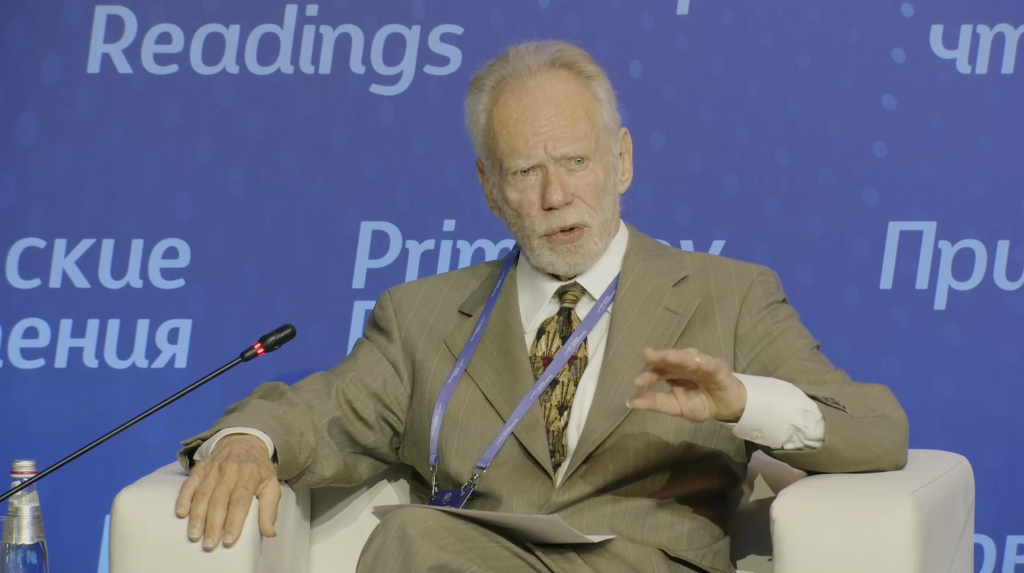
With no common definition of strategic stability or framework for arms control, and amidst growing military confrontation from the Arctic to the South China Sea, the world is entering a phase for which we have no ready answers. What comes next – and why the old playbook is no longer enough – we discussed with Dr. Robert Legvold, Professor Emeritus in the Department of Political Science at Columbia University.
The interview was conducted by Alina Pashina, PIR Center intern.
Alina Pashina: As our colleague Dr. Konstantin Bogdanov assumes, there is no general definition about strategic stability. How do you define the word strategic stability?
Robert Legvold: Well, strategic stability is normally, when we’ve talked about it in the past, in the context of a nuclear relationship. This is what Dr. Orlov and others understand. The problem is that there’s not a common definition of strategic stability, even in the context of nuclear weapons among nuclear powers. Probably the simplest definition of strategic stability at that level was the 1990 agreement the United States and the Soviet Union had, that was essentially to achieve a situation where neither side had any incentive for a first strike with a nuclear weapon.
However, when it comes to the issue of strategic stability and security in the broader sense, Eurasian security or Euro-Atlantic security, when we talked about it, essentially in that context, strategic stability is when the primary agendas of the major powers are not designed in a way that features competition and even a kind of focus on the other major power as an adversary. Strategic stability is when great powers look for where they have a common agenda. That is where the problem is not the issue of one other side’s growing military power or what they might be doing to threaten neighbors or other things. It is when the common agenda is dealing with major global issues, whether it’s pandemics or managing the risk of a nuclear war, or dealing with climate change or things like that. If you have a common agenda, even having different values, a Chinese political system and a U.S. political system, then you’re going to have strategic stability in the relationship.
But when you allow competition to intensify because of focusing on the narrow sources of what is the source of insecurity, that is when you focus on the way in which the other countries are a threat to you and therefore you have to respond by creating what from their point of view is a threat, this is called the security dilemma, then there is no strategic stability.
As I would say, normally we don’t end up talking about it this way. This is a personal proposition. I don’t know whether you sat Sergey Lavrov down with Marco Rubio, or with Wang Yi in China, and asked, ‘Do you agree that this should be the basis for strategic stability?’ – or if they’ve even begun to think in those terms. Governments at this point don’t seem to have the capacity to think about what strategic stability is. In their meetings and in the summit meetings, whether it’s Trump with Xi in Beijing or any of them, I guess there are no other sort of adversarial relations where you have summit meetings these days, they’ll often talk about strategic stability. That should be the objective. But if you listen closely, there’s never any definition or any explanation of what they mean by it.
Alina Pashina: In your opinion, is there any prospect of arms control today?
Robert Legvold: Not in the near term. First of all, the way in which we did arms control before in the Cold War, because it was a bipolar relationship, two major nuclear powers, and a regime in that context was worked out, SALT, then START and then the arms control arrangements within Europe in the post-Cold War period. That is no longer appropriate, and those were negotiated legal agreements, treaties and the like, for a variety of reasons. That’s no longer possible.
Nevertheless, at some point we will get back to thinking about where we can constrain military activity and military arms. For example, in the context of Europe, however the escalation in Ukraine winds down, a military confrontation will remain from the Arctic along a new Finnish border of 830 miles through Ukraine down to the Black Sea and at that point, we’ll need to think about guardrails. They may not be formally negotiated treaties, but it will be a question of thinking about risk reduction measures. It’ll be a matter of thinking about confidence measures, or dealing with the problem of surprise attacks, attacks from sudden start, those kinds of things.
At some point, we’ll have to get back to the problem we faced during the Cold War in the European context. That will also exist as the military competition grows in other areas. There is now a major multi-front military competition between the United States and China in Asia that has other components. That is, it has a Japanese component, a North Korean component at both the conventional level and increasingly at the nuclear level. There will have to be some kind of informal regime created that is now multilateral rather than bilateral. I suggest that even the US-China relationship, which will be a critical one, where we’ll be looking for risk reduction measures, not ways by which we limit the number of nuclear arms. That’s not what we’re going to negotiate. We’re going to have to look for ways in which we can create some confidence, some sense of transparency, some sense of predictability in the military activities of China, the United States, Japan, North Korea, South Korea, in the Asian context. We had done a lot of that in Europe, and then we let it all go. We let it all collapse. We’re going to have to come back and build it again.
Key words: Arms control; Strategic stability
AC
E16/NOS – 26/06/26
