
PIR Post № 5 (19), 2026. Nuclear past and present of Scandinavia: How Sweden, Norway, and Denmark are Reopening the Nuclear Sphere Against the Background of the French Initiative

July 27, 2026
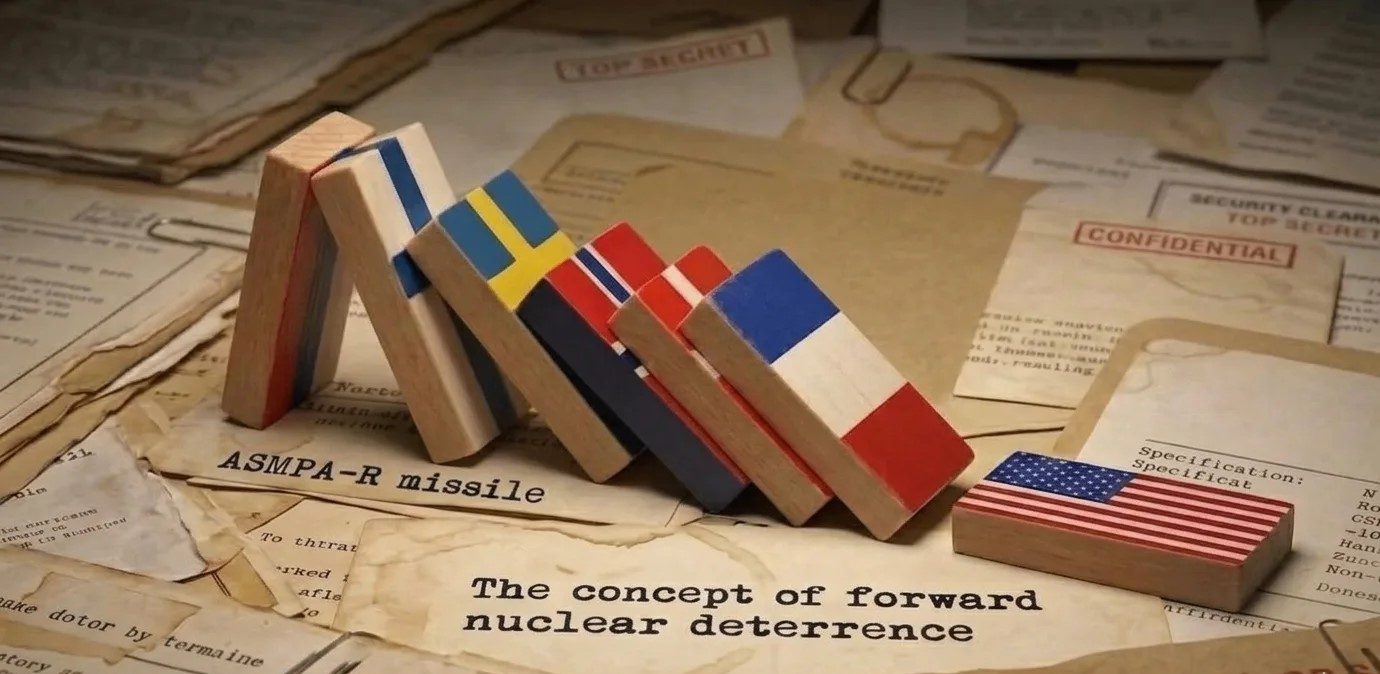
In the mid-2020s, the architecture of European security faced an unprecedented challenge. Donald Trump’s return to the White House in 2025 marked a reversion to the America First policy, which called into question the long-term reliability of American guarantees within NATO. Amid signals of a possible reduction in the US military presence in Europe and a review of funding for common defense programs, France has launched a forward deterrence initiative, offering European partners participation in its nuclear forces as an addition to the American umbrella. Nine countries joined the initiative, including Sweden, Norway and Denmark, which, despite their long-standing refusal to deploy nuclear weapons on their territory in peacetime, had already conducted research in the atomic field in the 1940s.
Nuclear development in Sweden, Norway and Denmark
Sweden. The study on nuclear weapons in Sweden began within the framework of the Swedish National Defense Research Institute (FOA). In 1945, the Swedish Atomic Committee was established to shape plans for the advancement in nuclear energy in Sweden. In 1948, the FOA presented the first report on the possibility of developing nuclear weapons in the country. Sweden planned to create about 100 nuclear warheads, worked with plutonium and possessed the necessary knowledge and technology, which allowed it to become a nuclear power by the end of the 1960s and early 1970s. To obtain weapons-grade plutonium, Sweden was developing a program for the production of this material in heavy-water power reactors based on domestic uranium ore. However, by the mid-1960s, strategic priorities had changed. In 1966, Sweden renounced the right to develop nuclear weapons, and after signing the Treaty on the Non-Proliferation of Nuclear Weapons (NPT) in 1968, activities began to curtail the research program, completed in 1972.
Norway. In the late 1940s, the Norwegian Defense Research Institute considered atomic weapons as one of the justifications for recommending that a nuclear reactor be developed in Norway. Important milestones were the establishment of the Atomic Energy Institute in 1948 and the launch of the first JEEP research reactor outside the Great Powers in 1951. However, in 1957, Prime Minister Einar Gerhardsen proclaimed the principle of “no nuclear weapons on Norwegian soil in peacetime”. In 1979, the Storting (Parliament) decided that energy supply should be based on hydropower, and in 1986 it was confirmed that the construction of nuclear power plants in Norway was not feasible.
Denmark. Like many other countries, Denmark sought to master nuclear technology for energy independence and scientific development. In 1955, a temporary commission on the use of atomic energy was formed in Denmark, and later that year a law was issued establishing a permanent atomic Energy Commission. In 1958, the official opening of the Risø National Laboratory, a key nuclear research site in the country, took place. At the same time, Denmark publicly advocated a nuclear-weapon-free status, and the public was also strongly opposed to nuclear weapons. Remarkably, the ban on nuclear weapons deployment in Denmark did not apply to Greenland: in 1957, Prime Minister Hans Christian Hansen secretly gave the United States the green light to store nuclear weapons at Thule Air Base in Greenland. The official ban on the deployment of nuclear weapons in Greenland in peacetime was agreed with the United States in 1968.
The French initiative for European nuclear deterrence
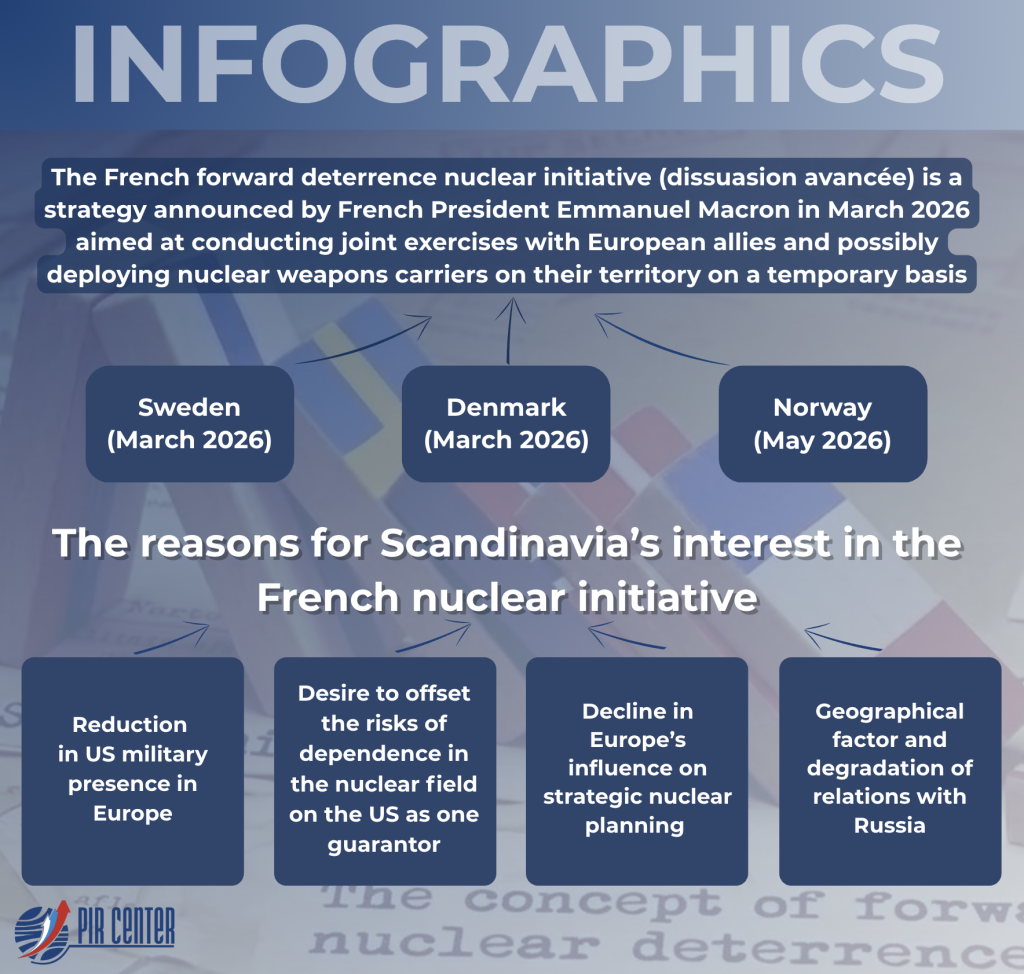
On March 2, 2026, Emmanuel Macron delivered a speech at the naval base on the island of Ile Long (Brittany) and announced France’s entry into a forward deterrence stage. This concept represents a “process of gradual development” of nuclear capabilities and provides for an increase in the number of nuclear warheads (France currently has about 290 warheads in its arsenal), but stated that the exact number would not be disclosed. France has also commissioned the ASMPA-R, an updated air-launched nuclear cruise missile, and is currently developing the ASN4G, the fourth-generation, hypersonic, air-launched nuclear missile, by 2035. On March 5, 2025, in his address to the nation, the president declared his intention to begin discussions on protecting Europe with the French nuclear umbrella. Simultaneously, he stressed that the decision on a possible strike would remain in the hands of the French president.
The French initiative to extend nuclear deterrence to European partners did not arise by chance. Growing uncertainty about the long-term commitment of the United States to Europe’s security and a review of transatlantic relations are the main drivers of discussions in Europe about nuclear deterrence. According to Etienne Marcuz, senior strategic weapons analyst at the Foundation for Strategic Research, “the fundamental lever of American influence in Europe is nuclear weapons.” However, as Washington reviews its commitments, European countries are forced to look for alternative mechanisms to ensure their security, seeking to create a more autonomous defense policy. At the same time, France is striving to strengthen its role in Europe and promote the concept of “strategic autonomy”. The country positions itself as the only nuclear power in the EU capable of offering the continent an alternative to the American umbrella. As French President Emmanuel Macron stated, “in the face of threats to our continent and not only to Europeans, it is necessary to be stronger and more sovereign.”
The accession of Sweden, Denmark and Norway to the French initiative
Sweden was among the first eight countries to join the French initiative. On April 23, 2026, Sweden and France held their first meeting within the framework of the joint Nuclear Steering Group in Paris and discussed the roadmap. Meanwhile, the Swedish authorities stressed that the initiative complemented the existing NATO deterrence and did not entail a change in the country’s nuclear doctrine. Prime Minister Ulf Kristersson said Sweden would participate in NATO planning, but nuclear weapons would not be deployed on Swedish territory in peacetime.
Denmark was also one of the first eight countries to join. The decision was particularly significant, given the 70-year history of the Danish ban on nuclear weapons. In March 2025, Danish Prime Minister Mette Frederiksen stressed that she was not going to “say no to other people’s ideas.” However, a heated political debate unfolded in Copenhagen: The Liberal Alliance party called for lifting the ban on nuclear weapons and allowing their deployment in Denmark. Significantly, back in January 2026, due to the aggravation of the situation around Greenland, Copenhagen began to contemplate the possibility of creating a joint nuclear program in Scandinavia. Danish Minister of Defense Troels Lund Poulsen said he was ready to discuss the deployment of nuclear weapons in the country, noting that he did not believe it needed to be done “then and there.”
On May 27, 2026, the Ministers of Defense of France and Norway signed a bilateral defense agreement in Paris, dubbed the Narvik Agreement. The name refers to the Battle of Narvik (northern Norway) during the Second World War, in which Norwegian and French troops participated. The agreement includes a clause on mutual defense, obliging the two countries to provide each other with assistance, including military aid, if necessary. Together, Norway joined the French initiative for European nuclear deterrence. A member of NATO but not of the EU, Norway demonstrates that the French initiative goes beyond European integration and has a broader geostrategic dimension. As explained by Norwegian Prime Minister Jonas Gahr Støre, the agreement is part of Norway’s “hedging strategy”, in which the country deepens defense cooperation with several leading European military powers in parallel with cooperation within NATO and with the United States. The Narvik Agreement covers a wide range of areas, including operational cooperation in the Arctic, exercises and training, pre-deployment of materiel, cybersecurity, space cooperation, maritime security, and defense industrial cooperation. Støre stressed that NATO and the United States remained the main guarantors of Norway’s security, and the French nuclear capabilities were an “important contribution” to the alliance’s overall deterrence potential. At the same time, he has repeatedly stated that the process does not entail changes in Norway’s nuclear policy and there will be no nuclear weapons in the country in peacetime.
The reasons for Scandinavia’s interest in the French nuclear initiative
The US foreign policy change. The Donald Trump administration, which returned to power in 2025, has consistently pursued a policy which is characterized as “America First” in Western analytics and assumes the priority of US national interests over allied obligations. Washington increasingly sees Europe not as an equal partner, but as a region to benefit from and which can be exposed to pressure. The course expressed itself in the review of common defense programs financing and a statement on the possible reduction of the American military presence in Europe. The decline in Washington’s military involvement in ensuring the security of the continent is perceived in Europe as a signal of the undermining of former transatlantic relations.
Doubts about the likelihood of full implementation of American guarantees. The key problem of the American nuclear umbrella is the so-called “credibility gap”, namely whether the United States is ready to risk a nuclear strike on its territory in order to protect European allies. According to some experts, European leaders cannot be sure that the United States will risk its own destruction for their safety. Even with the presence of American nuclear forces in Europe, the decision on their use remains the exclusive prerogative of Washington, which deprives European partners of significant influence on the strategic planning process, and therefore the allies have ceased to perceive American guarantees as unconditional.
The opportunity to diversify security guarantees through cooperation within Europe. The French initiative means diversifying security guarantees and strengthening the country’s own position within the framework of the European defense architecture. However, the French initiative does not replace the American nuclear umbrella, but complements it. The US one remains more powerful (over 5,000 warheads) and provides security guarantees within the framework of NATO. Nevertheless, joining the French initiative makes it possible to obtain nuclear “double insurance” in case the United States reneges on its obligations and reduce dependence on one guarantor. For example, for Norway, historically one of the most Atlanticist members of NATO, this is part of a broader risk mitigation strategy in which Oslo is simultaneously strengthening ties with Britain, Germany and France. The French project offers European partners closer involvement in strategic planning, which increases the sense of ownership and, consequently, confidence in the deterrence system.
Geographical factor. The common land border of Norway and Finland with Russia and the indication of Russia’s increased military presence in the Arctic create a sense of vulnerability in Scandinavia. For example, the Norwegian government openly talk about “the most serious security situation since the Second World War.” The strategic importance of the Arctic is a decisive factor in the calculations of Paris and the Scandinavian capitals as well. According to an analytical note from the Foundation for Strategic Research (FRS), Norway offers “access to the Arctic” to the French Strategic Air Forces, which could potentially allow French Rafale fighter jets carrying nuclear weapons to gain access to an extensive range of Russian strategic facilities. As Etienne Marcuz notes, if all the Nordic countries join the initiative, it will provide new corridors for attacking Russia, especially through the Arctic.
Thus, the journey of Sweden, Norway and Denmark in the nuclear field – from post-war research programs to voluntary abandonment of nuclear weapons deployment, and then to participation in the French forward deterrence initiative – showcases their rethinking of the nuclear issue in new geopolitical conditions. While in the 1960s and 1970s these countries assumed self‑restraint, guided by the principles of non-proliferation and regional stability, today they are returning to the subject as equal partners in the European collective defense system. Participation in strategic dialogue, joint exercises and operational planning allows Stockholm, Copenhagen and Oslo to diversify security guarantees, without relying solely on transatlantic ties, and receive “double insurance” in case of American obligations weakening.
Keywords: Sweden; Denmark; Norway; France; nuclear weapons; nuclear umbrella
NPT
E16/NOS – 26/07/27
