
OPEN SOURCES – CLOSED DATA: INTELLIGENCE MANUAL IN THE AGE OF THE “DIGITAL FOOTPRINT”


METHODOLOGY AND PRACTICE OF OPEN-SOURCE INTELLIGENCE (OSINT) FOR INTERNATIONAL SECURITY, ARMS CONTROL, AND WMD NONPROLIFERATION STUDIES
Sergey Semenov
PIR Center, 2025
(published in Russian)
URL: https://pircenter.org/wp-content/uploads/2025/03/25-03-03-REP-SEM-on-OSINT.pdf
“Intelligence has no right to boast.
Even hinting at success means putting someone at risk”.Gen. Leonid Shebarshin, Soviet intelligence officer,
Head of the First Chief Directorate of the KGB (1989–1991)
For a number of reasons, the topic of open-source intelligence (OSINT) as it applies to international relations has not yet gained widespread popularity in Russia (especially compared to Western countries). Although enthusiastic academics and independent researchers have been trying to streamline the training of specialists in the field for at least several years now, leading universities across the country are vying for the right to form the first cohorts of OSINT infantry.
At the same time, despite the general excitement surrounding the topic, the area of arms control, nonproliferation, and disarmament (ACNPD) remains, as it were, “outside the box” – in this area, foreign experts rule the roost.
The reason is the industry’s complexity. Hunting for “nuclear secrets” requires not only skillful source management but also an understanding of how the industry itself operates. A certain knowledge of physics, chemistry, geography, rocket science, and strength of materials is essential. One must be able to identify deliberate overstatements (or, conversely, understatements) of the performance characteristics of promising products. Knowledge of jurisprudence (including specific areas such as fiqh[1]) will also be useful for identifying potential loopholes in national legislation; and knowledge of mass communications is essential for effectively analyzing information campaigns and the actual dynamics of public opinion.
The list goes on and on – a good OSINT specialist in the field of open-source intelligence must literally know and be able to do everything. And sometimes even a little more. It’s no surprise that many who want to pursue open-source intelligence choose the path of least resistance and move into related fields (for example, competitive analysis of foreign companies).
However, difficult doesn’t mean impossible. And work to establish a scientific and practical foundation in this field is already underway. The starting point for this process can be seen in the Report “Methodology and Practice of Open-Source Intelligence (OSINT) for International Security, Arms Control, and WMD Nonproliferation Studies” by PIR Center research fellow Sergei Semenov. This is the first comprehensive work in Russia specifically tailored to the needs of ACNDP researchers.
The relevance of the stated topic is beyond question. In a context where even neutral countries (and, at first glance, not particularly interested in the military nuclear project) are cautiously trying to probe public opinion on the hypothetical acquisition of a nuclear arsenal, and are also conducting controversial work “away from prying eyes”, it’s important to anticipate the moves of vis-à-vis in a timely manner. To spot signs of change and grasp what’s on the surface, but hasn’t yet been chewed over by analysts and journalists.
As one of the guarantors of the Treaty on the Non-Proliferation of Nuclear Weapons (NPT), it’s crucial for Russia to remain on the agenda and develop its own OSINT specialists, focused on the ACNDP sector. And it’s not just about the commitment to the principle of “blood is thicker than water”[2]. Relying solely on the work of foreign colleagues (no matter how high-quality and comprehensive it may seem) runs the risk of falling into an information trap and failing to recognize the inculcation of certain negative attitudes. This is especially true given that the activities of Moscow’s allies in the nuclear field have angered Western analysts, who are sometimes inclined to exaggerate matters to suit political expediency.
However, the above is just the tip of the iceberg. Let’s move on to the overview of the Report. Despite its relatively short length (57 pages), it covers the main stages of open-source work and provides an overview of tools and useful resources. Thanks to this, even someone with no previous experience with OSINT can gain a basic understanding.
Another strength of the Report is its systematic approach. The author begins with a basic introduction to the topic (a review of relevant literature and basic internet search mechanics) and gradually moves to more complex tools and search combinations. The work places a primary emphasis on the analysis of satellite imagery – an important (but not the only) source of primary data on changes in the global WMD proliferation prevention system.
However, it’s worth remembering that OSINT isn’t “shadow boxing” but rather a no-holds-barred street race where gentleman’s rules rarely apply. It’s no coincidence that the author dedicated a separate section to the basics of “digital hygiene” and internet security. This is all to convey the simple truth: “For every intelligence agent, there’s a counterintelligence agent”. And for every open data hunter, there’s someone who wants to disrupt their work. At best, this can lead to a false trail (and thus reduce the final value of their work); at worst, it can discredit or “expose” them to their counterparts, which can create problems for both those performing the monitoring and potential clients of the assessment. Anticipating so-called counter-OSINT in time and taking preventative measures is half the battle.
Of course, beyond its clear strengths, the paper also has obvious areas for improvement. For example, the author could have easily expanded the section on social profiling (beyond a quick overview of the main search features on foreign social networks). Moreover, every project (even a nuclear one) is, first and foremost, about people. And an in-depth analysis of their digital footprint can sometimes reveal details that haven’t been captured by satellites or investigative journalists.
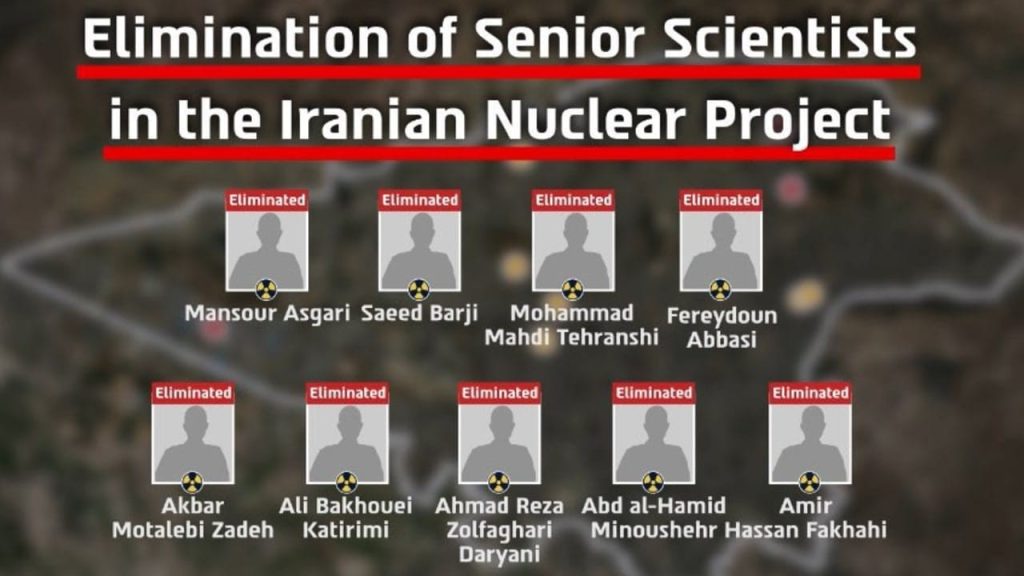
A striking example of this is the Israeli operations “Narnia” and “Red Wedding” (June 2025), aimed at eliminating key figures (scientists and managers) associated with the nuclear project. Open-source analysis played no less a role than the work of agents on the ground. First and foremost, it allowed for an understanding of the daily habits of Iranian nuclear workers, their social circles, and their weaknesses[3]. Despite the dubious nature of Israel’s goals, their OSINT infantry accomplished the mission: Iran’s nuclear program (or rather, its human resources) suffered some damage.
Another potential area of growth is the exploration of AI tools and their application to solving problems in the field of ACNDP. Given the rapid development of digital technologies, AI can simultaneously become both an assistant and a hindrance in research.
It should also be noted that, despite the author’s desire to provide a comprehensive overview of the available mechanics, the work remains somewhat vague: it lacks so-called “practical cases” that would illustrate this or that information retrieval technique – especially since there are many striking examples in global practice (in addition to the previously mentioned operations “Red Wedding” and “Narnia”).
However, the aforementioned quibbles do not detract from the work’s overall value. The Report “Methodology and Practice of Open-Source Intelligence (OSINT) for International Security, Arms Control, and WMD Nonproliferation Studies” is an important source of knowledge in the field of OSINT (and, in fact, the only Russian-language work in this field dedicated to arms control). It serves as a valuable resource for introductory training for specialists in the field. It also has the potential to develop into a larger research project (becoming a textbook or monograph).
At the same time, working with the manual already at this stage will require a certain amount of perseverance from the student (and, more importantly, basic competencies in the ACNDP sector); motivation; and flexible thinking.
[1] Fiqh (Islamic jurisprudence) – is a comprehensive field of Islamic sciences that deals with the understanding and implementation of Islamic laws derived from the Qur’an and Sunnah. It is a critical aspect of Islamic thought, as it governs both individual and communal life – Editor’s note.
[2] In Russian it’s sounds like “своя рубашка ближе к телу” and has the same meaning: family [in this particular context – Motherland] relationships and loyalties are the strongest and most important ones – Editor’s note.
[3] Also, in addition to collecting data directly on the “targets,” Israeli OSINT specialists separately “worked” on their entourage, including assistants, security guards, and graduate students from the universities where they were registered.
