
PIR-Post № 1 (15), 2026. One Europe, Two Umbrellas: Extended Nuclear Deterrence a la Francaise

March 4, 2026
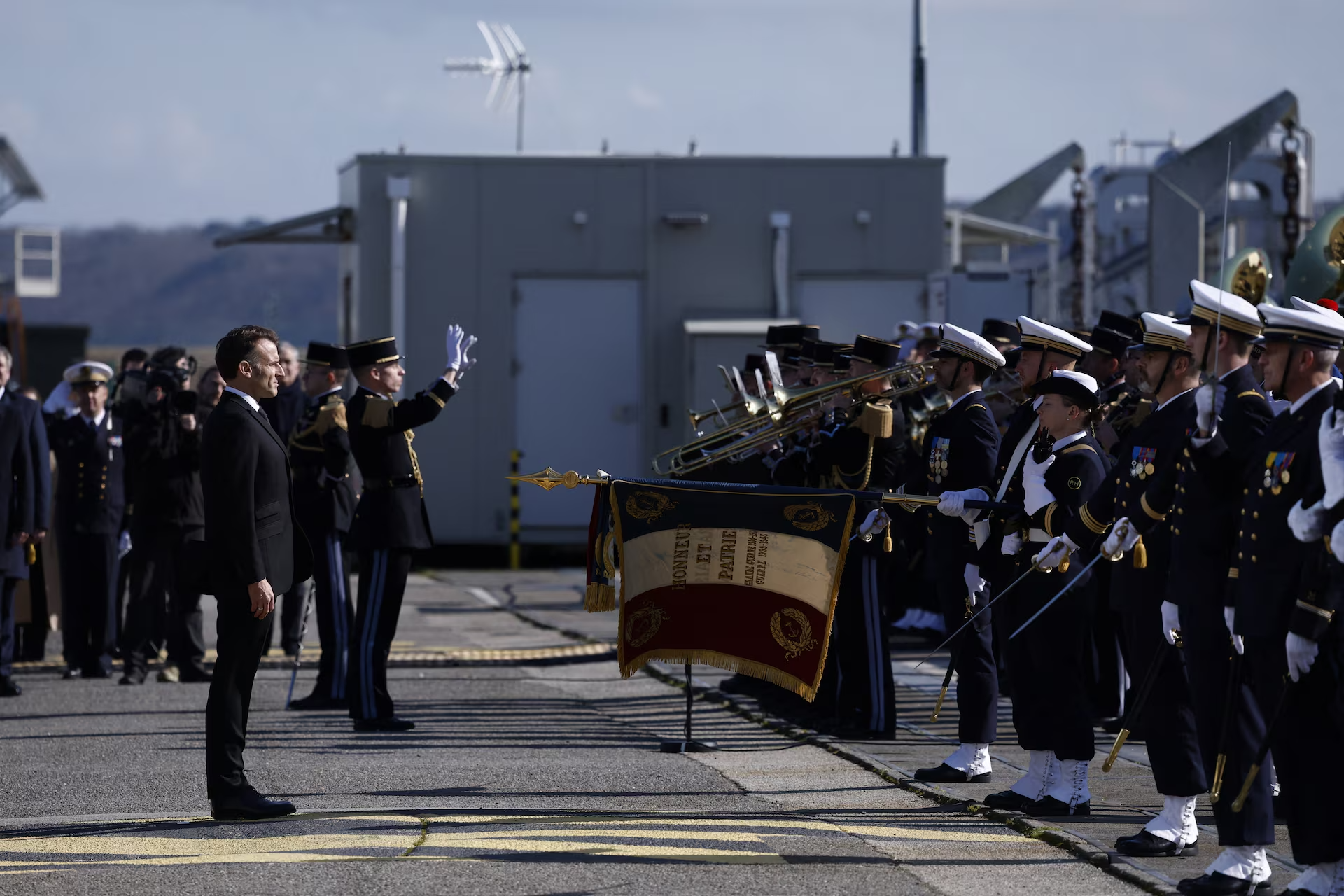
On Monday, at the French naval base on the Breton peninsula of Île Longue, Emmanuel Macron delivered an important speech on nuclear deterrence. An increase in nuclear warhead stockpiles was announced, alongside the classification of their numbers. More notably, within the framework of the “forward deterrence” concept, an initiative was put forward for joint nuclear exercises between France and its European allies (primarily Germany, but also Belgium, Denmark, Greece, the Netherlands, Poland, and Sweden). With that, the possibility of temporarily deploying French nuclear weapons on the territory of other European states is envisioned. E. Macron also indicated that only Paris could make the decision to use French nuclear weapons.
Just as observers began contemplating the practical implementation of these initiatives, a joint declaration of President Macron and Chancellor Merz was published. Noting that the “nuclear dimension of deterrence remains a cornerstone of European security,” the leaders agreed to establish a high-level bilateral nuclear steering group and to German participation in French nuclear exercises, whereby the German armed forces are assigned a conventional role, in contrast to NATO’s nuclear sharing (NS). Berlin and Paris also emphasized that this initiative complements NATO’s nuclear deterrence and NS rather than seeks to replace it and promised to maintain a close dialogue with the US, the UK, and other allies on these issues.
The declaration is also notable for its significant attention to the non-nuclear dimension of deterrence, specifically the development of anti-missile and anti-aircraft defense systems and high-precision long-range weapons. The purpose of such an approach, as indicated by the, is “to manage escalation beneath the nuclear threshold.” In other words, effective non-nuclear defensive and offensive capabilities will enable the achievement of set objectives in the event of a conflict without resorting to nuclear weapons, thereby enhancing the credibility of the overall deterrence system, which is naturally directed against Russia. It is interesting in this regard that Russia is not directly mentioned in the declaration, although the reference to the “evolving threat landscape” implies precisely this.
Finally, at first glance, the following excerpt might seem obvious: “France and Germany will continue to comply with their obligations under international law, including the Treaty on the Non-Proliferation of Nuclear Weapons.” However, against the backdrop of still marginal, yet existing domestic political discussions in Germany itself regarding the possibility of creating its own nuclear arsenal, this provision indicates that French nuclear guarantees have a nuclear dimension and are also aimed at neutralizing Berlin’s thinking of its own nuclear weapons. Such a situation is not new, as the US also previously formed nuclear umbrellas over countries that were close to creating their own nuclear weapons, including Germany.
It is necessary, though, to separate the wheat from the chaff and determine how genuinely new the initiatives proposed in Paris and supported in Berlin are. In particular, is the French nuclear umbrella over European allies really only starting to form now?
Essentially, no. In its nuclear doctrine, Paris has previously seen its own security intertwined with the security of its European allies (whether within NATO or the EU was never specified, but these largely overlap), noting that French “deterrence plays a European role,” and when defining the “vital interests” of France that constitute the condition for the possible use nuclear weapons, the interests of the “main partners” are taken into account. Moreover, the UK, as an ally of France in NATO but not the EU, is also included in this system, since, according to the provisions of the 2025 Northwood Declaration and other documents, the parties recognize “the intertwined nature of each other’s vital interests.” The foundational element of France’s nuclear doctrine has also remained unchanged to this day, namely the emphasis on the independence of its nuclear deterrence and the full sovereignty of Paris in nuclear decision-making.
The concept of “forward deterrence” itself was not introduced from scratch either. For instance, as Alexandra Zubenko notes in PIR Center report, Paris had previously made efforts to increase the “visibility” of its nuclear capabilities by, among other things, inviting European allies to its own exercises. In 2025, for example, the French Air and Space Force exercise Pégase, utilizing the air component of the nuclear triad (dual-capable Rafale fighter jets), took place in Europe for the first time, namely in Sweden. At that time, the French ambassador to the Kingdom, Thierry Carlier, stated: “<…> it is of course the case that our French vital interests also include the interests of our allies. In that perspective, the nuclear umbrella also applies to our allies, and of course, Sweden is among them.” This statement also indicates that France’s nuclear guarantees, putting aside their level of detail, had been provided to its European allies even before the current initiatives of E. Macron.
Implementing French initiatives will surely face problems. While maintaining the key provisions of France’s nuclear doctrine regarding the independence of its nuclear capabilities and the related decision-making process, it is not entirely clear how exactly the newly established nuclear steering group will function. In the joint statement, its tasks are reduced to “doctrinal dialogue” and “coordination of strategic cooperation, including consultations regarding the appropriate mix of conventional, missile defence and French nuclear capabilities.” Berlin is unlikely to participate in defining France’s nuclear doctrine or in Paris’s nuclear decision-making, but the Group may prove useful in preparing and conducting conventional support for the French Air and Space Force by the Luftwaffe in the event of such use. Furthermore, its usefulness may lie in advancing new initiatives and implementing existing ones in the field of integrated deterrence.
The French nuclear doctrine also raises the question of the specifics of hypothetical deployment of French nuclear weapons on the territory of other states, primarily Germany. On the one hand, such deployment might not involve the host nation’s air force participating in the immediate use of the stationed nuclear weapons (similar to the German role in the NS). Ultimately, the use of American non-strategic nuclear weapons stationed at the Incirlik (Turkey) and Aviano (Italy) airbases is delegated precisely to the US, not the respective nations’ air forces.
On the other hand, the hypothetical participation of Berlin and other states in the use of French nuclear weapons stationed on their territory may be theoretically possible. Indeed, while the French nuclear doctrine postulates its independence and sovereignty, the US in organizing NS also proceeds from the premise that the the use nuclear weapons is authorized exclusively in, with only political approval granted within the Nuclear Planning Group. Thus, with due dexterity, Paris could interpret its doctrine in a similar manner: asserting that a Luftwaffe pilot will employ a nuclear warhead only after authorization from Paris, the technical unlocking of the respective system, and solely against a target designated by Paris. Difficulties arise mostly in the realm of means of delivery, since Berlin has currently bet on purchasing the F-35A to strengthen its participation in the NS. The American fighter jet will obviously not be suitable for joint nuclear missions with France, so a different delivery vehicle will be required. This could be the Future Combat Air System (FCAS) project; however, at the moment, the initiative is on the brink of collapse due to Berlin’s decision to purchase additional F-35As and other disagreements.
Moreover, as Dmitry Danilov rightly notes, countries where French nuclear weapons could hypothetically be deployed (besides Germany, Poland could be one of the first such candidates) would become hostages to France’s military planning outside of NATO, which could raise doubts about the expediency of such a decision – at least as long as the NS exists and American non-strategic nuclear weapons are deployed in Europe.
In any case, Macron’s initiatives and the arrangements with Germany in the field of European deterrence represent a significant change in the European security environment. They can be explained by hedging logic, that is, reassurance in case the Trump administration’s isolationism reaches such heights that the US withdraws its umbrella over Europe. And even while it formally continues to exist, doubts about its credibility are growing. France’s non-nuclear allies in this regard may find reassurance in the more tangible nuclear guarantees of Paris in the face of the supposedly growing “Russian threat,” while Paris itself can strengthen its military-political positions within the EU and NATO without entering into direct conflict with the US, and quiet the voices advocating for the indigenous nuclear weapons in a number of other European capitals.
And although the nuclear steering group is currently bilateral, the creation of its multilateral equivalent, or the inclusion of other European states that have previously expressed interest in closer cooperation with Paris on nuclear deterrence, seems highly probable. The primary candidates are Belgium, Denmark, Greece, the Netherlands, Poland, and Sweden.
Keywords: France; Arms Control; European Security
AC
E16/SHAH – 26/03/04
