
PIR-Post № 3 (17), 2026. «To Be Free, One Must Be Feared»: on Macron’s Annual Address and European Reactions to Changes in France’s Nuclear Strategy

March 11, 2026
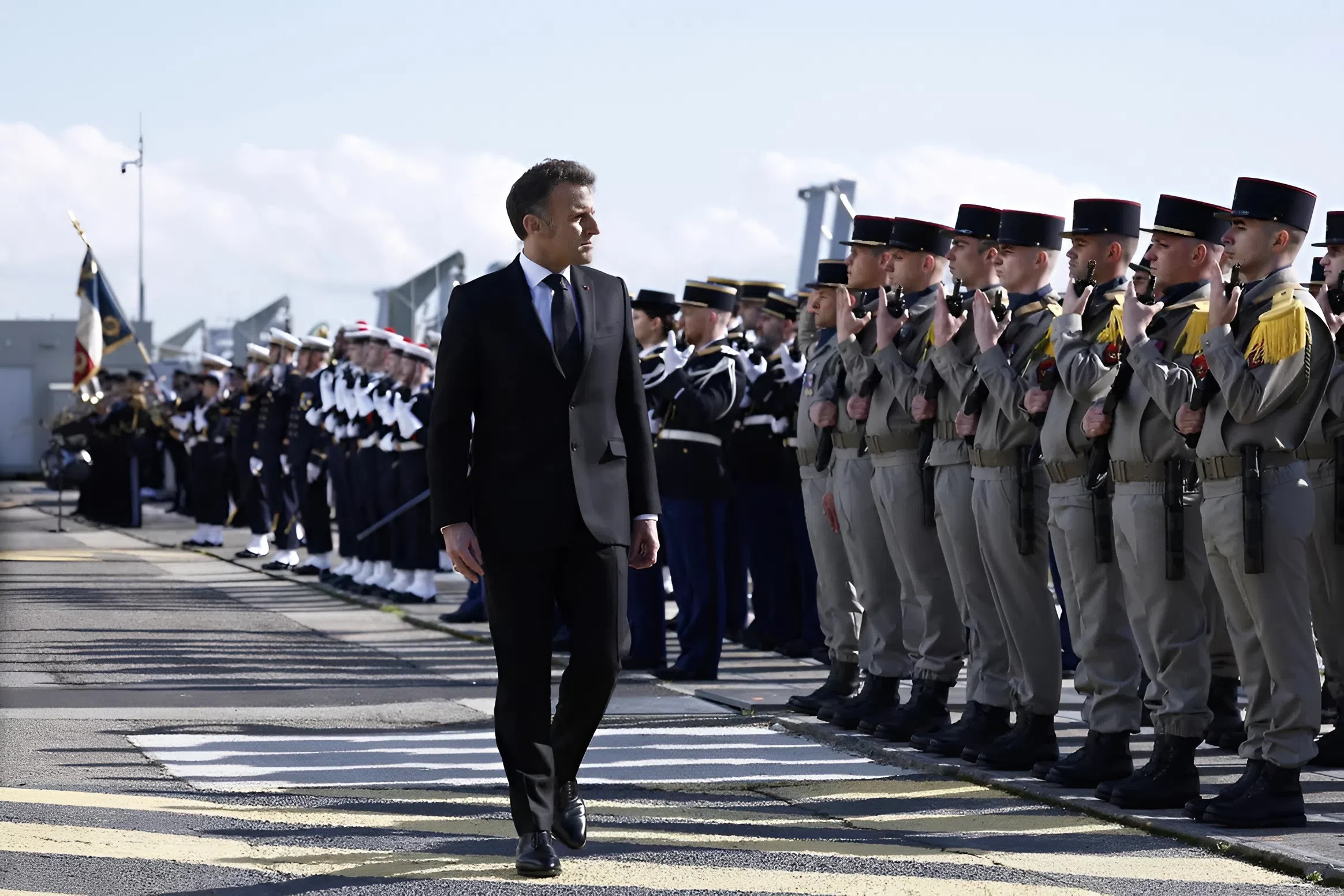
On Monday, Emmanuel Macron announced several changes to French nuclear planning and doctrine in his annual address at the Île Longue strategic submarine base. Key aspects of the president’s speech include increasing the number of French nuclear warheads, potentially deploying French fighters armed with nuclear-capable cruise missiles outside its territory, and announcing closer coordination with allies in defense and deterrence. Below is a brief examination of each of these aspects:
First, the president announced an increase in the number of nuclear warheads and stated that France will cease publishing data on warhead numbers, effectively ending transparency about its arsenal, following the UK model. It can be assumed this involves both increasing deployed warheads and expanding the overall nuclear stockpile in the longer term, currently at 290 warheads. From Macron’s speech, which emphasized the importance of non-strategic deterrence capabilities, it can be inferred that the focus is primarily on increasing the non-strategic arsenal, although an expansion of strategic warheads cannot be ruled out, since the current arsenal of strategic warheads (about 250) constitutes roughly a quarter of the full loadout for all four French SSBNs (around 1,000 warheads).
According to various estimates, France’s stocks include about 6-8 tons of weapons-grade plutonium and 25-32 tons of HEU, theoretically enabling significant arsenal expansion. Practically, however, mass buildup is unlikely given trends in the latest defense budget (2024-2030), revised annually. France’s 2026 defense budget is €57.1 billion, 13% higher than 2025’s €50.5 billion. Of this, ~€7.2-7.5 billion (13-14% of the total- a standard figure) goes to nuclear deterrence (dissuasion nucléaire), comparable to ~€7 billion in 2025. Exact breakdowns for nuclear modernization are not published, but these figures suggest no major arsenal growth.
The real question is the locations of warhead deployments. Macron stated France is considering deploying nuclear-armed fighters outside its territory in Europe, a significant reversal of French nonproliferation and security policy. No specific agreements were noted, but the president hinted Germany is a “key partner,” with Poland, Sweden, Greece, Denmark, the UK, Belgium, and the Netherlands also involved.
Third, “forward deterrence” involves deepening conventional missile cooperation – a course France has pursued for years, engaging European allies in missile defense, early warning, and short/medium-range missile development.
Under the ELSA (European Long-Range Strike Approach) project involving France, Germany, Italy, Poland, Sweden, and the UK, several weapons are in development:
These aim to create more affordable, mobile carriers for mass strikes that deplete enemy air defenses, increasing vulnerability and hindering advances without nuclear escalation (theater denial strategy)
Additionally, the president highlighted joint missile defense and early warning development – essentially countering Russian hypersonic weapons, viewed as a threat by France even before the SMO.
In early warning, the Franco-German JEWEL (Joint Early Warning for a European Lookout) program, launched in 2025 in response to “rising ballistic and hypersonic threats to Europe,” involves satellites and radars to detect ballistic/hypersonic missiles, complementing NATO systems. For missile defense, the upgraded Franco-Italian SAMP/T NG (New Generation) system was mentioned, built on the previous SAMP/T (MAMBA) with Ukrainian combat experience (where SAMP/T was supplied). The NG version is optimized for intercepting hypersonic models like Iskander-M (including Kinzhal hypersonic warheads), plus cruise missiles and UAVs.
Finally, the president reported expanding coordination mechanisms on deterrence and defense with Germany, the UK, and other Western European allies, as previously highlighted by PIR Center.
Essentially, this strengthens intra-European defense and deterrence coordination outside NATO mechanisms on bilateral/multilateral bases. Initiating such contacts gives France leadership in shaping cooperation and defense initiatives, most directly aimed at Russia and informed by Ukraine’s combat experience. Budget constraints limit scale without mass armament buildup, but a key aspect is that European conventional deterrence autonomy is forming in response to the so-called Russian threat, with Paris as the unifier, openly claiming its readiness to revise nonproliferation norms.
Reaction from European Allies
Quite predictably, one of the consequences of the ongoing reassessment of France’s nonproliferation policy has been the reaction of several EU countries, which have directly or indirectly expressed support for the idea of “forward deterrence.”
Polish Prime Minister Donald Tusk, for instance, stated that “Poland is in talks with France and a group of its closest European allies on an expanded nuclear deterrence program.”
An even more alarming signal came from the Nordic countries. Finland announced its intention to lift the previous ban on the deployment or transit of nuclear weapons on its territory. This refers to the so-called “Nuclear Energy Act,” in force since 1987, which prohibited the deployment or transit of nuclear weapons through Finland. The Finnish prime minister stressed that the country remains committed to NATO principles and would consider hosting nuclear systems only if such a decision were taken collectively within the alliance. Following Helsinki’s statements, Swedish Prime Minister Ulf Kristersson declared that the country’s doctrine of not stationing foreign troops or nuclear weapons on its territory “would not apply” if Sweden were to find itself in a “completely different situation.”
Although Finnish experts note that these statements “have nothing to do” with the remarks of the French president and do not imply that the countries are considering participation in the French initiative, it is clear that the discussion about revising the concept of nuclear deterrence in Europe – where France has assumed a leading role – has begun to trigger processes that may soon lead several European states to reconsider certain nonproliferation norms, which, needless to say, could have a profoundly negative impact on the global nonproliferation regime.
Keywords: France; Arms Control; European Security
AC
E16/SHAH – 26/03/11
