
THE WISDOM AND IRONY OF A VETERAN OF DIPLOMACY

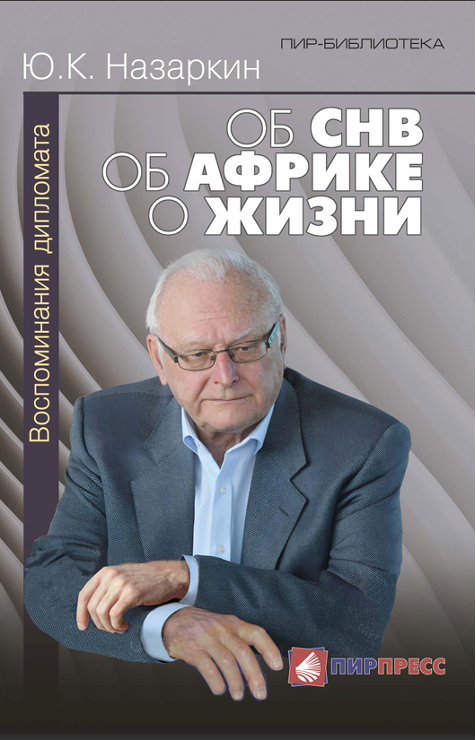
ON THE START[1]. ON AFRICA. ON LIFE: MEMOIRS OF A DIPLOMAT
Yuriy Nazarkin
Moscow. PIR-Press. Ves Mir Publishing House, 2024.
ISBN 978-5-7777-0940-0 (The Ves Mir Publishing House)
ISBN 978-5-6051623-3-9 (PIR Center)
(published in Russian)
URL: https://pircenter.org/wp-content/uploads/2024/07/Об–СНВ.-Об–Африке.-О–жизни.-Воспоминания–дипломата.-Ю.К.-Назаркин.pdf
PIR Center recently published this book as part of a series of memoirs by great figures who stood behind the nuclear nonproliferation and disarmament movements around the world. This is a good thing, because people pass away (God’s blessings upon Nazarkin!), and living testimonies of events long past are gone. The Internet, of course, “never forgets”, but as life shows, it also manages to lose a lot.
It’s an easy read, although in places it seems like some sections within the chapters aren’t quite in logical order. But then again, these are memoirs – they just came to mind and ended up on paper.
Like any retired ambassador of the Soviet era, Nazarkin is a wonderful storyteller. I remember how, in my first year at MGIMO University, we listened to the tales of such veterans in a course that, for some reason, was called “Fundamentals of Diplomatic Service”. Or perhaps those were the “fundamentals” – understanding what the diplomatic service consists of, hearing from real-life witnesses about its peculiarities (including the unflattering ones), and making an informed decision about whether to join it.
In these stories, Yuriy Nazarkin displays a great deal of freedom and light humor, sometimes bordering on sarcasm. And you realize it was a completely different corporate culture – similar to the TV series “Optimists”, with creativity and debate, sometimes bordering on dissidence. Although they were also careful to keep their mouths shut, as their obsession with secrecy was no less intense. The book contains numerous examples of absurd secrecy – in particular, the publication of the START I Treaty, which was eventually translated into Russian and posted by the UN, but from English, as Soviet colleagues kept the Russian text secret. It’s also fascinating to read about some practices and approaches that have survived to this day, almost from the 1930s, although, despite the healthy conservatism of foreign policy agencies (as well as throughout the world), they should have been changed long ago.
In light of current events[2], the informal meetings between the heads of the Soviet and American delegations at the height of the Cold War – cafe get-togethers, walks through the Swiss mountains, and other delights of normal human interaction, where positions were resolved – seem striking. Just like in Valery Fokin’s[3] play “An Honest Woman”. Today, such a thing is unthinkable – you’ll immediately become the target of criticism on social media and the object of scandal, not to mention ostracism from the fellow citizens on both sides. But during the superpower era, when the press was kept on a tight leash, this was a fairly common practice.
And they resolved major issues, although rounds of discussions lasted for years. Ironically, even then, political positions were determined in a wide variety of departments, including the Politburo, but diplomacy played a significant role in the work processes; it contributed to the development of ideas, even if it wasn’t always heard by other ministries associated with the military.
Yet, watching nuclear arms control and missile defense agreements crumble one after another, and the frenzy of “let’s hit them” and “might makes right” sweeping the world, one wonders: was it all worth it? For years, they’ve been arguing over how to count these carriers and warheads, even though they’re enough to destroy the world ten times over. Nazarkin himself admits, with a certain philosophical sensibility, that the questions, against the backdrop of the endless, eternal blue sky, seemed petty and trivial. But without them, who knows how the early 1980s would have ended, and at least humanity would have lived for 40 years without nuclear war. Although the plan for “universal nuclear disarmament by the year 2000” still seems tempting to many today, especially given the real problems plaguing the planet. And these require real negotiations, with solid preparation and solid training (i.e., those who possess the tools and mechanisms honed over the years at the Conference on Disarmament). Or perhaps, on the contrary, we should turn the chessboard upside down and break all the patterns, letting our opponents understand that institutionalization is a weakness? Although, as Vyacheslav Volodin[4] says, “the system beats the class”.
There’s not much about Africa, but it’s also interesting – the very beginning of decolonization and the establishment of diplomatic relations with the USSR. But all this is through the eyes of a young scoundrel who landed a job at the newly opened embassy and looked at the events with sobriety and irony, not with the hardened self-importance of a man frustrated by the system.
So you read and wonder – is it possible to describe with such ease, yet with such emphasis on meaning, the processes, encounters with unique people, and simply the events I participated in? Will it sound as momentous? And you realize that it can’t – they still have a long way to go to match the mastery of Nazarkin and his fellow great Soviet ambassadors and deputy ministers.
We are becoming smaller, what can we do?
[1] Originally published at Polikanov Speaks Telegram Chanel. URL: https://t.me/polikanovgovorit/1954 (in Russ.).
[2] As of Jule, 2024 – Editor’s note.
[3] Valery Fokin – Soviet and Russian theatrical and film director, actor and pedagogue. Artistic Director (2003-2024) and President (since 2024) of the Alexandrinsky Theatre (St. Petersburg); President (since 2011) of the Meyerhold Centre (Moscow) – Editor’s note.
[4] Vyacheslav Volodin – Russian politician, the 10th Chairman of the State Duma since 2016 – Editor’s note.
