

International security is experiencing one of the most challenging periods in recent decades. The familiar mechanisms for preventing crises and maintaining strategic stability are under pressure, trust between states is eroding, and the contours of the future world order remain a subject of intense debate. In Eurasia, where the interests of major powers, regional associations, and states with different foreign policy priorities intersect, the issue of shaping a common security architecture is of particular importance.
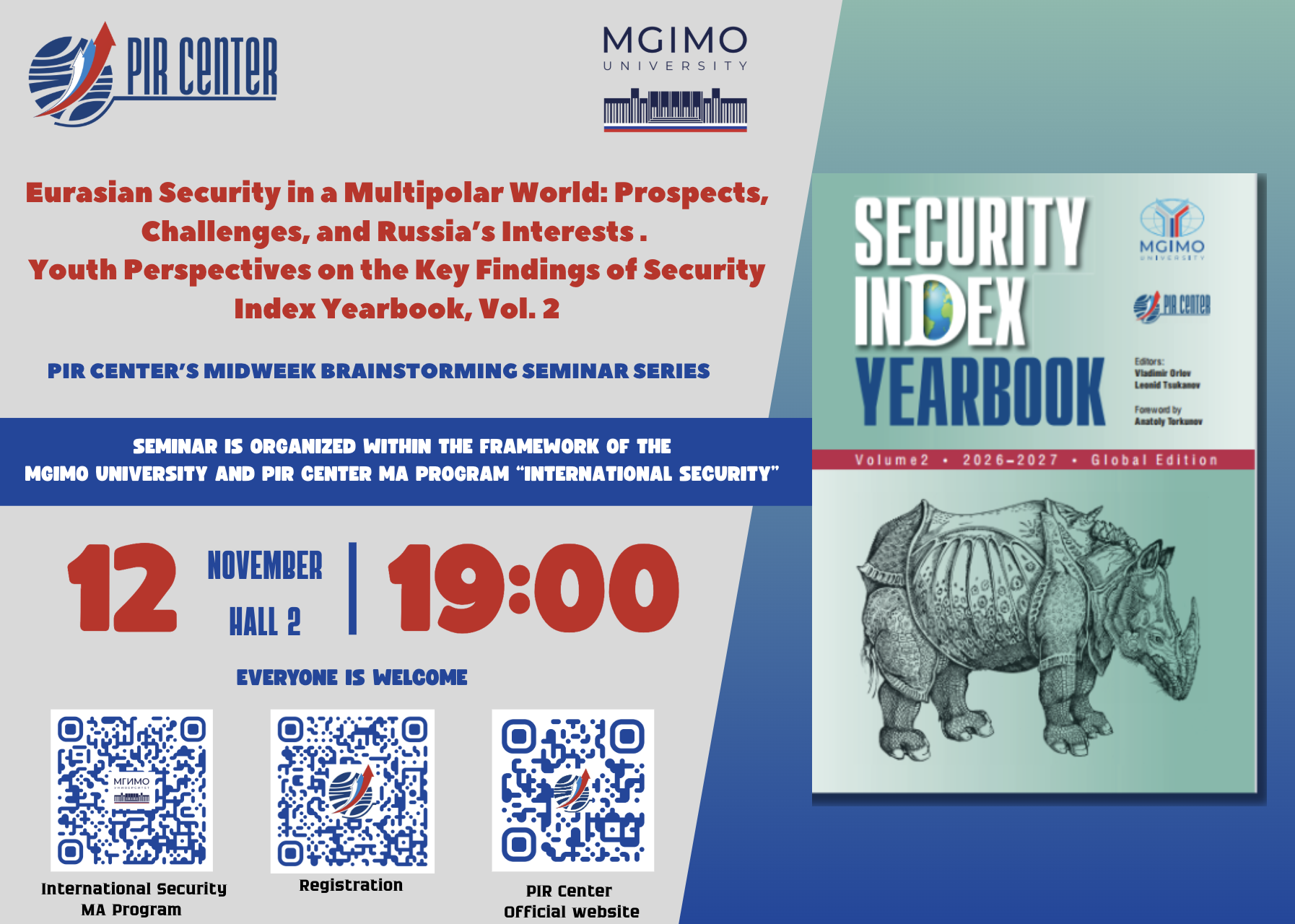
Can Eurasia become a space governed by generally accepted rules – or will the continent face further fragmentation into regional blocs? What mechanisms can ensure stability, and what is Russia’s role in their formation? These questions will be at the center of the expert seminar organized by PIR Center and MGIMO University of the Russian Ministry of Foreign Affairs, which will be held on November 12, 2026, as part of the joint the International security MA Program.
The starting point for the discussion will be the materials from the second volume of the Security Index Yearbook — a study by PIR Center and MGIMO University that examines key trends and challenges in international security. Participants are invited to view the conclusions of the Yearbook through the eyes of a new generation of researchers and to correlate the ideas presented in it with current processes in world politics.
The seminar is based on two chapters of the Yearbook:
- “Security Across the Eurasian Space: The Architecture That Unites”, — Ambassador-at-Large of the Russian Ministry of Foreign Affairs, Alexander Trofimov;
- “Eurasian Charter of Diversity and Multipolarity in the XXI Century”, — Minister of Foreign Affairs of the Republic of Belarus, Maxim Ryzhenkov.
The discussion will address the principles of the indivisibility of security, the prospects for forming a Eurasian architecture of cooperation, the potential of existing regional formats, and the role of the proposed Eurasian Charter of Diversity and Multipolarity. Special attention will be paid to how the national interests of states can be reconciled with the search for common approaches to ensuring security on the continent.
The main presentations will be delivered by second‑year students of the International security MA programm joint by PIR Center and MGIMO University: Dominik Albert, Irina Klimenkova, and Cui Huizheng. As part of the discussion, comments are also planned from young experts from various countries, as well as from senior Russian and international specialists on issues of global politics and security. This will make it possible to compare different national views on the future of Eurasia and to combine the research interests of young people with the experience of recognized experts.
The seminar is intended to serve as a platform for an open professional dialogue, where the main goal is not to offer pre‑prepared answers, but to identify possible directions for the development of a more stable and predictable security system in the Eurasian space. The registration is available via the link. For more information write to secretariat@pircenter.org.
November 12, 2026
From 19:00 to 21:50
Hall №2, MGIMO University
Working language – English
