
№ 29 (77), 2026. PIR Center Report Series: «It’s Going to Rain: Peculiarities & Prospects of Nuclear Umbrellas»
June 16, 2026
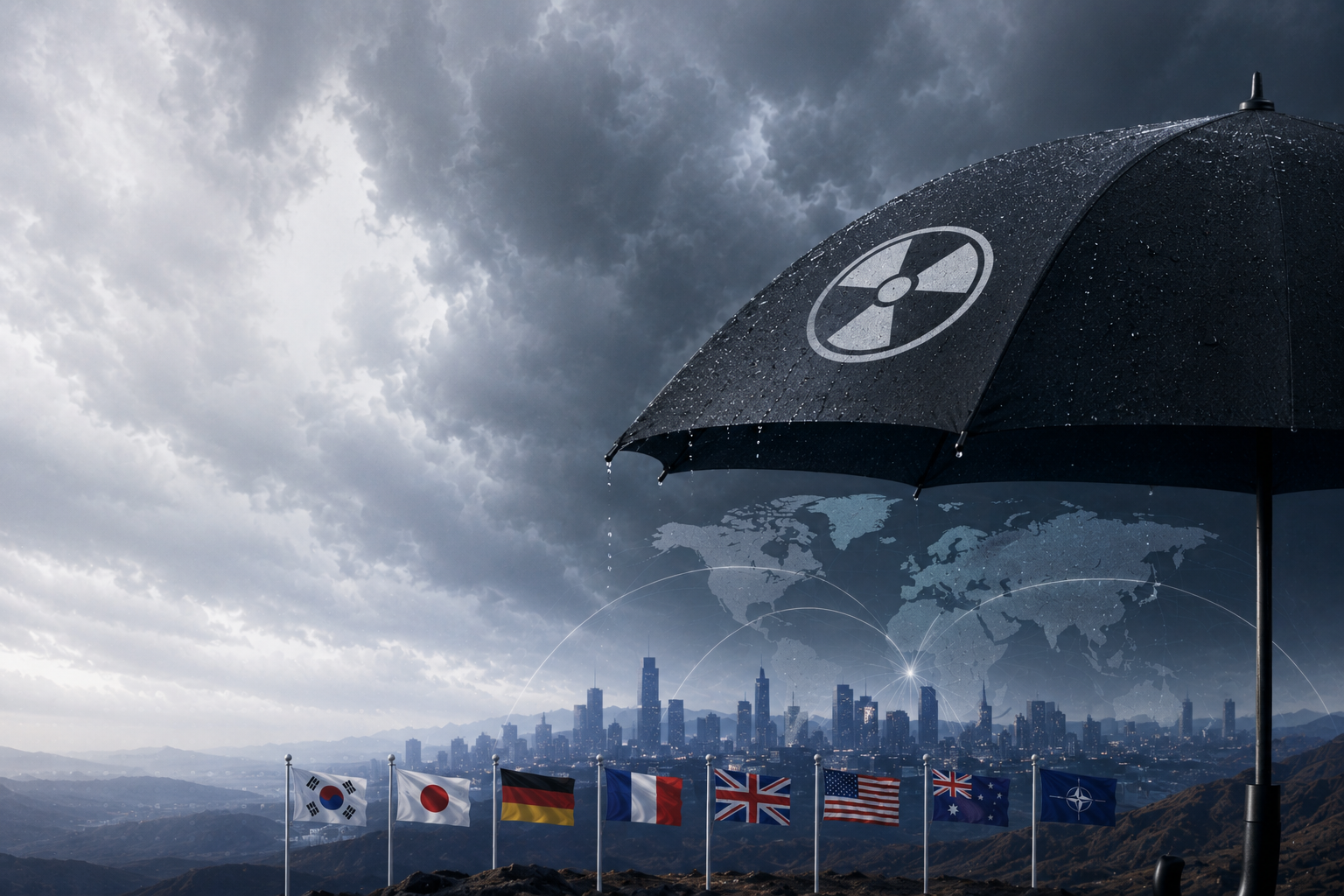
MOSCOW. JUNE 16, 2026. PIR PRESS. «A nuclear umbrella is not synonymous with extended nuclear deterrence but rather constitutes one of its elements. It does not necessarily imply the deployment of nuclear weapons on the territory of an ally and is not limited exclusively to protection against nuclear threats. First and foremost, it refers to a system of military-political and doctrinal guarantees provided by a nuclear-weapon state to its ally. Amid the growing role of the nuclear factor in Europe and the Asia-Pacific region, the practice of nuclear umbrellas will not disappear but will transform: the United States will strengthen its system of extended deterrence; France will further specify the European dimension of its nuclear guarantees; and Russia will develop the nuclear dimension of the Union State with Belarus», – Mr. Ilya Subbotin, PIR Center intern and student of the MA Program International Security, implemented jointly by MGIMO University and PIR Center.
PIR Center is pleased to announce the publication of its new report (in Russian), “It’s Going to Rain: Peculiarities & Prospects of Nuclear Umbrellas,” prepared by PIR Center intern Mr. Ilya Subbotin. The report is published as part of PIR Center Reports series (№50) and represents a comprehensive study of the practice of “nuclear umbrellas” – nuclear guarantees provided by nuclear-weapon states to their military-political allies. The purpose of the research is to identify the specific features of the practice of nuclear umbrellas at the present stage and to assess its prospects in the foreseeable future.
The report is based on the author’s research paper presented at PIR Center and MGIMO University seminar “It’s Going to Rain: Peculiarities & Prospects of Nuclear Umbrellas.” The scientific advisor of the research paper was Dr. Vladimir Orlov, PIR Center Founding Director and Professor at MGIMO University.
A video recording of the expert seminar and the speaker’s presentation are now available on PIR Center website in the “NONPROLIFERATION.WORLD” section, under the subsection of the online-course titled “Current Issues in International Security 2025–2026: PIR–MGIMO Seminar Series” (in Russian).
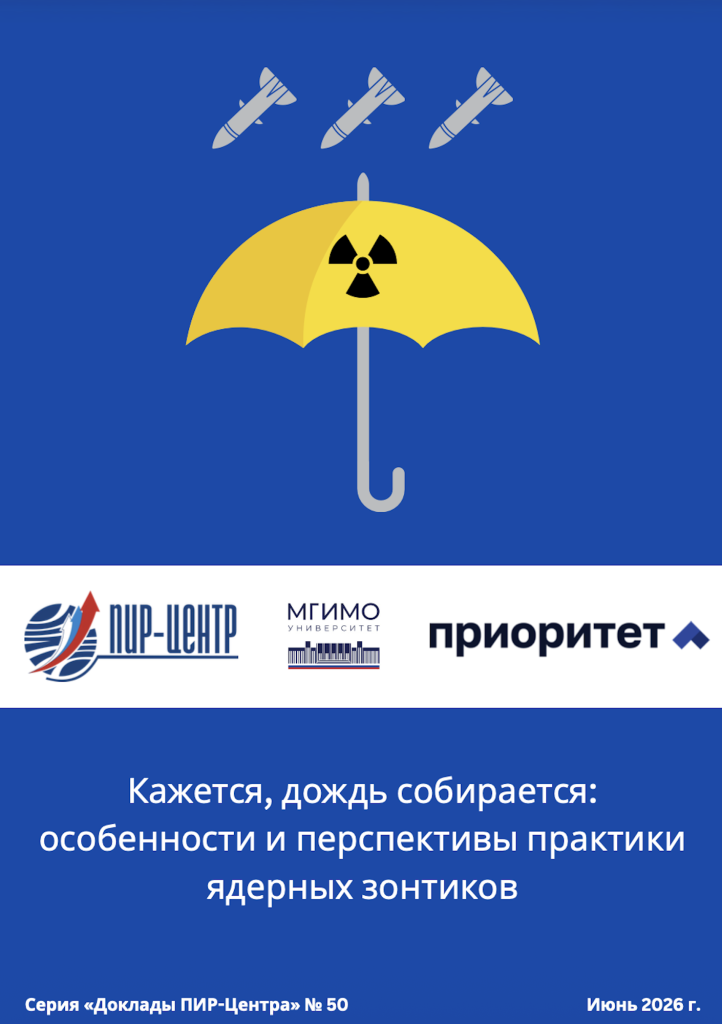
In the course of the research, the author summarized academic discussions on the essence of the concept of a “nuclear umbrella,” examined the history of the formation and evolution of nuclear umbrellas up to the early 2020s, and conducted a comprehensive analysis of contemporary nuclear umbrellas and the latest trends in their development. The report focuses on U.S. nuclear guarantees to Japan, the Republic of Korea, Australia, and NATO allies; the prospects for the Europeanization of nuclear deterrence; Russian guarantees within the framework of the CSTO and the Union State; and the question of whether new states may emerge under “nuclear umbrellas.”
The report was prepared within the framework of PIR Center and MGIMO University Consortium under the auspices of the Priority-2030 Strategic Academic Leadership Program.
Key Findings of the Report:
Reviews of PIR Center Report
This work is highly original and is based on a profound analysis of a wide range of documents, materials, and literature from a large number of countries. The author demonstrates an ability to analyze problems systematically and in their interconnections. The issues addressed in the work are examined with due regard to their evolution over the past 75-80 years, as well as in their dynamics and future prospects. The conclusions drawn by Mr. Subbotin are of practical significance for assessing the development of the military-strategic situation in the regions most important for Russia – Europe, the Middle East, and the Asia-Pacific region. In my view, the author is already a mature international affairs researcher who has proven his ability to conduct an objective analysis of the most complex strategic issues, said Dr. Dmitry Trenin, President of the Russian International Affairs Council, Director of the Institute of World Military Economy and Strategy at HSE University, and PIR Center Executive Board Member.
The work under review has undoubtedly succeeded and deserves high praise. The research is well-grounded. The author demonstrates a broad professional outlook and maturity of argumentation, said Dr. Alexey Krivopalov, Senior Research Fellow at the Center for Post-Soviet Studies, Primakov National Research Institute of World Economy and International Relations, Russian Academy of Sciences.
Keywords: International Security; Nuclear Nonproliferation
NINE
E16/SHAH – 26/06/16
