
№ 18 (62), 2026. Shifting Sands: The New Alliances of the Middle East: Interview with Dr. Gary Samore by Maksim Nosenko

August 18, 2026
Exclusive Interview


The new guest of this exclusive interview is Dr. Gary Samore, Director of Crown Center for Middle East Studies and Professor of the Practice of Politics at Brandeis University. Dr. Samore previously served as Special Assistant to the President and Senior Director for Nonproliferation and Export Controls under President Clinton from 1996 to 2001, and as President Obama’s White House Coordinator for Arms Control and Weapons of Mass Destruction from 2009 to 2013. In this interview, we have examined the war in Iran, emerging Middle Eastern alliances, the bilateral Pakistani-Saudi agreement, and the recent Pakistan-Saudi-Turkey trilateral pact, focusing specifically on nuclear nonproliferation.
The interview was conducted by Mr. Maksim Nosenko, Information, Publications & Digital Communications Program Coordinator at PIR Center.
Mr. Maksim Nosenko: To begin with, let’s talk about the war in Iran. How do you assess its implications for nuclear proliferation and stability in the Middle East?
Dr. Gary Samore: Well, I think we have to look at the June 2025 war, which is much more important than the war that started in February of this year in terms of Iran’s nuclear capabilities and motivations. So, I think the June 2025 war was very effective in destroying or damaging Iran’s main nuclear enrichment facilities at Fordow, Natanz, and Esfahan. It didn’t completely eliminate Iran’s capabilities, and Iran still has, of course, some enriched nuclear material which it could use to convert to weapons-grade material at some point in the future. And it’s believed that Iran probably has some components or spare centrifuges they could use to build a clandestine enrichment facility in order to produce weapons-grade uranium. But, as far as it’s possible to tell, there isn’t any evidence that Iran has actually tried to revive its nuclear program since the damage that it suffered back in June of 2025.
I think there’s a good argument that Iran’s motivation to have nuclear weapons is even stronger, not only because of the war in June of 2025, but the current conflict that started in February has given Iran a stronger incentive to have nuclear weapons as a deterrent against future conflict with Israel and the United States. And there’s, at least, some reason to believe that the death of the supreme leader, Khamenei, has removed at least one constraint on Iran’s nuclear program in the future. But, at the same time, Iran seems to be very cautious about reviving its nuclear program because of the risk that it would be exposed to and the advantage it has in terms of controlling the Strait of Hormuz. And the nuclear option is, at least right now, less important to Iran in terms of protecting itself against American aggression. So, I would say at this moment the war in June of 2025 and the war that started in February of 2026 have reduced the risk of Iran developing nuclear weapons. But, of course, that can change in the future. I mean, the conflict is not over. In the future, Iran may decide to try to revive its nuclear program, most likely with a clandestine, with a secret enrichment, small secret enrichment facility. People have identified potential locations, like tunnels in Pickaxe Mountain and so forth. At this point, I think a nuclear deal between the U.S. and Iran seems very unlikely. The focus is entirely on the Strait of Hormuz; I don’t think the Iranian government has much incentive to reach an agreement with the U.S. that would limit its future options.
I think President Trump, you know, doesn’t place that high a priority on the nuclear issue because in his mind, as he said over and over again, the only thing Iran has left is some nuclear material which is buried under rubble. So, I think it’s unlikely that there will be another nuclear agreement that would constrain Iran’s program. At the same time, as I said, I think Iran is very cautious about pursuing nuclear weapons at this point because of the risk that it would be detected and would lead to additional military strikes from the U.S. and from Israel.
Mr. Maksim Nosenko: I think that not only Iran but some other Middle Eastern countries got an additional motivation to think about nuclear weapons after the escalation in Iran. And, for example, in September, Pakistan and Saudi Arabia signed the Strategic Mutual Defense Agreement. Previously, according to the media, you stated: “I do think that the Saudis believe that they have some understanding with Pakistan, that in extremis they would have a claim to acquire nuclear weapons from Pakistan.” Can this agreement implicitly include this option? And what do you think about it now?
Dr. Gary Samore: So, I’ve always been a skeptic that there’s any kind of a formal agreement between Saudi Arabia and Pakistan concerning Pakistani nuclear protection or nuclear assistance to Saudi Arabia. During many years of working in the U.S. government, I never saw any information or intelligence that confirmed the existence of such an agreement. I think that continues to be true. I mean, I’ve seen nothing to indicate that the September 2025 Mutual Defense Agreement has any explicit nuclear commitments in it. Pakistan would be extremely reluctant to provide nuclear weapons to Saudi Arabia, much less use nuclear weapons to protect Saudi Arabia, especially against any enemy that had nuclear weapons. The most plausible scenario is that, in some kind of extreme situation, Pakistan might deploy Pakistani forces in Saudi Arabia, armed and equipped with nuclear weapons. This would be comparable to the U.S. forces in Europe armed with nuclear weapons. So, I could imagine that kind of an arrangement, but I don’t think that’s very likely, and I don’t think there’s been any discussion or commitment between Saudi Arabia and Pakistan for that kind of a step.
We know the Pakistanis have had conventional forces stationed in Saudi Arabia off and on for decades, and I’ve read that in the current conflict, Pakistan deployed a squadron of aircraft and some air defense systems and troops to Saudi Arabia. But, of course, that’s not indicative of any commitment to deploy nuclear weapons in Saudi Arabia. And I don’t see why Saudi Arabia would feel that was necessary. And, as I said, I think the Pakistanis would be extremely reluctant to deploy nuclear weapons in Saudi Arabia because it would be very controversial. And Pakistan is trying to maintain its relations with Iran, if only as a mediator between Iran and the U.S. So, I don’t think either the Saudis or the Pakistanis are looking to implement any kind of a nuclear arrangement under current circumstances.
Mr. Maksim Nosenko: How can Saudi Arabia protect itself amid the escalation in Iran? Saudi Arabia is a target of Iranian strikes, and Pakistani troops have already been stationed on Saudi territory. However, Iranian strikes persist, and Pakistani troops seemingly fail to provide comprehensive protection for Saudi Arabia. What are the red lines for Saudi Arabia as its territory is under attack and its strategic export is under threat? What should Saudi Arabia do to protect itself? To a certain extent, the nuclear option or nuclear discussions seem to be the most reliable option?
Dr. Gary Samore: I don’t think it would be credible for Saudi Arabia, or for Pakistan to use nuclear weapons against Iran in a conventional scenario. So, the way the Saudis – first of all, the Saudis cannot completely defend themselves against Iranian attacks, nor can any of the other Arab Gulf states. And that’s one of the reasons why all of them would like to see some kind of a ceasefire and a settlement of the conflict so that they’re no longer under threat from Iran. So, the primary Saudi effort to protect themselves is to try to end the war and prevent escalation. And we know that the Saudi crown prince, Mohammed bin Salman, has been urging Trump not to escalate. That’s because the Saudis are afraid that will provoke Iranian retaliation against Saudi energy infrastructure. Now, the Saudis and the other Gulf countries have some means to defend themselves with air defense and missile defense systems, but they know that that’s not perfect and that they can’t stop all Iranian missiles and drones from striking sensitive targets in Saudi Arabia. The Saudis can’t even defend themselves against the Houthis, who have far less capability than Iran. So, the other option for the Gulf, for Saudi Arabia and for the Gulf countries, is to threaten Iran directly.
And of course, we know from press reports that the Saudis and the Kuwaitis and the Emiratis and others have retaliated directly against Iran. In fact, I think it’s quite interesting that in the most recent exchange of fighting between the U.S. and Iran, Iran has not attacked Saudi Arabia. It attacked Kuwait, Qatar, Bahrain, and the Emirates, but did not attack Saudi Arabia. I think that’s an indication that the Iranians are, up to now anyway, deterred from striking Saudi Arabia because of their concern that the Saudis, who have a pretty capable air force, will retaliate against Iran. So, Saudi Arabia doesn’t have a perfect means to defend itself. They’re using some diplomacy, some defense, some deterrence, but none of that involves nuclear. So, I don’t think that nuclear weapons are a component of Saudi Arabia’s current policies toward trying to avoid being attacked in the context of the war between the U.S. and Iran.
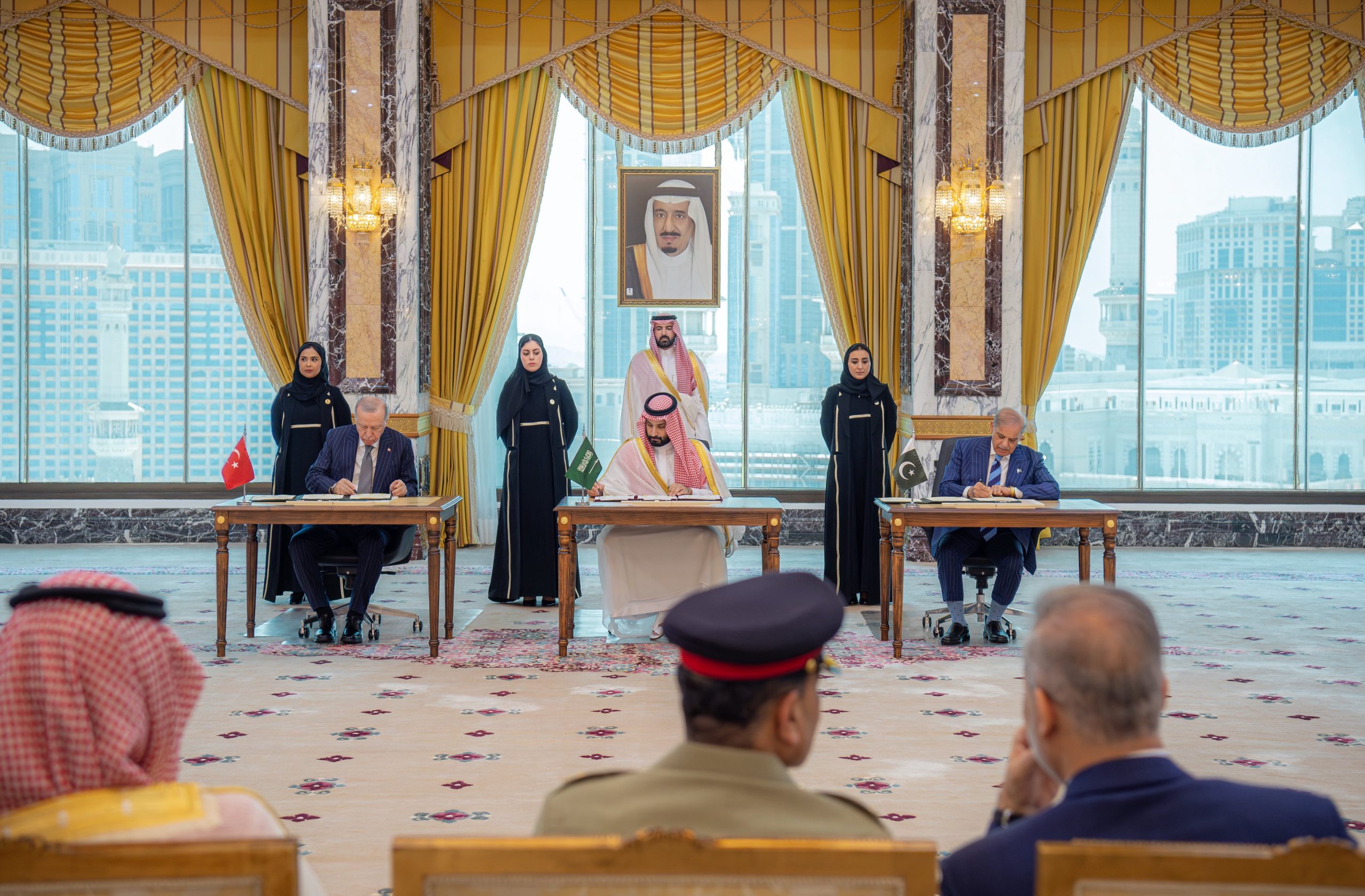
Mr. Maksim Nosenko: The situation has taken on a new dimension with the recent signing of a mutual defense memorandum by Pakistan, Saudi Arabia, and Turkey. Can we speak of the Pakistani nuclear umbrella in this case? And what is Turkey’s role in this new agreement, given that it’s a NATO member hosting U.S. nuclear weapons?
Dr. Gary Samore: Well, again, I don’t think this trilateral agreement has any nuclear dimension whatsoever. I think it’s primarily a political instrument because the Saudis and the other Gulf countries feel that their reliance, their dependence on the United States for protection, has not worked out the way they want it. Now, they can’t completely free themselves from dependence on the United States because the U.S. is the only country with the capacity and the willingness to defend the Gulf countries against Iran. Neither Turkey nor Pakistan is a reliable security partner if the Saudis are threatened by Iran. This trilateral agreement is a way for the Saudis to try to reduce dependence on the United States.
And there‘s a lot of talk about building some kind of regional security architecture that would include Turkey and Pakistan as an alternative to the American idea of the Abraham Accords – U.S., Israel, and the Emirates, and hopefully Saudi Arabia. And, just to say, I don’t think Saudi Arabia can depend on Turkey and Pakistan to defend it against external enemies, whether they’re the Houthis or the Iranians or the pro-Iranian militia groups in Iraq. I don’t think Turkey or Pakistan is interested in getting dragged into that kind of a conflict. Only the U.S. is prepared to fight alongside Saudi Arabia, as recently happened when the Saudis attacked pro-Iranian militia groups in Iraq. That was a joint U.S.-Saudi operation. There was no Turkish or Pakistani role whatsoever.
Mr. Maksim Nosenko: Can we forecast that, for example, Egypt or any other country will join the agreement in the near future?
Dr. Gary Samore: I don’t know exactly, but there were discussions about Egypt joining. And I think there was an Egyptian official present in Mecca when the agreement was signed and announced. But, for whatever reason, Egypt decided not to be a party to that agreement. I don’t know why.
Mr. Maksim Nosenko: Could any other Gulf country join the agreement?
Dr. Gary Samore: Well, they might. You know, the Gulf countries are very deeply divided on their strategy toward dealing with Iran. I mean, the Emiratis, the Saudis, the Kuwaitis, and the Bahrainis are relatively hardline, with Qatar obviously trying to act as a mediator and Oman trying to act as a mediator. So, it’s very difficult for the GCC countries to act in a coordinated diplomatic fashion. And people have talked for years about some kind of a regional air defense system, which makes a lot of sense from a military standpoint, but politically it’s never been possible. I don’t expect that to change anytime soon.
Mr. Maksim Nosenko: So, taking this into account, where is the Middle East security architecture heading?
Dr. Gary Samore: There isn’t one, and there can’t be. There are too many conflicts among the countries of the region for them to form a regional architecture. And ever since October 7, those regional conflicts have become much more acute, including especially the conflict between Israel and the United States, and Iran and its allies in the region. So, I’m very skeptical that any kind of a regional architecture is possible.
Mr. Maksim Nosenko: Is it possible to resolve the ongoing conflicts by negotiations?
Dr. Gary Samore: No. Unfortunately, the Israeli-Palestinian conflict and the conflict between Iran, Israel, and the United States cannot be resolved through negotiation. They can be managed, but under current conditions, they can’t be resolved.
Mr. Maksim Nosenko: And in that regard, can we forecast that in the next decade we will see new nuclear powers in the Middle East?
Dr. Gary Samore: That’s a very good question. It’s very hard to forecast. I mean, as I said, I think Iran has a very strong motivation to produce nuclear weapons. We know they have the basic scientific and industrial capacity. But, at the same time, it’s a very, very dangerous decision for Iran to take. And Iran’s previous nuclear strategy of developing what people call a hedging option – developing capacity for production of nuclear material and doing some research on nuclear weapons design and so forth – that strategy failed because it brought about a massive military attack against Iran. So, it’s unclear what nuclear strategy Iran will pursue in the future. And if they decide to pursue nuclear weapons, if the U.S. and Israel are able to detect it, that will probably lead to another military conflict. So, I think that outside of Iran – and obviously Israel – no other Arab country has the basic technical capacity to produce nuclear weapons. So, they would have to rely very heavily on external assistance in order to have the ability to produce nuclear weapons.
Mr. Maksim Nosenko: From my perspective, basically, the Arab countries have no intention of being the first new nuclear countries in the region, but they will definitely strive to be the second. For example, if Iran gets nuclear weapons, they will certainly do the same. However, at the same time, do the regional countries have an option to mitigate the risks by talking about nuclear weapons – by striking a deal like the one between the U.S. and Saudi Arabia? After that, there has been much discussion about possible nuclear proliferation in terms of that deal between Saudi Arabia and the U.S.
Dr. Gary Samore: I think Arab countries in the past have tried to build nuclear weapons, but they failed. I mean Iraq under Saddam Hussein, Libya under Gaddafi, and Syria under Assad. They had nuclear weapons programs, but those programs failed for a variety of reasons. So, from that standpoint, there is motivation in the Arab world among certain countries to have nuclear weapons, but they have not been able to execute on that ambition – partly because of the Israeli Air Force, which, of course, destroyed reactors in Syria and in Iraq, and partly because of American diplomatic pressure in the case of Libya, which led to the agreement to eliminate Libya’s nuclear program. The question will be: does that change in the future? Are there a set of circumstances and conditions which would make it possible for Arab countries to carry out their incentive to have nuclear weapons? And I think part of the argument against that is that the Arab countries that were most interested in pursuing nuclear weapons in the past – Iraq, Syria, and Libya – are now experiencing extreme political instability. And it’s very hard to pursue a nuclear weapons program – to organize the resources and carry out a nuclear weapons program – when those countries are so politically unstable, and in some cases, in the middle of real fragmentation and civil war. So, that’s an argument against the Arab countries being able to organize the resources necessary to pursue nuclear weapons. And again, it’s not about motivation, it’s about capacity.
Mr. Maksim Nosenko: You said that it’s impossible to resolve the regional conflicts by negotiations now. However, in a broader framework, are negotiations on strategic stability and arms control between the great powers like Russia, the U.S., and China possible today?
Dr. Gary Samore: Well, unfortunately, it’s very difficult because, as you know, U.S.–Russian relations are in, you know, very bad shape right now because of the escalation in Ukraine. And U.S.– China relations are in very bad shape. And in any event, China has no interest in that.
Keywords: Pakistan; Saudi Arabia; Iran; Middle East; nuclear weapons; uranium
NPT
E16/NOS – 26/08/18
