
№ 41 (89), 2026. PIR Center Report Series: “From Ally to Independent Player: Prospects for Australia’s Nuclear Independence Within the AUKUS Alliance”
August 3, 2026
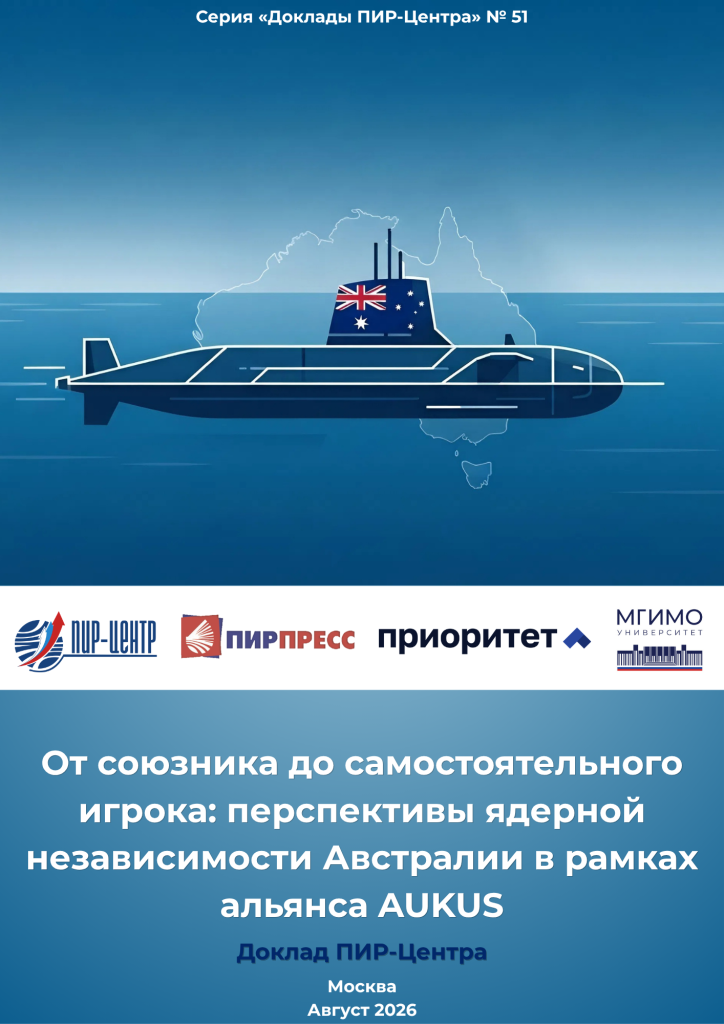
MOSCOW. AUGUST 3, 2026. PIR PRESS. “The prospects for Australia’s nuclear independence within the AUKUS alliance remain highly ambivalent. Currently, the nation stands on the threshold of a new phase in its strategic and defense development. Canberra is progressively seeking to shed its role as a “junior partner” to the United States and the United Kingdom. To achieve this, Canberra is increasing defense expenditures, modernizing its naval fleet, developing a domestic defense-industrial base, and acquiring access to naval nuclear propulsion technologies. However, these very processes demonstrate that Australian autonomy is developing not outside the framework of the alliance, but within it”, – Mr. Yuriy Shakhov, PIR Center editor and graduate of the MA Program International Security, implemented jointly by MGIMO University and PIR Center.
PIR Center is pleased to announce the publication of its new report (in Russian), “From Ally to Independent Player: Prospects for Australia’s Nuclear Independence Within the AUKUS Alliance,” prepared by Mr. Yuriy Shakhov, PIR Center editor and graduate of the MA Program International Security. The report is published as part of PIR Center Reports series (№51) and represents a comprehensive study of the extent to which Australia’s participation in the AUKUS partnership contributes to the formation of its nuclear independence and the strengthening of its strategic autonomy.
The report is based on a Master’s thesis presented by the author at MGIMO University in June 2026. The scientific advisor of the research paper was Dr. Vladimir Orlov, PIR Center Founding Director and Professor at MGIMO University.
A video recording of the expert seminar and the speaker’s presentation are now available on PIR Center website in the “NONPROLIFERATION.WORLD” section, under the subsection of the online-course titled “Current Issues in International Security 2025–2026: PIR–MGIMO Seminar Series” (in Russian).
Key Findings of the Report:
Reviews
The presented paper addresses an interesting, promising, and highly controversial topic of the AUKUS trilateral military agreement between the US, the UK, and Australia. Already at the initial stage of its implementation, it has exerted and continues to exert a serious impact on the strategic dynamics in the Indo-Pacific region, said Mr. Vladimir Ladanov, Chargé d`Affaires of Russia in India, PIR Center Advisory Board member (since 2024).
The implementation of the AUKUS project and the general erosion of the nuclear non-proliferation regime under conditions of international tension constitute one of the most acute issues of modern times – consequently, the presented work is highly relevant and possesses a distinct practical dimension. A major strength of the completed research is its detailed analysis of the infrastructure of “nuclear” science and education in Australia. The study is written in clear, accessible language, and its findings can be utilized in both academic and practical activities within the fields of international security analysis and international scientific and technological cooperation, said Mr. Dmitriy Stefanovich, Research Fellow at the Center for International Security at the Primakov National Research Institute of World Economy and International Relations of the Russian Academy of Sciences (IMEMO RAS), PIR Center Advisory Board member (since 2022).
Keywords: International Security; Nuclear Nonproliferation
NINE
E16/NOS – 26/08/03
