
№ 25 (69), 2026. Light at the End of the Tunnel: Prospects for Resolving the Ukraine Crisis: The interview with Thomas Greminger by Alexandra Zubenko

November 14, 2026
Exclusive Interview

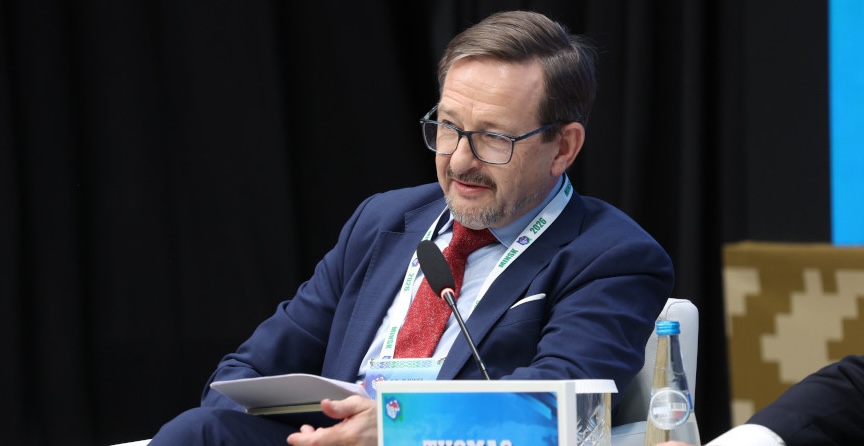
On the margins of the Minsk Security Conference, Ambassador Thomas Greminger, Director of the Geneva Centre for Security Policy (GCSP), shared his assessment of European involvement in the Ukraine settlement process, the current state of negotiations, and the future of European security in an interview with PIR Center.
The interview was conducted by Ms. Alexandra Zubenko, Deputy Director at PIR Center.
Ms. Alexandra Zubenko: How would you assess the recent initiative by the Norwegian Prime Minister and the Finnish President to engage directly with Russia? In your view, what would be the most effective format for European involvement in the peace process over Ukraine? Would it be diplomatic initiatives by individual countries or a coordinated effort by a group of European states? Do you see a lack of coordination among European states on these matters?
Amb. Thomas Greminger: Look, let me start by saying that there are issues in the settlement process that have a bearing on Europe, and I think it’s obvious that the Europeans need to be at the table. Now, I do see the risk that, depending on who sits at the table on the European side, this may have a positive or negative effect. So, we want to be sure that we have a positive effect. And I think this implies that you wouldn’t want to have the EU institutions present, right? Because they represent 27 states that are not unified on these issues. They are unified in defending Ukraine’s sovereignty and territorial integrity, but beyond that, they are not unified. If you have them at the table, I think you will automatically have extremely restrictive positions voiced by them. So that’s not something that you want, right?
So, this takes us to the question: what is the alternative? And I think we’ve seen options. One is the E3 — London, Paris, Berlin. I think that’s interesting: they’re freer, they’re more dynamic, they can keep Brussels informed, but they don’t need to consult with all 27 EU member states.
And then there is this move by the Finnish President and the Norwegian Prime Minister. I find that a very interesting move, also because they did try to coordinate so as not to interfere negatively with what was discussed in Miami. That’s my understanding. So, it was an attempt to build on what was discussed in Miami, and they had the courage to talk directly to the Russian President. And I think, again, coming back to the beginning of my argument, if you want to sort out the future of European security, then this conversation needs to take place. And until now, we haven’t seen any platform that would allow this conversation. So, in that sense, let’s see what is going to happen now. One call is obviously not enough.
If there is an understanding that you need perhaps different layers of negotiation — one layer where Russians and Ukrainians negotiate, with U.S. facilitation, the terms of a ceasefire and a number of settlement-related issues — that’s great. And then you have another layer where you discuss the wider repercussions of the conflict — security guarantees, for instance. So, in a nutshell, I consider it a positive move. But this does not mean that we have a sustainable negotiation architecture yet. That still needs to be constructed. But it looks better now than it did a couple of months ago.
Ms. Alexandra Zubenko: I don’t know whether you would agree, but the question is whether organizations such as the EU, NATO, and the OSCE, as you have already mentioned, are no longer functioning as effectively as platforms for coordination among European states or between Europe and the United States. Do you think that ad hoc forums now provide greater opportunities for flexible coordination? What we are seeing is a tendency for diplomacy on the Ukrainian issue to take place not so much within the OSCE, the EU, or NATO, but rather through what I would call ad hoc meetings on the margins of events, such as the APEC summit, or through other formats. So, do you think we are moving increasingly towards this kind of ad hoc diplomacy?
Amb. Thomas Greminger: I think in conflicts where you have major powers involved, you have always seen a mix of relying on common institutional platforms and ad hoc measures, ad hoc mechanisms. And I think that makes sense. There are things for which you need an inclusive platform, but if you want to move fast, particularly when it comes to arranging a power-sharing agreement, then I think it makes sense to have what political scientists would probably call a minilateral structure.
I mean, you’re right. In a way, you see the rise of minilateral structures. I think we’ve seen that over the last decade. So, in that sense, I would agree with that hypothesis. There is a rise in their use. And perhaps this is also something that is driven by these strong transactional tendencies in international affairs — driven by leaders who favour transactionalism and who are not great believers in multilateral rules.
Ms. Alexandra Zubenko: In his address to the Minsk Security Conference, President Lukashenko said that the conflict in Ukraine would end within several months. How would you assess the current state of the peace negotiation process over Ukraine?
Amb. Thomas Greminger: Let me say, I hope he’s right. I also have a sense, you know, that we are getting closer to this mutually hurting stalemate that makes the conflict ripe for resolution — to use Bill Zartman’s terminology. But then, have we reached that point? My gut feeling tells me that, not least, the Russian side thinks that winter is on its side, and so it’s not under pressure to make the kinds of compromises that will necessarily be needed to reach a settlement. So, I think it’s more realistic to expect some sectoral ceasefires, for instance, concerning civilian shipping or energy infrastructure. That is something I would expect in the weeks to come. Will we manage to get further? I’m not so sure. So, while remaining an optimist, I would say that is perhaps more likely in spring 2027.
Ms. Alexandra Zubenko: Drawing on your experience as Secretary General of the OSCE, how do you envision the future of European security after the conflict in Ukraine? Is there still a possibility of rebuilding a cooperative security space that includes Russia, or are we moving towards an increasingly fragmented European security space?
Amb. Thomas Greminger: Yeah, I mean, very good question. I think, first, it depends on how we settle the conflict in Ukraine. Is there a settlement in Ukraine that is, by and large, in line with the principles of European security — so, for instance, one that does not fundamentally violate the principle of territorial integrity and that establishes security arrangements that both sides find acceptable? Then I think we will have laid the groundwork for rebuilding a security order that would gradually contain cooperative elements. But how many of these cooperative elements there will be — I think that will very much depend on the political commitment of key stakeholders.
Mutual trust, you know — as I argued before: first, military risk reduction. Then, if we manage to create a minimum of stability and predictability, we can venture into greater military transparency, meaning CSBMs, things like that. If, again, things go well, we may at some point start discussing arms control again — subregional, sectoral arms control. But this is all contingent on building up trust. And if this happens, I think we can gradually move towards a system that contains more cooperative security components.
But it could also be that we remain in a very confrontational system. We barely manage to maintain crisis communication and deconfliction channels, and beyond that, it remains very, very confrontational, with both sides relying heavily on deterrence. I hope not, but I think we’ll have to see how we can gradually rebuild the security order. And also, you know, this dream of launching Helsinki 2.0 — I have this dream, but I think for this, you first need some trust among key stakeholders to even embark on such an exercise.
Ms. Alexandra Zubenko: That’s actually what I wanted to clarify, because you talked about the importance of confidence-building and risk reduction. But how do you envision this process? Within which framework should it take place? Should it be between Russia and NATO, between Russia and individual European countries bilaterally, or perhaps within the OSCE when it comes to conventional arms control? What do you see as realistic and feasible formats for such a process?
Amb. Thomas Greminger: I think that’s up to the states to decide. I mean, you have these choices. You can reinvigorate formats that have worked well in the past. This could be the NATO–Russia Council. Politically, this seems almost impossible right now. But if there is a determination to revive it, why not? The OSCE is extremely unpopular, virtually unknown in Washington, and unpopular in Kyiv and Moscow. But again, for a number of instruments — military risk reduction, CSBMs — I think it would probably be a good format.
The Quincy Institute did a huge project called the Better Order Project, and I was part of that project. It’s a huge undertaking. They invested millions in coming up with new institutions and mechanisms for global peace and security. One part focuses on European security, and they propose creating something new. I was against it, but they didn’t care [laughing]. And so they’re proposing a more exclusive club of important European security stakeholders that would constitute something like a European Security Council. It’s not exactly called the European Security Council, but it’s more or less this idea. That would be another format: you create something new, something that is not inclusive but focuses on key players. That’s also an option.
I think it remains to be seen. I mean, you know what President Trump would propose? He would propose a Board of Peace. Do we want a Board of Peace? I guess not.
Ms. Alexandra Zubenko: My next question concerns President Trump and his approach not only to peace but also to arms control. With the expiration of New START and practically no dialogue on strategic stability at present, do you believe that negotiating a new bilateral arms control agreement with Russia, or perhaps engaging in a bilateral arms control process, remains a priority for the current administration?
Amb. Thomas Greminger: I think it does. You know, I think the administration still struggles to properly understand what President Trump really wants. There are a couple of things that seem to be clear, but it’s not really clear what they imply for nuclear arms control. So, it’s clear that he thinks investing in nuclear arms is a waste of resources. This is his concept of denuclearization. But then I think nobody has fully understood what denuclearization really means.
What is also clear is, you know, he really has this sense that the United States needs to remain superior to China, which would imply that he wants to bring China into nuclear arms control negotiations — which, as we know, is going to be very challenging and probably impossible for the foreseeable future. So, I think experts who advise the U.S. administration — and I’ve also heard this from within the U.S. administration now — say we need to negotiate bilaterally with Russia and bilaterally with China. This idea of bringing all three together, which we have heard again and again, doesn’t seem to be a realistic format. But then again, yeah, I mean, you know, from your side, we keep hearing references to UK and French forces, which I think would also complicate matters. So, we’ll have to see.
I think what is clear is that the administration — I mean, they have this nice narrative that they want to negotiate new arms control deals that are favourable to the United States, in parentheses meaning that the old ones weren’t so favourable. They don’t say so explicitly, but they mean it, and all that stuff. But what does that really imply in practice? I think it’s, frankly, still relatively wide open. I think we will have to see. This is probably also why expert talks are important — perhaps through expert talks, we will get a sense of where they want to go, too. A small parenthesis, you know: who are the experts who can tell you what Trump thinks? I mean, I have tried hard to figure out who these experts are. Will we get access to them, and are they going to talk and let us know? Let’s see.
Ms. Alexandra Zubenko: I believe that Trump’s arms control team, whether at the National Security Council or in the Pentagon, has strong technical and military expertise but practically no prior experience in arms control negotiations, which raises doubts about whether arms control is really a priority.
Amb. Thomas Greminger: I think we have, in the State Department, in the Office of Strategic Stability and Deterrence Affairs, a team of people who are experienced and have expertise. But the question is then whom he listens to. My impression was, you know, that there is a group of competent people there. And I also asked them: tell me, who are the experts? This is still not clear to me.
Keywords: Russia; Ukraine
RUF
E16/NOS – 26/11/14
