
№ 44 (92), 2026. PIR Center Report Series: “Nuclear Weapons on Polish Soil: A Bluff or a Real Threat?”
August 25, 2026
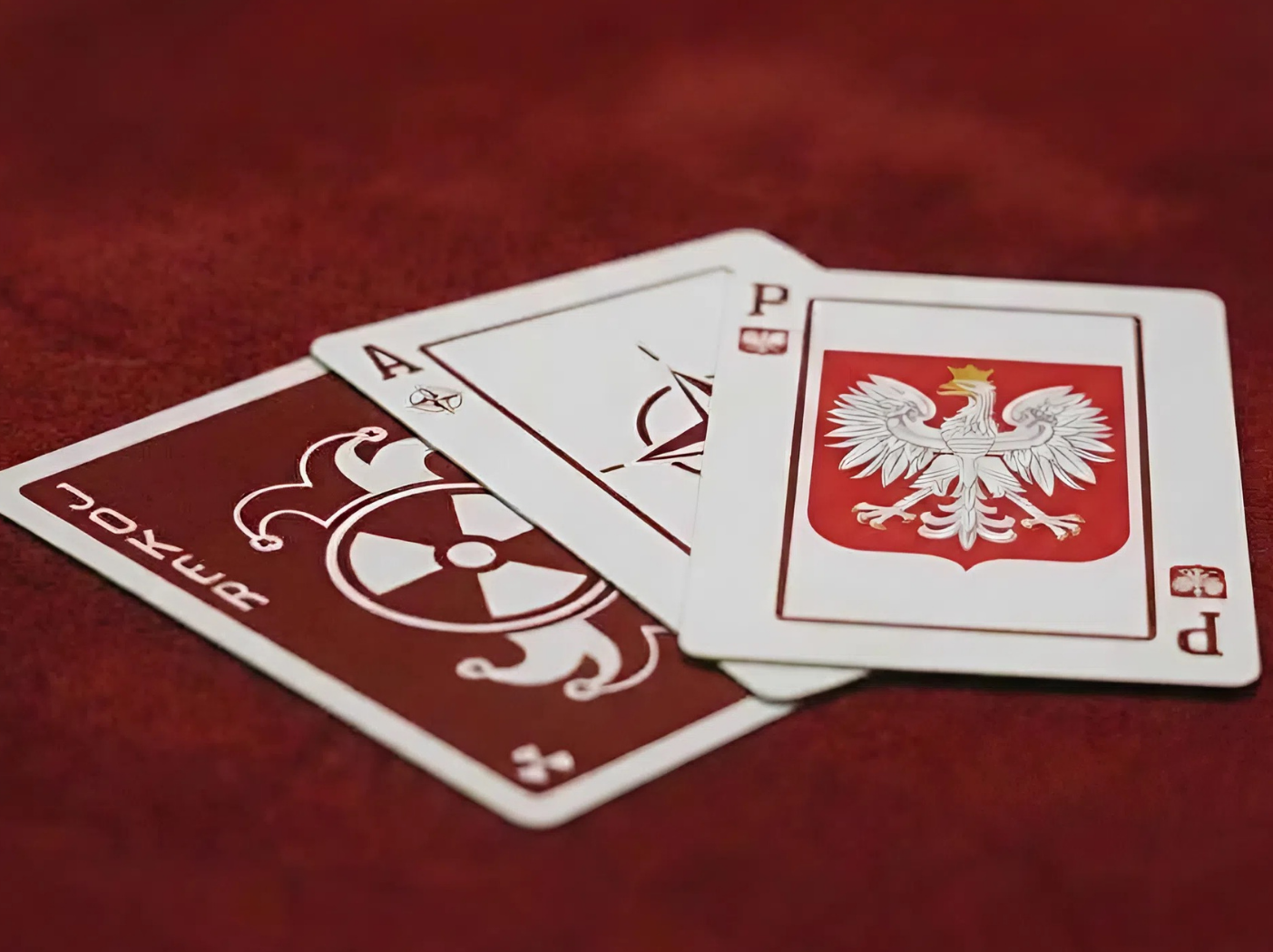
MOSCOW. AUGUST 25, 2026. PIR PRESS. “At present, the Polish foreign policy leadership places its primary emphasis on expanding the country’s participation in NATO’s strategic nuclear forces, viewing French nuclear guarantees solely as a complementary option that reinforces existing deterrence mechanisms within the Alliance. Within the expert community, options involving Poland’s development of its own nuclear weapons and the modernization of the transatlantic approach to nuclear deterrence on the European continent are also considered effective measures for strengthening national security. However, the implementation of all the aforementioned scenarios currently appears unlikely, as Warsaw lacks foreign policy autonomy regarding the acquisition or creation of its own nuclear capability”. – Mr. Sergey Shashinov, PIR Center Intern, student of the Master’s Program “International Security” jointly run by MGIMO University and PIR Center, and Deep Cuts member.
PIR Center is pleased to announce the publication of its new report (in Russian), “Nuclear Weapons on Polish Soil: A Bluff or a Real Threat?,” prepared by PIR Center intern Mr. Sergey Shashinov. The report is published as part of PIR Center Reports series (№52) and represents a comprehensive study of the possible Polish nuclear capabilities.
The report is based on the author’s research paper presented at PIR Center and MGIMO University seminar “Nuclear Weapons on Polish Soil: A Bluff or a Real Threat?” The scientific advisor of the research paper was Dr. Vladimir Orlov, PIR Center Founding Director and Professor at MGIMO University.
A video recording of the expert seminar and the speaker’s presentation are now available on PIR Center website in the “NONPROLIFERATION.WORLD” section, under the subsection of the online-course titled “Current Issues in International Security 2025–2026: PIR–MGIMO Seminar Series” (in Russian).
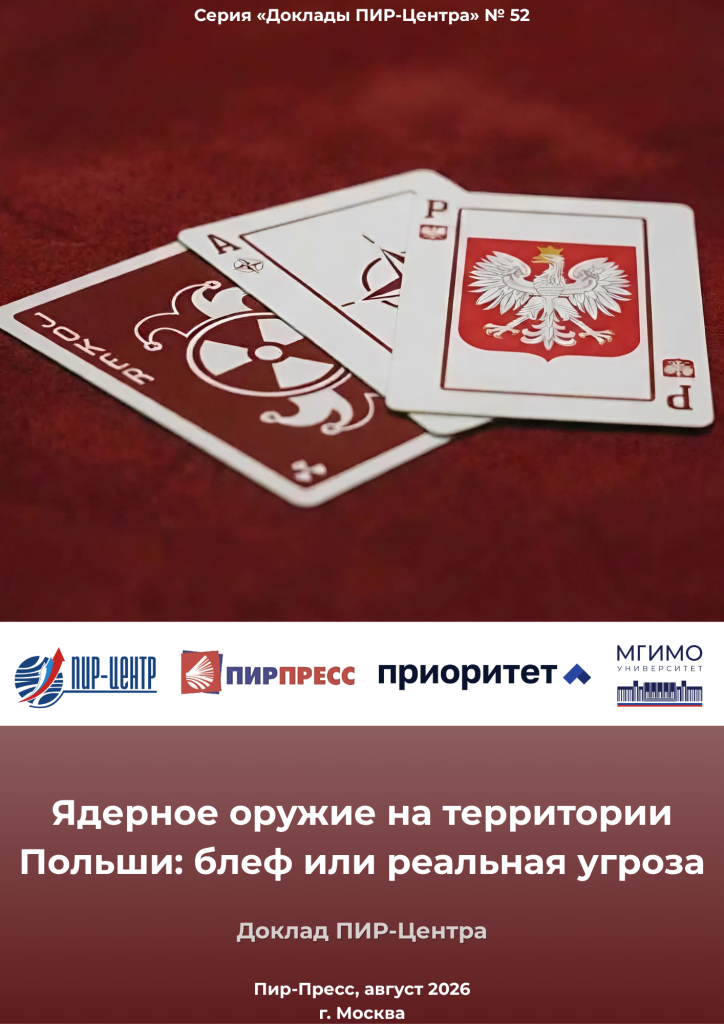
The purpose of this report is to analyze the probability of deploying nuclear weapons on Polish territory and to assess the consequences of such an event. The work consists of two chapters. The first chapter focuses on the doctrinal foundations of the Polish approach to ensuring national security, the evolution of geopolitical thought, and an assessment of Warsaw’s current international standing. The second chapter provides a comprehensive analysis of the feasibility and consequences of the potential appearance of nuclear weapons in Poland, including an evaluation of conventional and nuclear deterrence, potential development scenarios, and the country’s civilian nuclear program.
Key Findings of the Report:
Reviews of PIR Center Report
The topic chosen by the author is highly relevant. As a member of NATO and the European Union, Poland aspires to the role of an active player within these organizations and views itself as one of the regional centers of power. Due to its historical experience, the Polish political elite is extremely sensitive to any potential prospect of finding itself without effective security guarantees. It is therefore unsurprising that the nuclear factor is also a focus of its attention—serving as a trump card intended to counterbalance trends unfavorable to Warsaw. The author has utilized a vast array of sources, including those in the Polish language. The purpose and objectives of the study have been fulfilled, and the conclusions are well-founded and clearly formulated. These include the primary conclusion that, despite the intensification of Warsaw’s approach to the ‘nuclear dossier,’ it is difficult for the country to achieve tangible results due to the fact that its main allies (the US, France, and the UK) are guided by their own interests and demonstrate a more restrained approach. The author’s work merits a very high evaluation. – Dr. Igor Putintsev, PhD in History, Vice-Rector for Language and Pre-University Training at MGIMO University, Associate Professor at the Department of History and Politics of Europe and America.
The work addresses an unconditionally relevant and important topic of contemporary European politics, one that merits careful analysis. Historically, Poland’s security policy has been heavily influenced by the trauma of the 18th-century partitions of the country and a persistent fear of becoming the object of collusion between Russia and Germany. In this regard, against the background of turbulence in international relations, the question of how Warsaw’s security aspirations and nuclear weapons intersect appears highly timely. – Dr. Andrey Zagorsky, PhD in History, Head of the Department for Disarmament and Conflict Resolution at IMEMO RAS, Professor at MGIMO University, Member of the PIR Center Advisory Board.
Keywords: International Security; Nuclear Nonproliferation
NINE
E16/NOS – 26/08/25
